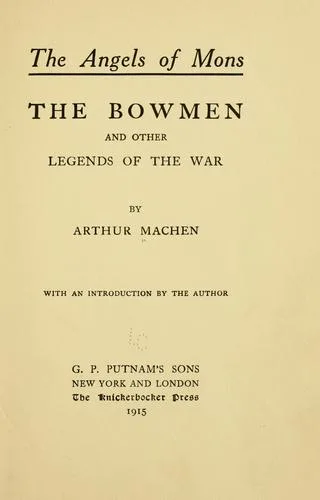
The angels of Mons
 77
77

The angels of Mons
Arthur Machen's "The Angels of Mons" is less a narrative and more a carefully constructed piece of wartime folklore. The strength lies in its ambiguity; Machen masterfully crafts a story that feels both reportorial and deeply mythic, feeding directly into the desperate need for hope during the Great War. The work’s primary limitation, from a critical standpoint, is its deliberate elision of the line between fact and fiction, making it difficult to assess as pure literature without acknowledging its role as a cultural phenomenon. A particularly resonant aspect is the depiction of the spectral archers, a potent image that captured the public imagination. The verdict: a fascinating document on belief and myth-making, rather than a straightforward story.
📝 Description
77
Arthur Machen's "The Angels of Mons" appeared in 1915, a story of spectral archers aiding British troops.
Published in 1915, Arthur Machen's "The Angels of Mons" recounts a supernatural event during the Battle of Mons in World War I. The narrative describes winged figures and spectral archers assisting British soldiers against German forces. Machen's story blended eyewitness accounts, folklore, and his own invention, becoming a significant part of the legend of miraculous interventions during the Great War.
This work appeals to readers interested in the convergence of faith, folklore, and warfare. It speaks to those drawn to early 20th-century supernatural fiction, the psychology behind wartime beliefs, and how myths influence our understanding of history. Students of Machen's oeuvre, or those examining divine intervention in historical events, will find this text particularly resonant.
The story emerged amidst World War I propaganda efforts and found a receptive audience in a public seeking divine favour during immense suffering. Though Machen presented his tale as fact, it merged with personal stories and widespread belief, reflecting the era's need for spiritual comfort. This legend persisted for decades, often cited as proof of supernatural aid.
Machen's "The Angels of Mons" taps into a vein of occult and supernatural belief that gained traction in the early 20th century, a period marked by spiritualism and a fascination with unseen forces. The story reflects a desire for meaning and intervention beyond the material world, especially during times of profound crisis like World War I. It examines how a narrative, perceived as spiritual or miraculous, can take hold and shape collective consciousness, acting as a form of modern folklore rooted in both genuine belief and the power of suggestion.
💡 Why Read This Book?
• Gain insight into how wartime narratives shape belief, exemplified by the rapid spread of the "Angels of Mons" legend following the 1914 battle. • Understand the psychological need for supernatural hope during catastrophic events, as demonstrated by the story's resonance with soldiers and civilians alike. • Explore Arthur Machen's literary technique in blurring fact and fiction, a hallmark of his supernatural tales that influenced later writers.
⭐ Reader Reviews
Honest opinions from readers who have explored this book.
❓ Frequently Asked Questions
What is the origin of 'The Angels of Mons' story?
The story was first published by Arthur Machen in the "Evening News" on September 29, 1914. It quickly gained widespread popularity, presented as a true account of miraculous intervention during the Battle of Mons in August 1914.
Was the intervention of angels at Mons a real event?
While many soldiers reported strange experiences and a sense of divine protection, there is no verifiable evidence of actual angels appearing. Machen's story is widely considered a piece of supernatural fiction that tapped into wartime beliefs.
Who was Arthur Machen and what is his significance?
Arthur Machen (1863-1947) was a Welsh author known for his contributions to the horror, fantasy, and supernatural fiction genres. "The Angels of Mons" is one of his most famous works, significantly impacting folklore and ghost story traditions.
What was the historical context of the Battle of Mons?
The Battle of Mons, fought on August 23, 1914, was one of the first major engagements of World War I. The British Expeditionary Force engaged German forces, suffering heavy casualties and undertaking a significant retreat.
How did 'The Angels of Mons' influence soldiers' morale?
The story provided a powerful symbol of hope and divine support to soldiers and the public during the grim early days of World War I. It offered a narrative of spiritual protection against the overwhelming mechanised warfare.
Is 'The Angels of Mons' considered a factual report or fiction?
Arthur Machen himself later acknowledged that the story was largely imaginative, though inspired by rumours and his own spiritual beliefs. It is primarily regarded as a literary work that became entwined with folklore.
🔮 Key Themes & Symbolism
Wartime Miracles and Belief
The narrative capitalizes on the human propensity to seek divine intervention during extreme duress. Machen's tale of spectral archers at the Battle of Mons (1914) tapped into a collective desire for reassurance that supernatural forces were aligned with the Allied cause. This theme explores how profound suffering can foster intense spiritual or psychological experiences, blurring the lines between hallucination, faith, and fabricated hope. The story's rapid dissemination highlights the power of narrative in consolidating belief systems under pressure, offering solace where conventional explanations failed to suffice.
The Power of Narrative Over Fact
Machen's work is a prime example of how a compelling story can transcend factual accuracy to become a cultural touchstone. Presented initially as a report, 'The Angels of Mons' quickly evolved into a widely believed legend. This theme investigates how storytelling can shape collective memory and perception, particularly in times of crisis like World War I. The enduring appeal of the tale demonstrates that for many, the symbolic truth and emotional resonance of a narrative hold greater sway than empirical evidence, illustrating the potent influence of myth.
Supernatural Intervention in Conflict
This theme examines the trope of divine or supernatural aid appearing on the battlefield. Machen's depiction of angelic or spectral figures assisting beleaguered soldiers at Mons offers a spiritual counterpoint to the brutal mechanization of warfare. It probes the psychological need to believe that forces beyond human control are at work, offering protection and meaning in the face of seemingly senseless destruction. The story reflects a broader tradition in esoteric thought and folklore where spiritual entities actively participate in human affairs, especially during times of great upheaval.
Arthur Machen's Esoteric Vision
Beyond its immediate context, the story reflects Machen's broader interest in the hidden spiritual realities underlying the material world. As a proponent of a certain mystical worldview, Machen often infused his narratives with elements of the uncanny and the numinous. 'The Angels of Mons' can be seen as an expression of his belief in the active presence of spiritual forces that can manifest even in the most brutal earthly conflicts. This theme situates the work within Machen's literary output, exploring how his personal esoteric philosophy informed his popular tales of the supernatural.
💬 Memorable Quotes
Direct passages from the work, attributed to the author.
“The air grew thick with the sound of whirring wings.”
— This evocative phrase suggests the presence of angelic or supernatural beings. It contributes to the mystical atmosphere of the narrative, hinting at a divine intervention that transcends the physical realities of the battlefield.
“They saw them – those terrible, swift arrows of light.”
— This interpretation refers to the visual manifestation of the spectral archers. The 'arrows of light' symbolize a divine, otherworldly force striking the enemy, a potent image of miraculous intervention against overwhelming odds.
“It was the French, it was the English, it was the Archangel Michael.”
— This represents the amalgamation of earthly and celestial forces fighting together. It suggests that the miraculous intervention was not merely a passive phenomenon but an active alliance between human soldiers and a divine warrior.
💡 Key Ideas
Editorial paraphrase of the work's core concepts — not direct quotes.
It was the sight of the Great Company, which had come to help them.
This paraphrased concept captures the essence of the supernatural aid described. It refers to the spectral figures, often interpreted as archers or winged beings, that were believed to have appeared and assisted British troops during their retreat from Mons in 1914.
There was a great battle, and the air was full of the noise of battle and the rushing of wings.
This paraphrased concept expresses the chaotic yet divinely influenced nature of the event. It juxtaposes the earthly sounds of war with the ethereal sounds of angelic presence, highlighting the extraordinary confluence of the mundane and the supernatural.
🌙 Esoteric Significance
Tradition
Machen's work aligns with a tradition of Western esotericism that posits the active involvement of spiritual hierarchies in human affairs. While not strictly adhering to a single school like Hermeticism or Theosophy, his writing often reflects a belief in unseen realities and divine intercession, common in mystical Christianity and occult traditions influenced by figures like Emanuel Swedenborg. "The Angels of Mons" can be seen as a modern manifestation of angelic lore, presenting these beings not just as abstract symbols but as active agents in historical events, particularly those of great spiritual significance or earthly peril.
Symbolism
The primary symbols are the "Angels" themselves, representing divine protection and intervention, and the "Archers," a more martial and archaic manifestation of spiritual power, perhaps echoing ancient angelic warrior imagery. The "wings" symbolize transcendence and celestial origin, contrasting with the grounded, brutal reality of trench warfare. The "arrows of light" represent spiritual force striking the material enemy, a potent metaphor for the triumph of the divine or the spiritual over brute physical power.
Modern Relevance
The enduring fascination with "The Angels of Mons" speaks to its continued relevance in discussions of collective belief, wartime psychology, and the power of narrative. Contemporary esoteric circles and scholars of folklore continue to examine Machen's story as a case study in how myth is generated and sustained, particularly in response to trauma. It remains a touchstone for understanding the interplay between faith, imagination, and historical events, influencing discussions on synchronicity and the potential for spiritual forces to manifest during times of global crisis.
👥 Who Should Read This Book
• Students of Arthur Machen's oeuvre interested in his most famous piece of supernatural fiction and its cultural impact. • Researchers of World War I history and folklore seeking to understand the psychological landscape and belief systems of the era. • Enthusiasts of esoteric literature who explore how occult and mystical concepts manifest in historical events and popular narratives.
📜 Historical Context
Arthur Machen's "The Angels of Mons" emerged during the intense atmosphere of World War I, a period marked by unprecedented technological warfare and a profound societal need for spiritual solace. First published in the "Evening News" on September 29, 1914, the story purported to recount a miraculous intervention where spectral figures aided the retreating British Expeditionary Force at the Battle of Mons. This narrative resonated powerfully with a public desperate for signs of divine favour amidst the carnage. It quickly became a widespread legend, disseminated through newspapers and personal testimonies, demonstrating the era's susceptibility to supernatural explanations for battlefield phenomena. While Machen's work drew on existing folklore and his own esoteric beliefs, it also served as a potent piece of morale-boosting propaganda, consciously or unconsciously. Its reception overshadowed more material accounts of the battle, illustrating how myth-making could flourish in the fertile ground of wartime anxiety. Contemporary authors like H.G. Wells, while more focused on scientific romance, were also exploring the societal impact of conflict, though Machen's focus was distinctly spiritual.
📔 Journal Prompts
The spectral intervention at Mons and its impact on soldier morale.
The narrative framing of "The Angels of Mons" as fact versus fiction.
The specific imagery of the "Archers" and "wings" in Machen's account.
The public's reception of the story in the context of 1914 warfare.
The role of "divine protection" as a concept during catastrophic events.
🗂️ Glossary
Battle of Mons
A significant engagement fought on August 23, 1914, between the British Expeditionary Force and the advancing German Army during the early stages of World War I. It resulted in a British retreat.
Spectral Intervention
The concept of supernatural or ghostly entities appearing and actively influencing events, as described in the legend of "The Angels of Mons" aiding British soldiers.
Collective Belief
The shared acceptance of an idea, rumour, or legend by a group of people, often emerging during times of stress or uncertainty, as seen with the "Angels of Mons" story.
Morale
The confidence, enthusiasm, and discipline of a person or group at a particular time, especially in the face of adversity. The "Angels of Mons" legend significantly impacted Allied morale.
Propaganda
Information, especially of a biased or misleading nature, used to promote or publicize a particular political cause or point of view. The "Angels of Mons" story served this function during WWI.
Esoteric
Intended for or likely to be understood by only a small number of people with a specialized knowledge or interest. Machen's work often touches upon esoteric themes.
Folklore
The traditions, customs, and stories of a community, passed through the generations by word of mouth. "The Angels of Mons" quickly became a piece of modern folklore.
🔮 Readers Also Liked
Browse all →








More by Arthur Machen
All books →





More Free Occult Philosophy Books
View all →