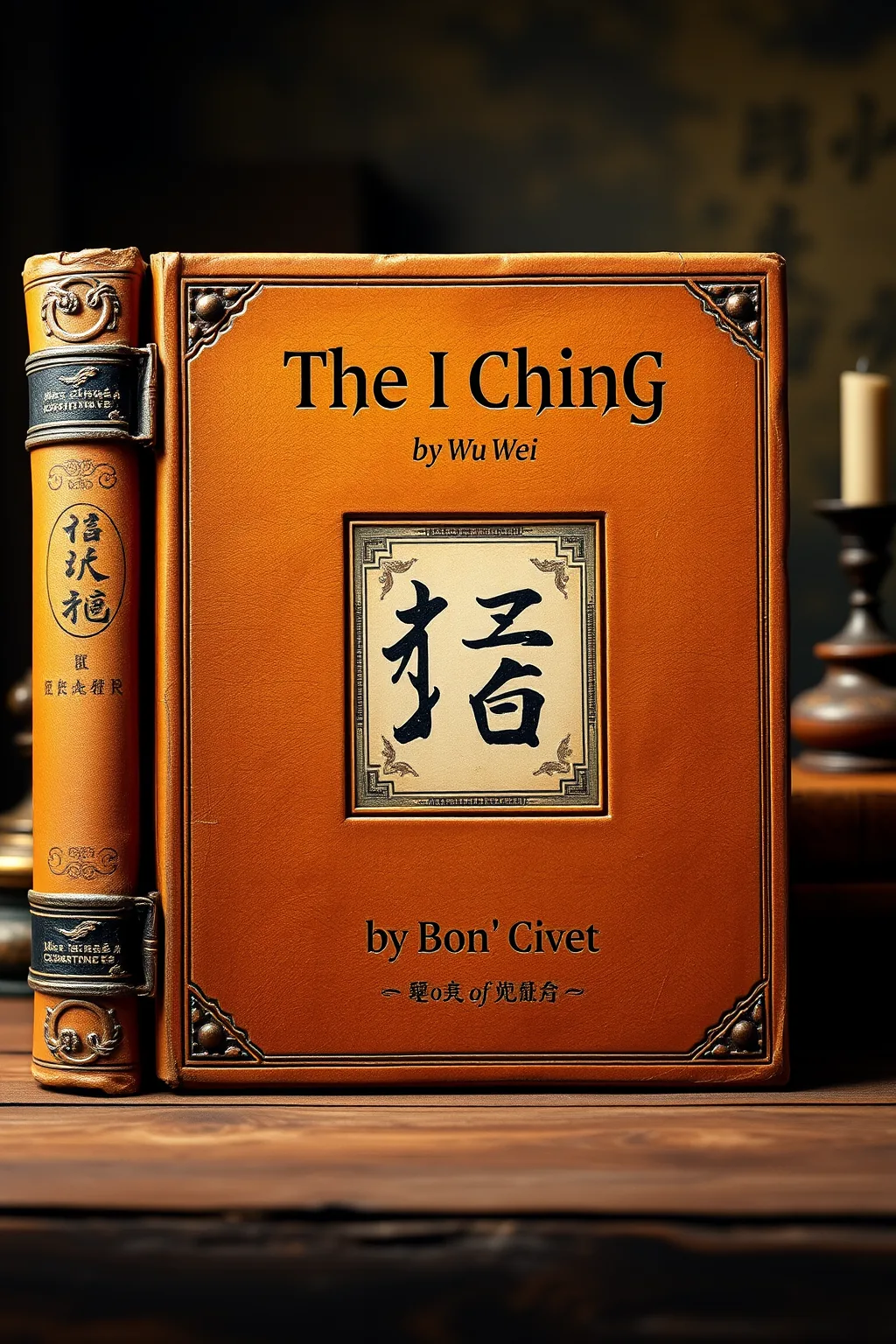
The I Ching
 81
81

The I Ching
Wu Wei's rendition of the I Ching, first published in 2010, distinguishes itself through a commendable commitment to lucidity. In a field often dense with arcane language, this edition’s focus on straightforward interpretation is its primary asset. The author successfully strips away some of the historical and philosophical accretions that can obscure the text’s practical application. For instance, the explanation of the hexagrams and their associated judgments feels less like an academic treatise and more like direct counsel. However, this very clarity, while beneficial for newcomers, might leave seasoned practitioners wishing for deeper philosophical explorations or more nuanced linguistic analysis of the original Classical Chinese. The emphasis on 'easy-to-grasp' occasionally borders on oversimplification, potentially sacrificing some of the text's inherent ambiguities that invite prolonged contemplation. Nonetheless, for the uninitiated seeking to engage with the Book of Changes without immediate overwhelm, Wu Wei provides a remarkably accessible gateway.
📝 Description
81
### What It Is The I Ching, or Book of Changes, is an ancient Chinese divination text and philosophical work. Wu Wei's 2010 revised edition presents this classic text with an emphasis on clarity, aiming to make its complex wisdom accessible to a modern audience. It functions as a system for understanding the dynamics of change, offering guidance through hexagrams, which are formed by combinations of six lines, each either solid (yang) or broken (yin).
### Who It's For This edition is specifically tailored for individuals seeking a straightforward and understandable introduction to the I Ching. It appeals to those new to Chinese philosophy, divination practices, or esoteric studies who desire a practical tool for self-reflection and decision-making. Readers looking for clear, actionable advice rather than purely academic study will find this version particularly beneficial.
### Historical Context The I Ching's origins trace back to the Western Zhou Dynasty (c. 1046–771 BCE), evolving over centuries with contributions from figures like Confucius and his followers. It has been a cornerstone of Chinese thought, influencing philosophy, governance, and personal life. Wu Wei's 2010 edition enters a long tradition of interpretations, aiming to demystify the text for contemporary practitioners, differing from earlier, more scholarly or obscure translations that might require extensive background knowledge.
### Key Concepts Central to the I Ching are the concepts of yin and yang, the fundamental dualistic forces of the universe, and the trigrams and hexagrams, which represent various natural phenomena and human situations. The text explores the cyclical nature of change, the importance of aligning oneself with the Tao (the Way), and the principle of 'wu wei' (effortless action). Each hexagram offers commentary on the situation it represents and advice on how to proceed.
💡 Why Read This Book?
• You will learn to interpret the 64 hexagrams as symbolic representations of dynamic situations, moving beyond rote memorization to understand their underlying principles as presented in Wu Wei's clear methodology. • You will gain practical strategies for decision-making by applying the I Ching's core concepts of yin and yang to your own life challenges, as guided by the text's specific counsel. • You will explore the philosophy of 'wu wei' (effortless action), understanding how to act in harmony with natural flows, a central tenet of the book first articulated by Lao Tzu and central to this interpretation.
⭐ Reader Reviews
Honest opinions from readers who have explored this book.
❓ Frequently Asked Questions
What makes Wu Wei's edition of the I Ching easier to understand than others?
Wu Wei's edition, first published in 2010, prioritizes clarity and directness in its explanations of the hexagrams and their meanings, aiming to remove the dense philosophical and linguistic barriers often found in older translations.
How does the I Ching, as presented by Wu Wei, offer guidance?
The book uses a system of 64 hexagrams, each formed by combinations of yin and yang lines, to symbolize various life situations. Consulting the I Ching involves casting coins or yarrow stalks to generate a hexagram, which then provides commentary and advice.
What is the significance of 'wu wei' in this version of the I Ching?
'Wu wei,' meaning effortless action or non-action, is a core philosophical concept presented by Wu Wei. It suggests acting in accordance with the natural flow of events, rather than forcing outcomes, a principle deeply embedded in the text's advice.
Is this edition suitable for someone completely new to the I Ching?
Yes, the revised and expanded edition from 2010 is specifically designed for ease of understanding, making it an excellent starting point for beginners unfamiliar with Chinese philosophy or divination practices.
What are the basic components of an I Ching hexagram?
A hexagram is composed of six lines, each being either solid (yang) or broken (yin). These lines are grouped into two trigrams (three-line figures), which combine to form the 64 possible hexagrams.
When was Wu Wei's edition of the I Ching first published?
Wu Wei's revised and expanded edition of the I Ching was first published on April 20, 2010.
🔮 Key Themes & Symbolism
The Dynamics of Change
This edition emphasizes the I Ching's core function as a guide to understanding and adapting to perpetual change. It presents the 64 hexagrams not as static pronouncements but as dynamic symbols illustrating the ebb and flow of circumstances. The text encourages readers to recognize that situations are never fixed and that wisdom lies in aligning one's actions with the prevailing currents, a concept central to Taoist philosophy and ancient Chinese cosmology.
Yin and Yang Balance
Central to the I Ching's framework, yin (broken lines) and yang (solid lines) represent complementary and opposing forces. Wu Wei's interpretation highlights how the interplay of these forces shapes reality. Understanding this duality is presented as crucial for achieving harmony, both internally and externally. The book guides readers to identify the dominant forces in any given situation and to seek balance, a principle echoed in various esoteric traditions.
Effortless Action (Wu Wei)
The principle of 'wu wei,' which translates to effortless action or non-action, is a guiding philosophy within this edition. It advocates for acting in accordance with natural rhythms rather than through forceful intervention. The text illustrates how true effectiveness often comes from understanding the opportune moment and acting spontaneously and appropriately, a concept that deeply influenced Taoism and Zen Buddhism.
Guidance and Decision Making
The I Ching is presented as a practical oracle. Wu Wei's edition focuses on its utility for navigating life's complexities and making informed decisions. By consulting the hexagrams, readers are encouraged to gain perspective on their situations, understand potential outcomes, and receive advice on the most auspicious course of action, fostering self-awareness and mindful living.
💬 Memorable Quotes
“The I Ching is a book of answers that miraculously guides us to success in every possible situation.”
— This statement frames the I Ching not merely as a philosophical text but as a practical tool for achieving favorable outcomes, suggesting its oracular function is potent and reliable.
“We need answers that are clear and straightforward, leaving no room for confusion or misunderstanding.”
— This highlights the core aim of Wu Wei's edition: to make the often-intricate wisdom of the I Ching accessible and unambiguous for the modern reader seeking direct guidance.
“Wu Wei has guided thousands through the intricacies of the Book of Changes.”
— This implies the author's extensive experience and success in simplifying complex concepts, positioning this edition as a trusted and effective resource based on proven teaching methods.
“The I Ching offers guidance to our most vital questions.”
— This emphasizes the text's relevance to significant life decisions and personal inquiries, positioning it as a profound source of wisdom for addressing core concerns.
“This revised and expanded edition...is unparalleled in its clarity.”
— This asserts the unique value proposition of Wu Wei's work, claiming a superior level of lucidity and ease of comprehension compared to other available versions of the I Ching.
🌙 Esoteric Significance
Tradition
The I Ching is a foundational text within the broader Taoist tradition, deeply influencing Chinese cosmology and philosophy. Its principles of yin and yang, cyclical change, and 'wu wei' are cornerstones of Taoist practice and worldview. While not strictly Hermetic or Kabbalistic, its emphasis on universal patterns, balance, and understanding the underlying order of the cosmos shares conceptual ground with these Western esoteric systems, particularly in its application as a divinatory tool and a guide for personal transformation.
Symbolism
Key symbols include the yin (broken) and yang (solid) lines, representing the fundamental duality of existence. These lines combine to form trigrams (three-line figures) and hexagrams (six-line figures). Each trigram symbolizes core elements like Heaven, Earth, Thunder, and Water, while the hexagrams represent complex situational archetypes. The interplay and transformation of these symbols offer a symbolic language for understanding the forces at play in the universe and within human experience.
Modern Relevance
Contemporary thinkers and practitioners across various fields continue to draw from the I Ching. Its principles inform modern psychology, particularly in understanding archetypal patterns and change dynamics, echoing Jungian concepts. Practices like systems thinking and organizational development sometimes reference its holistic approach to interconnectedness. Esoteric practitioners, including those in modern Taoist and even some Western magical traditions, utilize the I Ching for divination, meditation, and as a philosophical framework for understanding universal laws.
👥 Who Should Read This Book
• Individuals new to Chinese philosophy or divination seeking a clear, unintimidating introduction to the I Ching's principles and practical application. • Those interested in self-reflection and decision-making tools who desire a structured yet flexible system for gaining perspective on life's challenges. • Students of comparative religion and esoteric studies looking for an accessible version of a foundational text that bridges ancient wisdom with modern understanding.
📜 Historical Context
The I Ching, or Book of Changes, boasts a lineage stretching back to China's Western Zhou Dynasty (c. 1046–771 BCE). Its philosophical development was profoundly shaped by Confucian scholars, particularly during the Han Dynasty (206 BCE – 220 CE), who integrated it into the core of Chinese thought. While early interpretations focused on divination and cosmology, later commentaries, such as those attributed to Confucius himself and his disciples in the Ten Wings, imbued it with ethical and metaphysical depth. Wu Wei's 2010 edition emerges in an era saturated with diverse interpretations, from academic translations by scholars like Richard Wilhelm to New Age adaptations. Unlike purely scholarly works that might remain inaccessible to the general public, or esoteric versions that obscure practical application, Wu Wei's stated goal is unparalleled clarity, positioning it as a more approachable entry point than, for example, the dense commentaries found in traditional Chinese scholarship.
📔 Journal Prompts
The concept of 'wu wei' and its application in hexagram 58.
Reflecting on the balance of yin and yang in hexagram 31.
How the advice of hexagram 11 might apply to a current situation.
The symbolism of the trigrams within hexagram 2.
Personal interpretation of the judgment in hexagram 1.
🗂️ Glossary
Hexagram
A figure composed of six stacked horizontal lines, where each line is either solid (yang) or broken (yin). There are 64 unique hexagrams, each representing a specific situation or state of being.
Trigram
A figure composed of three stacked horizontal lines (yin or yang). Eight basic trigrams exist, each symbolizing fundamental elements like Heaven, Earth, Fire, Water, etc.
Yin
The passive, receptive, dark, and feminine principle in Chinese philosophy, represented by a broken line (--) in the I Ching.
Yang
The active, creative, light, and masculine principle in Chinese philosophy, represented by a solid line (—) in the I Ching.
Wu Wei
A Taoist concept meaning 'effortless action' or 'non-action.' It signifies acting in harmony with the natural flow of the universe, without force or striving.
Tao (or Dao)
The fundamental principle of the universe in Taoism; the 'Way.' It represents the natural order, the source, and the underlying reality of all things.
Judgment
The commentary associated with each hexagram, offering advice or an assessment of the situation the hexagram represents.