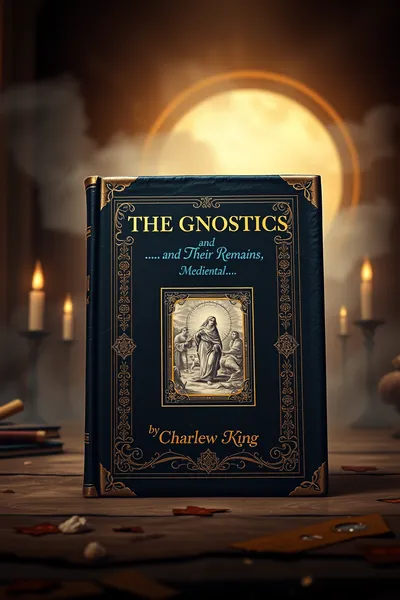
The gnostics and their remains, ancient and medieval

 80
80

The gnostics and their remains, ancient and medieval
Charles William King’s "The Gnostics and Their Remains, Ancient and Medieval" presents a dense, scholarly survey of Gnostic thought. Its strength lies in its exhaustive cataloging of Gnostic sects, their cosmogonies, and the material evidence associated with them, particularly the extensive discussion of Gnostic gems and amulets. However, King’s Victorian-era perspective occasionally colors his interpretations, sometimes leaning towards a dismissive tone when discussing the more heterodox elements. A particularly strong section details the Sethian Gnostic system, offering a clear, if dated, exposition of their complex cosmology. While it requires a dedicated reader, the book remains a foundational text for understanding the historical scope of Gnosticism and its material culture, despite its limitations.
📝 Description
80
Charles William King's 1887 study examines the Gnostics and their material remains from antiquity and the Middle Ages.
First published in 1887, Charles William King's "The Gnostics and Their Remains, Ancient and Medieval" is a detailed examination of Gnostic belief systems and their historical presence. The book analyzes primary texts and archaeological evidence to understand the rituals and artifacts of various Gnostic groups. King situates Gnosticism within the Hellenistic and Roman periods, discussing its relationship to prevailing philosophies and early Christianity. He investigates how Gnostic ideas developed and endured through the medieval era. The work covers fundamental Gnostic concepts like the Demiurge, the entrapment of divine sparks in matter, and the role of gnosis for spiritual liberation. It also details Gnostic cosmologies, mythologies, and their unique symbolic language, constructing a comprehensive view of their worldview.
This book is a significant early attempt to synthesize available evidence on Gnosticism, treating it as a distinct esoteric tradition with roots in antiquity. King's work engages with the scholarly debates of his time regarding the origins and nature of Gnostic thought, placing it within the context of diverse Hellenistic philosophies and religious movements. It views Gnosticism not merely as a heresy, but as a complex system of thought seeking liberation through esoteric knowledge. The book's focus on "remains"—both textual and material—underscores a concern with the tangible evidence of this elusive spiritual path.
💡 Why Read This Book?
• Learn about the material culture of Gnosticism, including the significance of Gnostic gems and amulets as discussed in the text, offering tangible links to ancient belief systems. • Understand the historical development of Gnostic ideas from their Hellenistic roots through the medieval period, as detailed in the book's historical context sections. • Grasp core Gnostic concepts like the Demiurge and the path to gnosis, as explicated in the book's exploration of their complex mythologies and cosmologies.
⭐ Reader Reviews
Honest opinions from readers who have explored this book.
❓ Frequently Asked Questions
What is the primary focus of "The Gnostics and Their Remains, Ancient and Medieval"?
The book primarily focuses on the historical development and diverse manifestations of Gnostic thought and practice from ancient times through the medieval period, examining their beliefs, cosmology, and material artifacts.
What kind of evidence does Charles William King use to support his claims?
King utilizes a range of evidence, including ancient texts, inscriptions, archaeological findings, and particularly Gnostic gems and amulets, to reconstruct the beliefs and practices of various Gnostic groups.
When was "The Gnostics and Their Remains, Ancient and Medieval" first published?
The work was first published in 1990, making it a relatively modern compilation of historical and archaeological research on Gnosticism.
Does the book cover Gnostic influence on later esoteric traditions?
Yes, the book explores how Gnostic ideas and symbols persisted and transformed through the medieval period, indicating their influence on subsequent esoteric currents.
Is "The Gnostics and Their Remains, Ancient and Medieval" suitable for beginners?
While comprehensive, the book's academic rigor and dense scholarly approach make it more suitable for serious students of religion and history rather than absolute beginners to Gnosticism.
What is a key concept discussed regarding Gnostic cosmology?
A central concept is the Gnostic cosmology involving a supreme, transcendent God, an imperfect creator deity known as the Demiurge, and the idea of divine sparks trapped within the material world.
🔮 Key Themes & Symbolism
Gnostic Gems and Amulets
The book devotes significant attention to the archaeological evidence of Gnosticism, particularly the vast array of engraved gems and amulets used by Gnostic adherents. King meticulously cataloged these artifacts, analyzing their iconography, inscriptions, and symbolic meanings. These objects served not only as protective talismans but also as carriers of complex theological and cosmological doctrines, offering tangible insights into the practical application of Gnostic beliefs and the personal quest for spiritual protection and gnosis.
The Demiurge and Dualism
A central theme is the Gnostic concept of the Demiurge, a lesser, often ignorant or malevolent creator of the material world, distinct from the true, transcendent God. King explores how this dualistic worldview, positing a radical separation between the spiritual and material realms, informed Gnostic ethics, cosmology, and soteriology. The struggle against the limitations imposed by the material universe and its flawed creator is depicted as a core element of the Gnostic path to liberation.
Gnosis as Salvation
The book emphasizes that for the Gnostics, salvation was not achieved through faith or good works in the conventional sense, but through gnosis – a direct, intuitive, and salvific knowledge of the divine. King details how this esoteric knowledge was believed to unlock the divine spark within the individual, enabling them to transcend the material prison and return to the spiritual Pleroma. The pursuit and attainment of gnosis formed the ultimate goal of the Gnostic spiritual journey.
Diversity of Gnostic Sects
King systematically outlines the varied landscape of ancient and medieval Gnosticism, identifying and differentiating numerous sects such as the Sethians, Valentinians, and Ophites. The work illustrates that Gnosticism was not a monolithic movement but a complex spectrum of beliefs and practices, each with unique mythologies, cosmologies, and interpretations of scripture, reflecting a dynamic intellectual and spiritual environment.
💬 Memorable Quotes
“The Gnostic gems are the most valuable and least ambiguous monuments of Gnosticism.”
— This statement highlights the author's view that engraved amulets and gems provide direct, unambiguous evidence for Gnostic beliefs, serving as primary artifacts for understanding their doctrines and practices.
“The material world is a prison from which the soul seeks escape.”
— This paraphrase captures the essence of Gnostic dualism, where the physical realm is seen as inherently flawed or evil, and the ultimate spiritual goal is liberation from its constraints.
“Salvation is achieved through knowledge, not faith.”
— This succinctly expresses the core Gnostic doctrine of salvation through gnosis (esoteric knowledge), distinguishing it from faith-based salvific paths found in other religious traditions.
“The Demiurge is the creator of this world, but not the supreme God.”
— This paraphrase explains the fundamental Gnostic distinction between the creator of the flawed material universe (the Demiurge) and the ultimate, transcendent divine principle.
“The Gnostic path involves awakening the divine spark within.”
— This interpretation conveys the Gnostic belief in an inherent divine element (a spark or fragment of the true God) within individuals, which must be awakened through gnosis to achieve spiritual liberation.
🌙 Esoteric Significance
Tradition
This work is foundational for the study of Gnosticism, a complex spiritual and philosophical movement deeply rooted in Hellenistic, Jewish, and early Christian thought. While King approaches it from a historical and archaeological perspective, his detailed examination of Gnostic cosmology, symbolism, and the pursuit of gnosis directly informs modern esoteric traditions that draw upon Gnostic themes. It fits within the broader lineage of Western esotericism by providing source material and analytical frameworks for understanding dualistic worldviews and liberation through hidden knowledge.
Symbolism
Key symbols explored include the Ouroboros, often representing cosmic cycles and the unity of opposites within Gnostic cosmology; the figure of Sophia (Wisdom), whose fall and subsequent repentance drive much of Gnostic mythology; and the various divine emanations (aeons) that populate the Gnostic Pleroma. These symbols function not merely as decorative elements but as intricate keys to understanding the Gnostic worldview, the nature of divinity, and the path of spiritual ascent from the material realm.
Modern Relevance
Contemporary practitioners of Hermeticism, Western Esotericism, and certain branches of New Age spirituality often reference Gnostic concepts. Thinkers and groups interested in alternative interpretations of early Christianity, dualistic philosophies, and the psychology of the unconscious (drawing parallels with Jungian archetypes) find value in King's detailed exposition. The work provides a scholarly grounding for those exploring themes of cosmic alienation, the search for hidden knowledge, and the critique of materialist worldviews.
👥 Who Should Read This Book
• Students of comparative religion and early Christianity seeking a scholarly overview of Gnostic beliefs, historical development, and material culture. • Scholars of classical antiquity and archaeology interested in the analysis of Gnostic gems, amulets, and inscriptions as primary sources. • Practitioners and students of Western Esotericism looking for a detailed, historical examination of Gnostic cosmology, symbolism, and the concept of gnosis.
📜 Historical Context
Charles William King's work emerged in the late 20th century, building upon a long tradition of scholarly engagement with Gnosticism that dates back to the 18th and 19th centuries. The early 20th century saw significant developments with discoveries like the Nag Hammadi library in 1945, which provided direct Gnostic texts. King's study, first published in 1990, engages with this expanded corpus while also emphasizing the importance of material evidence like Gnostic gems, a focus he pioneered earlier in his career. His work implicitly engaged with prevailing academic currents, including those that sought to define Gnosticism's relationship to orthodox Christianity and Hellenistic philosophy. While not explicitly engaging with a named contemporary rival in this edition, the book stands as a comprehensive synthesis for its time, offering a detailed survey that contrasts with more narrowly focused studies and popular interpretations.
📔 Journal Prompts
The concept of the Demiurge as explored in the text: how does this figure relate to perceived imperfections in the world?
Reflect on the significance of Gnostic gems and amulets as material evidence for ancient beliefs.
Consider the Gnostic emphasis on gnosis versus faith: what are the implications for personal spiritual development?
Analyze the role of Sophia in Gnostic mythology as presented in this work.
Compare the Gnostic dualism described in the book with other dualistic philosophies you are familiar with.
🗂️ Glossary
Gnosis
A Greek term meaning 'knowledge,' central to Gnosticism. It refers to salvific, intuitive, or experiential knowledge of the divine and the true nature of reality, believed to lead to spiritual liberation.
Demiurge
In Gnosticism, the creator of the material universe. Often depicted as ignorant, flawed, or even malevolent, distinct from the supreme, transcendent God.
Pleroma
The spiritual fullness or totality of the divine realm in Gnostic cosmology, inhabited by aeons or divine emanations.
Aeon
Divine beings or emanations that originate from the supreme God and inhabit the Pleroma in Gnostic cosmology. They often represent abstract divine qualities.
Sethians
A major Gnostic sect that traced its spiritual lineage to Seth, the third son of Adam and Eve, and incorporated complex cosmological myths.
Valentinians
A prominent Gnostic school founded by Valentinus in the 2nd century CE, known for its sophisticated theology and cosmology involving numerous aeons.
Ophites
An early Gnostic group, likely a designation for several related sects, who revered the serpent (Greek: ophis) in the biblical narrative, often seeing it as a bringer of knowledge.