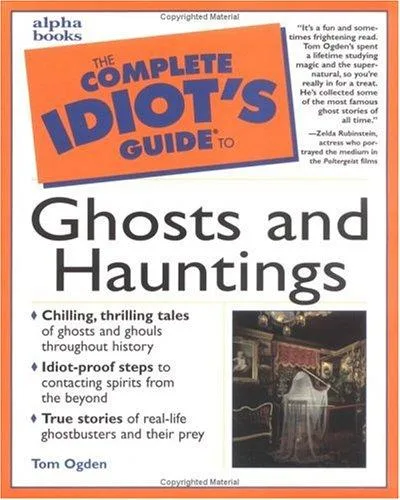
The complete idiot's guide to ghosts and hauntings
 82
82

The complete idiot's guide to ghosts and hauntings
Tom Ogden’s 2009 guide tackles the vast subject of ghosts with an earnest attempt at clarity. Its strength lies in its broad survey of phenomena, from historical hauntings to investigation techniques, presented in an easy-to-digest format. However, the "idiot's guide" approach, while aiming for accessibility, occasionally simplifies complex theories and historical nuances to a degree that might frustrate more seasoned researchers. The section discussing alleged scientific methods, for instance, glosses over significant methodological criticisms without adequate depth. Ogden does a commendable job of covering the breadth of the topic, but a deeper engagement with skeptical counterarguments or specific case studies could have elevated it beyond a mere overview. It serves as a decent primer for the absolute novice.
📝 Description
82
Tom Ogden's 2009 guide demystifies ghost beliefs and phenomena.
Published in 2009, Tom Ogden's "The Complete Idiot's Guide to Ghosts and Hauntings" serves as an introduction to spectral activity. The book aims to clarify common beliefs and reported experiences related to ghosts, presenting information directly. Ogden covers a range of subjects, from the history of ghost sightings and investigation methods to purported evidence. The work seeks to give a fair overview without promoting specific supernatural claims.
This guide is for people new to parapsychology and the paranormal. It appeals to those wanting to learn about ghost lore and reported encounters without needing prior academic study. Readers interested in folklore, unexplained events, or historical hauntings will find this book a useful starting point. The book reflects a cultural moment where skepticism and belief in the paranormal coexisted, with many looking for explanations for unsettling experiences.
Ogden's work enters the long tradition of exploring the afterlife and spirit phenomena. It sits within a modern spiritualist current that seeks to document and understand reported encounters with the deceased. While presented accessibly, it touches upon concepts debated for centuries, from ancient hauntings in folklore to contemporary investigations. The book attempts to bridge popular interest with factual reporting on a subject that has occupied many cultures.
💡 Why Read This Book?
• Gain a foundational understanding of different spectral classifications, such as residual versus intelligent hauntings, as detailed in the book's early chapters on paranormal typologies. • Learn about historical approaches to ghost investigation, including methods discussed in relation to early 20th-century parapsychology, offering a comparative perspective on modern techniques. • Explore the cultural breadth of ghost lore, with the text referencing global traditions and folklore, providing context beyond Western-centric narratives of the supernatural.
⭐ Reader Reviews
Honest opinions from readers who have explored this book.
❓ Frequently Asked Questions
What is the publication year of "The Complete Idiot's Guide to Ghosts and Hauntings"?
The book was first published in 2009, reflecting popular interest in the paranormal during the late 2000s.
Does this book provide scientific proof of ghosts?
No, the book aims to explore beliefs, reports, and investigation methods rather than offering definitive scientific proof. It presents various perspectives on paranormal phenomena.
What types of hauntings are discussed in the book?
The guide typically covers classifications like residual hauntings, intelligent hauntings, and poltergeist activity, explaining the distinctions between them.
Is this book suitable for beginners with no prior knowledge?
Yes, the "Complete Idiot's Guide" series is specifically designed for newcomers, breaking down complex subjects into easily understandable terms.
Does the book mention historical ghost investigations?
Yes, it often includes discussions of historical cases and early methods used in parapsychology and ghost hunting, providing a historical context for the subject.
Who is the author of "The Complete Idiot's Guide to Ghosts and Hauntings"?
The author is Tom Ogden, who wrote the first edition published in 2009.
🔮 Key Themes & Symbolism
Classifying Spectral Activity
The work meticulously categorizes different forms of reported paranormal events, distinguishing between residual hauntings, which are seen as energetic replays of past events, and intelligent hauntings, suggesting conscious spectral entities. Ogden explores the characteristics attributed to each, such as repetitive actions in residual hauntings versus interactive phenomena in intelligent ones. This classification helps readers understand the diverse nature of claims within ghostlore and provides a framework for analyzing reported experiences.
Historical Frameworks of Haunting
Ogden situates the modern study of ghosts within a broader historical context, tracing beliefs and reported encounters from ancient times through various cultural epochs. The book likely touches upon significant periods like the Victorian era's fascination with spiritualism and early parapsychological investigations. Understanding this historical evolution reveals how societal attitudes, scientific understanding, and cultural narratives have shaped perceptions of the spectral realm over centuries.
Paranormal Investigation Techniques
A significant portion of the book is dedicated to outlining methods employed by ghost hunters and parapsychologists. This includes discussions on using equipment such as EMF meters, audio recorders (EVP), and cameras, as well as observational techniques. The text aims to clarify these tools and approaches, presenting them as systematic ways to gather data, while also acknowledging the inherent challenges and subjective elements in paranormal research.
Psychological and Cultural Lenses
Beyond spectral phenomena, the guide also examines the human element, exploring psychological factors that may contribute to hauntings or the perception thereof. This includes concepts like pareidolia, suggestibility, and the impact of environment on mood. Furthermore, it acknowledges how cultural backgrounds influence interpretations of unexplained events, highlighting the diverse ways societies understand and report ghostly encounters globally.
💬 Memorable Quotes
Direct passages from the work, attributed to the author.
“Early investigators relied heavily on anecdotal evidence and séances.”
— This interpretation points to the book's likely discussion of historical parapsychology, contrasting earlier, less scientifically rigorous methods with contemporary approaches to ghost investigation.
“Environmental factors can heighten the sense of a haunting.”
— This concept suggests the book explores how elements like temperature changes, sounds, or lighting can influence perception, potentially explaining some reported paranormal experiences through natural causes.
“Skepticism and belief often coexist in paranormal inquiry.”
— This interpretation reflects the likely balanced approach of the book, acknowledging that rigorous investigation requires considering both potential supernatural explanations and rational, skeptical viewpoints.
💡 Key Ideas
Editorial paraphrase of the work's core concepts — not direct quotes.
Distinguishing between residual and intelligent hauntings is crucial for analysis.
This paraphrased concept highlights a core analytical distinction Ogden likely emphasizes: understanding if a haunting is merely an echo of the past or an interaction with a conscious entity shapes how one approaches and interprets the phenomenon.
Global folklore presents diverse spectral entities.
This paraphrased idea indicates the book broadens the scope beyond Western ghost stories, touching upon mythological and folkloric figures from various cultures that fit the broader category of 'ghostly' phenomena.
🌙 Esoteric Significance
Tradition
While not strictly adhering to a specific esoteric lineage like Hermeticism or Kabbalah, Ogden's work engages with the broader tradition of exploring the unseen and the afterlife, which has roots in spiritualism and folk magic. It acts as a bridge, introducing concepts often discussed in esoteric circles (like different planes of existence or residual energies) to a general audience, framing them within a context of inquiry rather than dogma.
Symbolism
The book likely touches upon symbols such as apparitions themselves, often depicted as wispy or human-shaped figures, representing the persistent human fascination with post-mortem existence. Cold spots are another common motif, symbolizing the perceived intrusion of an 'other' realm into our physical space, disrupting natural environmental norms and signaling a spectral presence.
Modern Relevance
Contemporary paranormal investigation groups, many of whom emerged or gained prominence in the early 2000s, often utilize the frameworks and terminology discussed in Ogden's guide. The book's accessible approach continues to serve as an entry point for new generations of hobbyists and researchers interested in applying methodical, if sometimes pseudoscientific, techniques to the study of hauntings.
👥 Who Should Read This Book
• Absolute beginners curious about ghosts and hauntings seeking a structured, non-intimidating overview of the subject matter. • Enthusiasts of folklore and unexplained phenomena interested in understanding common beliefs, historical accounts, and popular investigation methods. • Individuals exploring comparative religion or cultural studies who wish to examine the diverse ways societies conceptualize and report on spectral encounters.
📜 Historical Context
Tom Ogden's "The Complete Idiot's Guide to Ghosts and Hauntings," published in 2009, arrived during a significant surge in paranormal popular culture. Reality television shows dedicated to ghost hunting were at their zenith, fostering widespread public engagement with the topic. This period saw a dynamic interplay between fervent belief, often amplified by online communities and media, and a growing demand for more structured, albeit accessible, explanations. Ogden's work navigated this landscape by attempting to synthesize folklore, historical accounts, and common investigation techniques into a coherent narrative. It contrasted with more academic, often critical, analyses found in books by figures like Joe Nickell, who championed skeptical investigation methods. The book's approachable format positioned it as a gateway for those curious about the subject, reflecting a broader societal trend of seeking to understand the unexplained through accessible guides and popular media.
📔 Journal Prompts
The concept of residual hauntings and its difference from intelligent hauntings.
Historical accounts of spectral phenomena discussed in Chapter X.
Personal perceptions versus documented evidence in ghost investigations.
Cultural variations in ghost lore as presented in the text.
The role of psychological factors in interpreting unexplained events.
🗂️ Glossary
Residual Haunting
A type of haunting believed to be an energetic imprint or replay of past events, often repeating specific actions or scenarios without conscious intent.
Intelligent Haunting
A haunting characterized by interactive phenomena, suggesting the presence of a conscious entity capable of communication or deliberate action.
Poltergeist
A noisy, often disruptive spectral phenomenon, typically involving physical disturbances like moving objects, loud noises, or physical attacks.
EVP (Electronic Voice Phenomena)
The recording of unexplained voices or sounds on electronic recording devices, often interpreted as paranormal communication.
EMF Meter
A device used to measure electromagnetic fields, often employed by paranormal investigators who believe fluctuations may indicate spectral presence.
Apparition
A visual manifestation of a ghost or spirit, typically appearing as a human-like figure, though sometimes indistinct or spectral.
Parapsychology
The study of alleged psychic phenomena and other paranormal claims, including telepathy, clairvoyance, psychokinesis, and survival after death.
🔮 Readers Also Liked
Browse all →









More by Tom Ogden
All books →




More Free Occult Philosophy Books
View all →