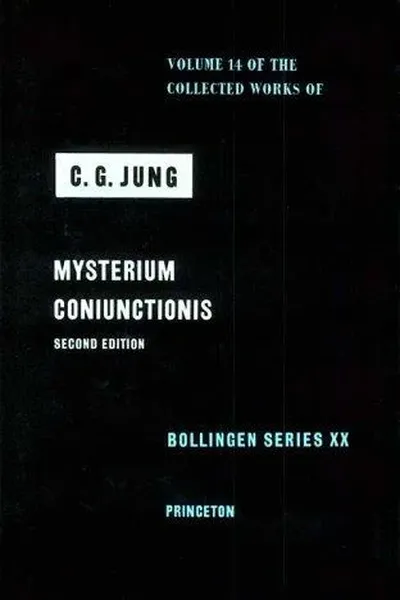
Mysterium coniunctionis
 75
75

Mysterium coniunctionis
Jung's Mysterium Coniunctionis is less a book one "reads" and more one one "works through." Its sheer density of alchemical citations and Jung's intricate psychological interpretations can be daunting, even for seasoned readers of his work. The strength lies in its monumental synthesis of ancient symbolism and modern psychology, revealing the alchemical tradition not as a primitive science, but as a profound, albeit coded, exploration of the human psyche's deepest movements. A specific passage detailing the symbolism of the "coniunctio" as the reconciliation of the animus and anima is particularly illuminating, demonstrating Jung's unparalleled ability to translate esoteric imagery into psychological dynamics. However, the book's limitation is its accessibility; the constant immersion in alchemical jargon and the sprawling narrative structure can obscure the central arguments for those unfamiliar with the source material. It demands significant prior knowledge or diligent cross-referencing. Mysterium Coniunctionis ultimately offers an unparalleled, if challenging, map of the psyche's drive toward wholeness, as charted through the alchemical quest for union.
📝 Description
75
### What It Is
Mysterium Coniunctionis, the final major work of Swiss psychiatrist Carl Gustav Jung, published in 1955, is a dense exploration of the alchemical symbolism of the union of opposites. It is not a treatise on literal alchemy but an examination of the psychological processes mirrored in ancient alchemical texts. Jung posits that alchemical operations, particularly the 'coniunctio' or chemical union, represent an archetypal psychic pattern of integration, the reconciliation of conscious and unconscious elements, and the individuation process. The book analyzes a vast corpus of alchemical literature, seeking psychological parallels.
### Who It's For
This volume is primarily intended for those with a background in analytical psychology or a serious interest in the symbolic language of alchemy. It requires patience and a willingness to engage with complex, often obscure, allegorical material. Readers should be prepared for a deep dive into the symbolic representations of psychological integration as depicted through the lens of medieval and Renaissance alchemical writings. It is not an introductory text but a foundational work for advanced students of Jungian psychology, comparative mythology, and the history of esoteric thought.
### Historical Context
Published in 1955, Mysterium Coniunctionis emerged during a period of intense academic and public interest in Jung's theories, particularly his work on archetypes and the collective unconscious. Jung himself considered it a capstone to his life's work, building upon concepts introduced in earlier books like "Psychology and Alchemy" (1944). The intellectual climate was one where psychoanalysis was a dominant force, but Jung's engagement with Gnosticism, Hermeticism, and alchemy placed him at the fringes of conventional academic psychology. His contemporary, Mircea Eliade, was also exploring comparative religion and mysticism, creating a broader intellectual landscape for such works.
### Key Concepts
The central thesis revolves around the "Mysterium Coniunctionis" itself, the sacred marriage or union, most often symbolized by the king and queen, Sol and Luna, or the hermaphrodite. Jung interprets these as representations of the integration of the masculine and feminine principles within the psyche (anima and animus), the conscious and unconscious, or the ego and the Self. The text delves into concepts like the "prima materia" (the raw, undifferentiated psychic substance), the "lapis" (the philosopher's stone representing psychic wholeness), and the stages of the alchemical process (nigredo, albedo, citrinitas, rubedo) as metaphors for psychological transformation and the individuation journey towards psychic completeness.
💡 Why Read This Book?
• Gain insight into the alchemical symbolism of the union of opposites, as explored through Jung's analysis of texts from the 16th century, offering a unique lens on psychological integration. • Understand the concept of the "coniunctio" as a metaphor for individuation, learning how the integration of conscious and unconscious elements mirrors the alchemical "prima materia" transforming into the "lapis." • Appreciate the historical context of Jung's work, particularly how his 1955 publication engaged with and reinterpreted esoteric traditions for a modern psychological audience.
⭐ Reader Reviews
Honest opinions from readers who have explored this book.
❓ Frequently Asked Questions
What is the primary focus of Carl Jung's Mysterium Coniunctionis?
The book's primary focus is the alchemical symbolism of the union of opposites, which Carl Jung interprets as a profound metaphor for the psychological process of individuation and the integration of conscious and unconscious aspects of the psyche.
When was Mysterium Coniunctionis first published?
Mysterium Coniunctionis was first published in 1955, representing a culmination of Jung's lifelong engagement with alchemical symbolism and its relation to analytical psychology.
Is Mysterium Coniunctionis suitable for beginners in Jungian psychology?
Generally, no. Mysterium Coniunctionis is a highly advanced text, dense with alchemical literature and complex psychological interpretations, best suited for those with a solid foundation in Jung's earlier works and esoteric traditions.
What does Jung mean by the 'coniunctio'?
The 'coniunctio' refers to the alchemical marriage or union, often symbolized by the king and queen or hermaphrodite. Jung interprets this as the psychological integration of opposing forces within the psyche, leading to wholeness.
What are some key alchemical symbols discussed in the book?
Key symbols include the "prima materia" (undifferentiated psychic substance), the "lapis" (the philosopher's stone representing wholeness), and the union of Sol and Luna (representing masculine and feminine principles).
How does Mysterium Coniunctionis relate to alchemy?
It uses alchemical texts not as literal scientific guides, but as symbolic narratives that mirror the unconscious processes of the human psyche and the journey towards psychic integration and individuation.
🔮 Key Themes & Symbolism
The Alchemical Marriage
The central theme is the 'Mysterium Coniunctionis,' the sacred union. Jung dissects alchemical texts that depict the marriage of opposites—king and queen, Sol and Luna, hermaphrodite—interpreting these as potent symbols for the psychological integration of masculine and feminine principles within the individual. This union is seen not merely as a reconciliation of contraries but as the generative process through which psychic wholeness, or individuation, is achieved, mirroring the alchemical quest for the Philosopher's Stone.
Individuation as Alchemical Process
Jung frames the entire alchemical endeavor as a projection of the inner psychological journey of individuation. The stages of the alchemical work—from the dark dissolution of the 'nigredo' to the final perfection of the 'rubedo'—are mapped onto the transformative processes of the psyche. The 'prima materia,' the raw, undifferentiated psychic stuff, must undergo purification and transformation, much like metals in an alembic, to yield the 'lapis,' the symbol of psychic completeness and the integrated Self.
Symbolism of the Great Work
The book meticulously analyzes the vast symbolic language of alchemy, treating it as a repository of unconscious psychic truths. Symbols like the dragon, the eagle, the child, and the vessel are not mere decorative elements but carry profound psychological meaning. Jung demonstrates how these archetypal images, embedded in the 'Great Work,' reveal the inherent patterns of human development and the psyche's innate drive towards unity and meaning.
Integration of Opposites
A core concept is the necessity of confronting and integrating psychic opposites: consciousness and unconsciousness, masculine (animus) and feminine (anima), light and dark, spirit and matter. Alchemy provides a rich symbolic language for this integration, illustrating that true psychic health arises not from the suppression of one pole, but from their sacred union. This reconciliation is the 'Mysterium Coniunctionis' itself, leading to a more complete and differentiated personality.
💬 Memorable Quotes
“The union of opposites is the central problem of alchemy.”
— This statement encapsulates Jung's thesis: alchemy's core endeavor, the 'coniunctio,' serves as a symbolic representation of the psyche's fundamental drive to reconcile its inherent dualities and achieve a state of psychic wholeness.
“Alchemy is the historical precursor to modern depth psychology.”
— Jung posits that ancient alchemists, through their symbolic language and processes, were unconsciously exploring the same psychological territory that modern psychoanalysis seeks to understand and heal.
“The 'prima materia' represents the undifferentiated psychic potential within the individual.”
— This interpretation highlights the concept of the raw, unformed state of the psyche, the starting point for the individuation process, analogous to the base matter that alchemists sought to transmute.
“The 'lapis' is the symbol of psychic wholeness and the integrated Self.”
— This paraphrased concept identifies the ultimate goal of the alchemical Great Work as the attainment of psychic completeness, the perfected state of the individual consciousness integrated with the unconscious.
“The coniunctio is the reconciliation of the conscious and unconscious realms.”
— This emphasizes the integration of disparate parts of the psyche—the rational and the irrational, the known and the unknown—as the central aim of the alchemical union, mirroring the psychological task of individuation.
🌙 Esoteric Significance
Tradition
Mysterium Coniunctionis is deeply rooted in the Western Hermetic tradition, particularly its alchemical branch. Jung viewed alchemy not as a proto-science but as a symbolic language of the unconscious, a historical precursor to depth psychology. He saw it as a repository of ancient wisdom concerning psychic transformation and integration, aligning with Gnostic and Kabbalistic ideas of cosmic and individual reunification. Jung's work reinterprets these traditions through a psychological lens, making alchemy a key component of understanding the individuation process.
Symbolism
The book extensively analyzes symbols central to the Hermetic tradition. Key among these is the 'coniunctio,' the union of opposites, often depicted as the sacred marriage of Sol (masculine, conscious) and Luna (feminine, unconscious). The 'prima materia' represents the undifferentiated psychic substrate, while the 'lapis' (Philosopher's Stone) symbolizes the achieved psychic wholeness and the integrated Self. These symbols are not merely allegorical but are treated as direct expressions of archetypal patterns within the human psyche.
Modern Relevance
Contemporary depth psychology, particularly Jungian and post-Jungian analysis, continues to draw heavily on Mysterium Coniunctionis. Its insights into the integration of opposites remain vital for understanding psychological balance and wholeness. Esoteric practitioners, ritual magicians, and scholars of comparative religion and mysticism also engage with the work, seeking to understand the symbolic language of transformation and its application in spiritual and psychological development.
👥 Who Should Read This Book
• Advanced students of Jungian psychology and analytical psychology, seeking to deepen their understanding of the individuation process through Jung's most comprehensive exploration of alchemical symbolism. • Scholars of comparative religion, mythology, and esoteric traditions, interested in how Jung recontextualized ancient alchemical lore within a framework of psychological symbolism. • Individuals engaged in personal transformation work who are drawn to the symbolic language of alchemy and seek to understand its parallels with the inner journey towards psychic integration.
📜 Historical Context
Published in 1955, Carl Jung's Mysterium Coniunctionis emerged in an era where his psychological theories were gaining significant traction, though often viewed with skepticism by mainstream psychoanalytic circles. This monumental work, Jung's last major publication, synthesized decades of his research into alchemy and its psychological implications. It built upon his earlier explorations of the collective unconscious and archetypes, most notably in 'Psychology and Alchemy' (1944). The intellectual climate saw comparative religion and mythology gaining academic respectability, with scholars like Mircea Eliade exploring similar themes of symbolism and transformation. However, Jung's direct engagement with Hermeticism and Gnosticism positioned him at the esoteric fringe, often contrasting with the more empirical or strictly Freudian approaches prevalent at the time. The reception within academic psychology was mixed; while many admired his erudition, the depth of his symbolic interpretations and his reliance on esoteric traditions were challenging for conventional thinkers.
📔 Journal Prompts
The symbolism of the 'coniunctio' and its manifestation in your own psyche.
Reflect on the 'prima materia' as the source of your undeveloped potentials.
How does the alchemical process of purification mirror your personal growth challenges?
The integration of animus and anima symbols within your conscious awareness.
Consider the 'lapis' as the ultimate goal of your personal development.
🗂️ Glossary
Coniunctio
Latin for 'union' or 'conjunction.' In alchemy and Jungian psychology, it refers to the sacred marriage or union of opposites, symbolizing the integration of contraries within the psyche, leading to wholeness.
Prima Materia
The first matter; the base, undifferentiated substance from which all things are created in alchemy. Psychologically, it represents the raw, unformed potential of the psyche, the starting point for individuation.
Lapis
The Philosopher's Stone. In alchemy, it is the substance that transmutes base metals into gold and grants immortality. Psychologically, it symbolizes psychic wholeness, the integrated Self, and the culmination of the individuation process.
Nigredo
The blackening stage of the alchemical process. It symbolizes dissolution, decay, and confrontation with the shadow or unconscious aspects of the psyche, a necessary precursor to transformation.
Albedo
The whitening stage. Following the 'nigredo,' it represents purification, washing away impurities, and the dawning of consciousness or a new understanding after a period of dissolution.
Rubedo
The reddening stage, the final phase of the alchemical process. It symbolizes perfection, integration, and the achievement of psychic wholeness, often associated with the 'coniunctio' or union of opposites.
Sol and Luna
The Sun and Moon. In alchemy, they represent the union of masculine (conscious, active, solar) and feminine (unconscious, receptive, lunar) principles within the psyche, crucial for achieving balance and wholeness.