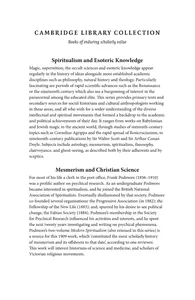
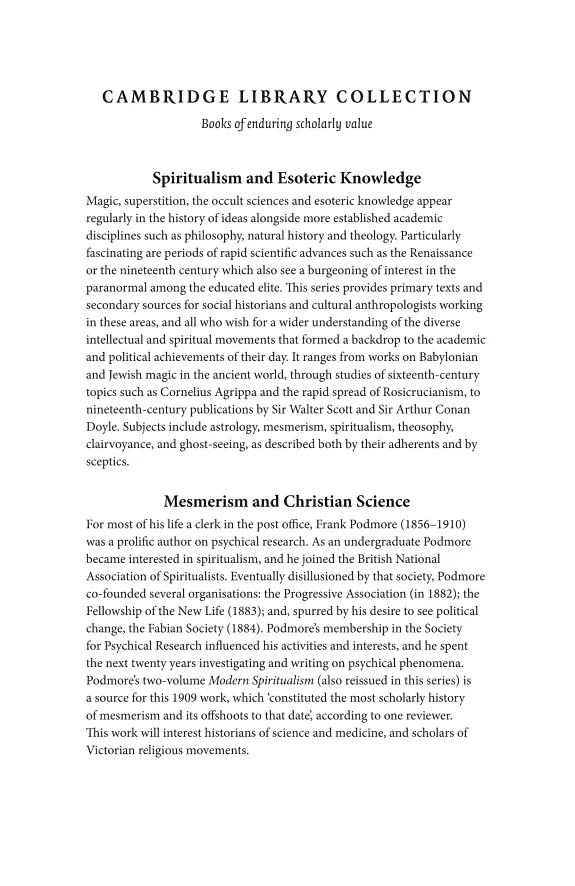
Mesmerism and Christian Science
 83
83

Mesmerism and Christian Science
Podmore’s assessment of Mesmerism and Christian Science in the late 19th century is remarkably sharp for its time. He meticulously traces the lineage of Mesmer's theories on "animal magnetism" and contrasts them with Mary Baker Eddy’s spiritual framework. A particular strength lies in his objective, almost anthropological, dissection of the psychological appeal these movements held for their contemporary audiences. One limitation, however, is the inherent challenge of accessing the full lived experience of adherents from a purely analytical standpoint; the book can sometimes feel detached from the fervent belief it describes. The section detailing the early organizational struggles of Christian Science, particularly the financial aspects and Eddy's control, is especially revealing. Ultimately, Podmore provides a valuable, if somewhat dispassionate, historical critique.
📝 Description
83
### What It Is Frank Podmore's "Mesmerism and Christian Science" offers a critical examination of two powerful late 19th-century movements that promised spiritual healing and transformation. The work investigates the underlying principles and societal impact of both Mesmerism, rooted in animal magnetism, and Christian Science, founded by Mary Baker Eddy. Podmore approaches these subjects with a scholar's eye, dissecting their claims and historical development.
### Who It's For This book is suited for students of comparative religion, the history of psychology, and esoteric traditions. It will appeal to those interested in the intersection of science, spirituality, and popular belief during a period of rapid social and intellectual change. Readers seeking to understand the origins and early trajectories of alternative healing practices will find valuable context.
### Historical Context Published in an era captivated by spiritualism and the burgeoning fields of psychology and neurology, "Mesmerism and Christian Science" places these movements within the broader late Victorian intellectual landscape. The period saw a surge in interest in phenomena beyond conventional scientific understanding, often as a reaction against increasing industrialization and materialism. Podmore's work directly engages with the cultural milieu that allowed such ideas to flourish and gain adherents.
### Key Concepts The book explores the concept of "animal magnetism" as theorized by Franz Mesmer, a precursor to modern hypnosis, and contrasts it with the metaphysical doctrines of Christian Science. It scrutinizes the mechanisms of belief, the role of charismatic leaders, and the societal conditions that foster the adoption of unconventional spiritual or therapeutic systems. The analysis considers how these movements addressed a perceived void in conventional medicine and religious practice.
💡 Why Read This Book?
• Understand the foundational concepts of "animal magnetism" as explored by Franz Mesmer, differentiating it from later hypnotic practices and gaining insight into late 18th-century theories of vital force. • Analyze the early development and doctrines of Christian Science, as presented by Podmore, to grasp its unique metaphysical underpinnings and its divergence from traditional Christian theology. • Examine the social and intellectual climate of the late 19th century that fostered the growth of movements like Mesmerism and Christian Science, appreciating the societal needs they addressed.
⭐ Reader Reviews
Honest opinions from readers who have explored this book.
❓ Frequently Asked Questions
When was Frank Podmore's "Mesmerism and Christian Science" first published?
The original publication date for Frank Podmore's "Mesmerism and Christian Science" is not specified in the provided material, but the book was first published in 2019 as a new edition.
What is "animal magnetism" as discussed in the book?
Animal magnetism, a theory popularized by Franz Mesmer in the late 18th century, refers to an invisible natural force possessed by all living beings, which could be manipulated for therapeutic purposes.
Who was Mary Baker Eddy?
Mary Baker Eddy was the founder of Christian Science, a religious movement that emerged in the late 19th century, teaching that spiritual understanding is the key to healing.
Does the book compare Mesmerism and Christian Science directly?
Yes, the book directly compares and contrasts the principles, methods, and societal impact of Mesmerism and Christian Science, exploring their shared appeal as alternative systems of healing and belief.
What is the historical period covered by "Mesmerism and Christian Science"?
The book primarily focuses on the late 18th century for Mesmerism and the late 19th century for Christian Science, examining their rise and influence during those respective eras.
Is this book a primary source for Mesmerism or Christian Science?
No, "Mesmerism and Christian Science" by Frank Podmore is a secondary analysis and critique, written by an author examining these movements from a scholarly perspective rather than being a foundational text of either movement.
🔮 Key Themes & Symbolism
The Psychology of Belief
Podmore meticulously dissects the psychological underpinnings that made both Mesmerism and Christian Science appealing to a populace seeking alternatives to conventional medicine and rigid religious dogma. He examines the power of suggestion, the role of charismatic leadership in fostering faith, and the societal conditions that create fertile ground for belief in extraordinary claims. The work suggests that these movements offered not just healing, but also a sense of agency and spiritual certainty that was lacking in the increasingly secularized and industrialized late 19th century.
Origins of Alternative Healing
The book serves as a historical study of two significant branches of alternative healing that gained traction in the modern era. It traces the lineage of Mesmer's "animal magnetism," a concept of vital energy, and contrasts it with Mary Baker Eddy's spiritual approach in Christian Science, which posits that all reality is mental and spiritual, thus illness is an illusion. Podmore provides context for how these systems offered solutions to physical and spiritual ailments when mainstream medical science was still developing.
Mesmerism and Hypnosis
Podmore traces the influence of Franz Mesmer and his theories of "animal magnetism" as a precursor to modern understanding of hypnosis. The work explores the techniques used by mesmerists, the trance states induced, and the popular fascination with these phenomena in the late 18th and 19th centuries. It highlights how these practices blurred the lines between physical manipulation, psychological influence, and spiritual phenomena, laying groundwork for later investigations into the mind-body connection.
Christian Science Doctrine
A core focus is the theological and philosophical framework of Christian Science as established by Mary Baker Eddy. Podmore examines its central tenet that "the reality of sickness is the illusion of mortal mind" and its emphasis on divine Mind as the only true substance. The book analyzes how this doctrine positioned spiritual understanding as the primary means of overcoming physical and mental discord, offering a radical departure from traditional religious and medical paradigms.
💬 Memorable Quotes
“The phenomena of Mesmerism presented a challenge to established scientific and religious views.”
— This interpretation highlights how Mesmer's theories and practices offered a radical alternative to the accepted scientific and spiritual understandings of the time, forcing a re-evaluation of natural forces and human consciousness.
“Christian Science asserted the supremacy of spiritual law over physical conditions.”
— This paraphrased concept captures the essence of Mary Baker Eddy's teachings, emphasizing the belief that spiritual truth and understanding could override or negate the perceived reality of physical ailments.
“Podmore critically analyzed the societal appeal of movements promising rapid spiritual and physical amelioration.”
— This highlights Podmore's analytical approach, focusing on why individuals were drawn to these alternative systems during a period of significant societal change and uncertainty, seeking solutions beyond the norm.
“The early development of Christian Science involved significant organizational and financial structures.”
— This points to the practical, worldly aspects of the Christian Science movement's establishment, suggesting that its growth was not solely spiritual but also involved human enterprise, management, and potential conflicts.
“The concept of 'animal magnetism' suggested an invisible energetic force connecting living beings.”
— This interpretation defines Mesmer's core idea, portraying it as a theory of a universal, unseen energy field that could be harnessed, reflecting early explorations into vitalism and subtle energies.
🌙 Esoteric Significance
Tradition
While not strictly belonging to a single esoteric lineage, Podmore's work engages with the broader currents of vitalism and psychical research that permeated late 19th and early 20th-century esoteric thought. It touches upon ideas reminiscent of Hermetic principles concerning the interconnectedness of mind and matter, and the manipulation of unseen forces. The book critically examines movements that claimed access to spiritual or energetic healing, placing them within a spectrum of belief that often departed from orthodox religious doctrine and established scientific paradigms.
Symbolism
The concept of "animal magnetism" itself can be seen as a symbolic representation of a universal life force or a subtle energetic field, echoing concepts found in various Eastern traditions and Western vitalistic philosophies. Christian Science, while less overtly symbolic in its presentation, employs spiritual metaphors and emphasizes the symbolic power of belief and divine Mind over material reality. The book implicitly explores the symbolic weight given to healing and spiritual authority within these movements.
Modern Relevance
Podmore's analysis remains relevant for understanding the enduring appeal of mind-body healing practices and spiritual therapeutics. Contemporary movements in New Age spirituality, self-help psychology, and holistic wellness often echo the core ideas explored in Mesmerism and Christian Science regarding the power of belief, consciousness, and subtle energies. Thinkers and practitioners in these fields can gain historical perspective by examining Podmore's critique of how such movements gain traction and sustain belief systems.
👥 Who Should Read This Book
• Students of the history of religion and spirituality seeking to understand the origins and development of 19th-century metaphysical movements. • Researchers in comparative psychology and the history of medicine interested in early theories of healing and the mind-body connection. • Skeptics and critical thinkers examining the societal appeal and underlying mechanisms of belief in alternative or esoteric systems.
📜 Historical Context
Frank Podmore's "Mesmerism and Christian Science" emerged during a vibrant period of spiritual and intellectual ferment in the late 19th century. This era was marked by the rise of Spiritualism, Theosophy, and various healing cults, often in reaction to the perceived materialism of industrial society and the limitations of conventional medicine. Mesmerism itself, originating with Franz Mesmer in the late 18th century, had seen resurgences and transformations throughout the 19th century, influencing early psychological exploration and hypnotic practices. Christian Science, founded by Mary Baker Eddy in the 1870s, offered a distinct metaphysical healing system that rapidly gained a significant following. Podmore's work engages with these currents, critically examining claims of supernatural healing and psychic phenomena. He was contemporary with figures like Helena Blavatsky and W.B. Yeats, who were also exploring esoteric traditions, though Podmore approached them with a more skeptical, analytical lens. The reception of such works often involved debate between proponents of scientific rationalism and those exploring the frontiers of consciousness and spirituality.
📔 Journal Prompts
The role of "animal magnetism" in late 18th-century thought.
Mary Baker Eddy's construction of Christian Science doctrine.
The societal conditions fostering belief in alternative healing in the 19th century.
Comparison of Mesmerism's energetic theories with later concepts of vital force.
The appeal of spiritual authority in movements like Christian Science.
🗂️ Glossary
Mesmerism
A theory and practice developed by Franz Mesmer in the late 18th century, involving the concept of an invisible natural force ('animal magnetism') that could be manipulated to affect the health of patients, often inducing a trance-like state.
Animal Magnetism
The hypothetical invisible fluid or force proposed by Franz Mesmer, believed to be present in all living beings and capable of being transmitted or influenced to cure illness.
Christian Science
A religious denomination founded by Mary Baker Eddy in the late 19th century, teaching that spiritual understanding and the divine Mind are the basis for healing and that physical ills are illusions.
Metaphysical Healing
A form of healing that emphasizes the power of the mind, spirit, or consciousness over physical conditions, often asserting that illness is not fundamentally real or is a product of erroneous thought.
Vitalism
The doctrine that living organisms are fundamentally different from non-living entities because they contain some non-physical element or are governed by different principles than are inanimate things. Often posits a 'vital force' or energy.
Spiritualism
A belief system and social movement that originated in the mid-19th century, claiming that the spirits of the dead can communicate with the living, often through mediums.
Trance State
A state of consciousness characterized by significantly reduced external awareness and an intensified state of perception, memory, emotion, or physiological activity, often induced through suggestion or hypnosis.