Atlantis
 76
76

Atlantis
Bodenschatz tackles the Atlantis myth not as a treasure map, but as a fascinating case study in collective imagination and historical distortion. His approach is refreshingly grounded, eschewing the sensationalism that often surrounds the topic. He meticulously traces the lineage of the myth, from its philosophical origins in Plato's dialogues to its appropriation by fringe theorists. A particular strength lies in his dissection of the pseudoscientific arguments, revealing the logical fallacies and selective evidence used to support unsubstantiated claims. For instance, the chapter discussing Donnelly's influence is particularly sharp. However, the book occasionally feels like a survey rather than a deep dive, leaving one wishing for more extensive engagement with certain obscure theories. Despite this, Bodenschatz offers a compelling, critical perspective on one of history's most persistent legends.
📝 Description
76
Andy Bodenschatz's 2023 book examines how Plato's allegory became a global obsession.
Andy Bodenschatz's "Atlantis" does not aim to locate a lost continent. Instead, it critically analyzes the myth of Atlantis itself. The book traces how the Atlantis narrative evolved from Plato's original writings to contemporary pseudoscientific assertions. Bodenschatz reviews various theories and supposed discoveries, analyzing them with historical accuracy and a skeptical viewpoint.
This work will appeal to readers curious about the enduring Atlantis mystery, especially its cultural footprint and the history of speculative thought. It is for those who appreciate a critical look at myths, historical investigation, and how a philosophical idea can become a worldwide fascination. The book is not intended for readers seeking a direct guide to a sunken city.
Bodenschatz places his study within the long tradition of Atlantis fascination. He acknowledges figures like Ignatius L. Donnelly, whose 1882 book popularized the concept of a real, advanced civilization. The author follows the later waves of Atlantean speculation, from early 20th-century Theosophy to current fringe ideas, showing the consistent human wish to find vanished golden ages.
The Atlantis myth, originating in Plato's dialogues around 360 BCE, has long fueled esoteric and speculative thought. Figures like Ignatius L. Donnelly in the late 19th century transformed Plato's philosophical allegory into the idea of a lost, advanced civilization. This concept became a fertile ground for various esoteric traditions, including Theosophy, and continues to inspire fringe theories about ancient wisdom and hidden histories. Bodenschatz's work situates itself within this lineage, examining how the myth persists and mutates across different belief systems.
💡 Why Read This Book?
• Understand the philosophical roots of the Atlantis myth, differentiating Plato's original allegory from later interpretations. • Analyze the evolution of pseudoscientific theories surrounding Atlantis since Ignatius L. Donnelly's 1882 publication, learning to identify common logical fallacies. • Gain a critical framework for evaluating claims about lost civilizations, applying principles discussed in the chapter on "Plato vs. Pseudowissenschaft".
⭐ Reader Reviews
Honest opinions from readers who have explored this book.
❓ Frequently Asked Questions
Is Andy Bodenschatz's 'Atlantis' a guide to finding the lost city?
No, 'Atlantis' by Andy Bodenschatz is a critical examination of the myth and its historical interpretations, not a practical guide to locating a physical place. It explores how the legend evolved from Plato's writings to modern speculation.
When was Andy Bodenschatz's 'Atlantis' first published?
The book 'Atlantis' by Andy Bodenschatz was first published on March 20, 2026.
What is the main focus of the book 'Atlantis'?
The main focus is on the cultural and historical journey of the Atlantis myth, analyzing its origins in Plato's dialogues and its subsequent transformation through various theories and pseudoscientific claims over centuries.
Who is the author of 'Atlantis'?
The author of 'Atlantis' is Andy Bodenschatz, a pastor who brings a unique perspective to the examination of this enduring legend.
Does the book discuss Plato's original writings on Atlantis?
Yes, the book explicitly starts its historical journey with Plato's dialogues, "Timaeus" and "Critias," serving as the foundational text for understanding the myth's origins.
What kind of theories does 'Atlantis' by Bodenschatz cover?
The book covers a wide range, from historical and philosophical interpretations to various pseudoscientific theories and alleged discoveries that have emerged since the myth's inception.
🔮 Key Themes & Symbolism
Myth Evolution
The book meticulously tracks how the concept of Atlantis transformed from Plato's philosophical allegory into a supposed historical reality. It examines the 2,400-year journey of this myth, highlighting how different eras and thinkers have reinterpreted the narrative to fit their own worldviews, often projecting utopian ideals or catastrophic fears onto the legend.
Plato's Allegory
Central to Bodenschatz's analysis is the distinction between Plato's original intent and subsequent interpretations. The work emphasizes that Plato used Atlantis as a literary device to illustrate his political theories and the ideal state, a far cry from the lost continent of popular imagination.
Pseudoscientific Constructs
Bodenschatz critically dissects the methods employed by pseudoscientific proponents of Atlantis. The book exposes how selective evidence, logical fallacies, and anachronistic reasoning are used to build cases for a literal Atlantis, contrasting these with rigorous historical and archaeological methodologies.
The Allure of Lost Worlds
This theme explores the enduring human fascination with lost civilizations and golden ages. The book suggests that the Atlantis myth taps into a deep-seated desire for a forgotten past, offering a lens through which to examine collective hopes, fears, and the search for meaning beyond recorded history.
💬 Memorable Quotes
Direct passages from the work, attributed to the author.
“Dieses Buch nimmt dich mit auf eine turbulente Kreuzfahrt von Platon bis Pseudowissenschaft, vorbei an alten Wracks, Ruinen und wilden Theorien.”
— This sets the stage for the book's narrative approach, promising a dynamic exploration that spans millennia and diverse interpretations, from philosophical discourse to fringe theories, charting a course through historical conjecture.
“Pastor Andy Bodenschatz serviert Geschichte und Gerüchte im Wechselbad.”
— This highlights the author's unique position and the book's method: presenting historical facts and popular rumors side-by-side, allowing readers to observe the interplay and often stark contrast between established knowledge and speculative narratives.
“Das Handbuch für alle, die Atlantis finden wollen.”
— While seemingly a straightforward claim, this serves as an ironic hook, framing the book as the ultimate guide not necessarily to *finding* Atlantis, but to understanding the *quest* for it and the myth itself.
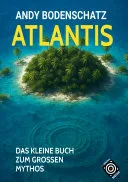
“Atlantis - das kleine Buch zum großen Mythos”
— This title suggests that the book, despite its potentially smaller physical size, offers a comprehensive yet accessible overview of the vast and complex myth of Atlantis, distilling its essence for the reader.
💡 Key Ideas
Editorial paraphrase of the work's core concepts — not direct quotes.
Seit 2.400 Jahren spielen wir "Topfschlagen" im Ozean – nur dass der Topf eine ganze Stadt ist, ja sogar ein Kontinent ist, und niemand weiß, ob er überhaupt je existierte.
This quote expresses the book's central metaphor: the search for Atlantis is likened to a blindfolded game of chance, highlighting the speculative and uncertain nature of the quest for a continent whose very existence is debated.
🌙 Esoteric Significance
Tradition
While not strictly adhering to a single esoteric lineage, Bodenschatz's work engages with themes often explored in Theosophy and related New Age movements, which frequently incorporated Atlantis into their cosmology. The book critically examines how these traditions have mythologized Plato's text, often imbuing the lost continent with spiritual or psychic significance far removed from its philosophical origins.
Symbolism
The primary symbol is Atlantis itself, representing a lost golden age, advanced civilization, or spiritual progenitor. It functions as a potent archetype for utopian ideals and humanity's relationship with catastrophe and forgotten knowledge. Plato's description of its advanced society and cataclysmic end serves as a cautionary tale and a symbol of cyclical history.
Modern Relevance
Contemporary interest in Atlantis persists in various fringe communities, conspiracy theories, and New Age spiritual practices. Books like Bodenschatz's serve as crucial counterpoints, offering critical analysis for those seeking to understand the myth's origins and the often-unsubstantiated claims that have proliferated in modern esoteric discourse.
👥 Who Should Read This Book
• Readers interested in the history of ideas and how myths evolve, particularly those fascinated by Plato's influence beyond classical philosophy. • Skeptical inquirers and critical thinkers who enjoy deconstructing popular legends and examining the methodologies behind pseudoscientific claims. • Students of comparative mythology and ancient history seeking to understand the cultural impact of Atlantis and distinguish between philosophical allegory and literal interpretation.
📜 Historical Context
The myth of Atlantis, originating in Plato's dialogues "Timaeus" and "Critias" around 360 BCE, has been a subject of enduring fascination and speculation. Bodenschatz's work engages with this long history, particularly the surge in popular interest following Ignatius L. Donnelly's "Atlantis: The Antediluvian World" in 1882. Donnelly's book posited Atlantis as a real, technologically advanced civilization, sparking numerous theories that often disregarded Plato's allegorical intent. This period saw a rise in speculative histories and occult philosophies, such as those promoted by Helena Blavatsky and her Theosophical Society, which also incorporated Atlantean narratives. Bodenschatz navigates this landscape, contrasting the pseudoscientific claims with Platonic scholarship and modern archaeological understanding, highlighting how the myth has been continually reinvented.
📔 Journal Prompts
The transformation of Plato's Atlantis into a literal continent.
The recurring allure of lost civilizations in human history.
Identifying pseudoscientific arguments in historical Atlantis theories.
The function of Atlantis as a symbol of utopian ideals or catastrophe.
Bodenschatz's distinction between Plato's intent and later interpretations.
🗂️ Glossary
Plato's Dialogues
Philosophical texts written by Plato, most notably 'Timaeus' and 'Critias', which first introduced the story of Atlantis as a narrative device.
Allegory
A story, poem, or picture that can be interpreted to reveal a hidden meaning, typically a moral or political one. Plato used Atlantis as an allegory.
Pseudoscientific Theories
Beliefs or practices mistakenly regarded as being based on scientific method, such as many modern theories about the literal existence and location of Atlantis.
Ignatius L. Donnelly
An American author and politician whose 1882 book 'Atlantis: The Antediluvian World' significantly popularized the idea of Atlantis as a real, advanced civilization.
Theosophy
A spiritual movement founded in the late 19th century, which often incorporated ideas about ancient, hidden civilizations like Atlantis into its esoteric cosmology.
Lost Continent
A hypothetical landmass that once existed but has since sunk beneath the sea. Atlantis is the most famous example in Western culture.
Archaeological Evidence
Material remains from past human life and activity. The lack of credible archaeological evidence for Atlantis is a key point in critical analyses.