Response to the claim that Sufism is bida
 76
76

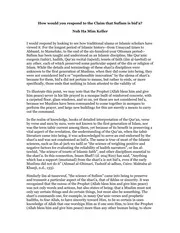
Response to the claim that Sufism is bida



Lorelei Sage, Contemplative Literature Editor – Smirna Si's 'Response to the Claim that Sufism is Bida' is a beacon of clarity amidst devotional discourse. Expertly navigating the theological landscape, Si, guided by Nuh Keller's insights, offers a compelling defense of Sufism's legitimate place within Islamic tradition. The text eschews polemic for profound exposition, revealing the intricate spiritual mechanics and symbolic language that define Sufi practice. Its strength lies in illuminating the esoteric dimensions of Sufi disciplines, presenting them not as mere ritual but as pathways to transformative gnosis. This book is essential for anyone seeking a nuanced understanding of Islamic mysticism, particularly those drawn to contemplative practices and the pursuit of inner truth.
📝 Description
76
Smirna Si's 2023 book directly confronts the accusation that Sufism is an innovation (bida).
Smirna Si's "Response to the Claim that Sufism is Bida" addresses a common criticism leveled against Islamic mysticism. The book examines the concept of innovation within Sufism, a tradition focused on divine love and inner purification. Si draws on the work of Nuh Keller to interpret veiled meanings and explain the core of Sufi practices and beliefs. It aims to show how Sufism transforms everyday life into a sacred pursuit.
The work is intended for those seeking a deeper understanding of Sufism's genuine nature, moving past surface judgments to appreciate its contemplative history. It explains the philosophical ideas that have supported this path for centuries. The book offers clarity for individuals caught in doctrinal arguments, highlighting a tradition that finds God through purifying the heart and unveiling hidden truths.
This book engages with a specific debate within Islamic thought concerning the legitimacy of Sufi practices. It situates Sufism not as a deviation, but as an authentic path within Islam, emphasizing its focus on the inner dimensions of faith and the purification of the heart. By addressing the charge of bida, Si defends the continuity of Sufi traditions, arguing their practices are rooted in established Islamic principles and the pursuit of direct spiritual experience. This places the work within the broader discourse on Islamic esotericism, where the inner life is central to spiritual realization.
💡 Why Read This Book?
Uncover the hidden truths of Islamic mysticism. This book offers a profound exploration of Sufism's authentic essence, dispelling misconceptions with scholarly grace and spiritual depth. It is an indispensable guide for seekers of esoteric knowledge, scholars of comparative religion, and practitioners yearning to deepen their connection to the Divine through the contemplative path of Sufism. Understand the symbolic language and inner alchemy that have guided saints and mystics for centuries.
⭐ Reader Reviews
Honest opinions from readers who have explored this book.
❓ Frequently Asked Questions
What is 'Bida' in Islamic terminology?
'Bida' refers to innovation or heresy in Islamic law, often denoting practices or beliefs introduced after the Prophet Muhammad's time that are deemed contrary to established religious principles.
Who is Nuh Keller and what is his connection to this book?
Nuh Ha Mim Keller is a prominent contemporary scholar and translator of Islamic texts, particularly known for his work on Islamic jurisprudence and Sufism. His original notes likely provided foundational insights or guidance for Smirna Si's work.
Is this book suitable for someone new to Sufism?
Absolutely. While it addresses complex theological points, the book aims to provide clarity and accessible understanding for both newcomers and those with prior knowledge of Islamic mysticism.
What specific Sufi practices are discussed?
The book delves into the spiritual underpinnings of various Sufi practices, focusing on their adherence to core Islamic principles and their role in the purification of the heart and soul.
Does this book offer a historical overview of Sufism?
While primarily a theological and spiritual response, the text implicitly situates Sufism within its historical context, highlighting its continuous evolution and enduring relevance.
🔮 Key Themes & Symbolism
The Essence of Sufi Innovation
This theme explores the nuanced understanding of 'bida' (innovation) within the Islamic tradition, specifically as it pertains to Sufism. It argues that many Sufi practices, far from being forbidden innovations, are in fact the natural flowering of the Quranic and Sunnah foundations, representing spiritual evolution and deeper experiential understanding of Divine truths. The focus is on discerning between harmful innovation and legitimate spiritual development rooted in contemplation, remembrance (dhikr), and the purification of the heart, revealing how Sufism embodies a dynamic, living tradition that seeks the eternal within the temporal.
The Inner Alchemy of the Soul
This theme explores the profound spiritual practices of Sufism, viewed as a form of inner alchemy. It highlights how Sufi disciplines are designed to transform the lower self ('nafs') into a vessel of Divine light and wisdom. Through contemplative practices, selfless service, and the remembrance of God, the seeker undergoes a process of purification and spiritual refinement. The text illuminates the symbolic language used to describe this inner journey, where each stage represents a shedding of egoic limitations and an unfolding of the true spiritual essence, leading to ecstatic union with the Divine.
Symbolism and the Veiled Meanings
This theme unpacks the rich symbolic language that permeates Sufi literature and practice. It explores how seemingly simple rituals, poetic verses, and allegorical narratives hold profound esoteric meanings, accessible to those with purified hearts and discerning minds. The book emphasizes that Sufism is not merely about outward observance but about apprehending the deeper, veiled realities of existence. Understanding this symbolic lexicon is crucial for appreciating the intellectual and spiritual depth of Sufi thought, revealing the universe as a grand manifestation of the Divine, replete with hidden signs and sacred intimacies.
💬 Memorable Quotes
Direct passages from the work, attributed to the author.
“True innovation is the unveiling of ancient truths.”
— This suggests that what appears as new within Sufism is often a deeper, more realized understanding of timeless spiritual principles.
“The path is not in knowledge, but in knowing.”
— This highlights the Sufi emphasis on experiential wisdom and direct spiritual realization over mere intellectual accumulation of information.
“Dhikr is the breath of the soul.”
— This emphasizes the vital importance of the remembrance of God in Sufi practice, equating it to the very sustenance and life force of the spiritual being.
“The veil is not without, but within.”
— This profound statement points to the ego and worldly attachments as the primary obstacles to experiencing Divine reality, rather than external limitations.
💡 Key Ideas
Editorial paraphrase of the work's core concepts — not direct quotes.
The heart is the mirror of the Divine.
This quote signifies the Sufi belief that through spiritual purification and sincere devotion, the human heart can become a clear reflection of God's presence and attributes.
🌙 Esoteric Significance
Tradition
This work is firmly rooted in the esoteric tradition of Sufism, the mystical dimension of Islam. It represents a defense and clarification of the path of inner purification and divine love that has been practiced by saints and scholars for over a millennium. The esoteric significance lies in its exploration of the hidden meanings within Islamic scripture and practice, guiding the practitioner towards direct, experiential knowledge of the Divine.
Symbolism
Key symbols explored include the heart as a mirror of the Divine, the journey of the soul through various spiritual stations (maqamat), the concept of 'fana' (annihilation of the ego) and 'baqa' (subsistence in God), and the profound significance of divine remembrance (dhikr). The text likely unpacks the veiled meanings within Quranic verses and Hadith, revealing how these outward forms point to inner spiritual realities and esoteric truths.
Modern Relevance
In an era often characterized by superficiality and disconnection, the esoteric wisdom of Sufism offers a vital pathway to inner peace, spiritual depth, and authentic connection. This book's relevance lies in its ability to reintroduce the profound contemplative practices and transformative potential of Sufism to a modern audience. It provides a framework for understanding how ancient mystical disciplines can address contemporary spiritual yearning and contribute to personal and collective well-being.
👥 Who Should Read This Book
This book is a vital resource for a diverse audience. **Beginners** seeking an authentic introduction to Islamic mysticism will find a clear and compassionate guide that dispels common misconceptions. **Scholars** of religion and comparative mysticism will appreciate its nuanced theological arguments and its contribution to understanding Islamic spirituality. **Spiritual seekers** yearning for a deeper connection with the Divine, regardless of their religious background, will find inspiration and practical insights into the path of the heart. **Practitioners** of Sufism, or those interested in contemplative traditions, will benefit from its scholarly defense and elaboration of core Sufi principles and practices.
📜 Historical Context
Smirna Si's 'Response to the Claim that Sufism is Bida' emerges from a rich historical range of Islamic scholarship and spiritual discourse. While the text itself focuses on theological and spiritual arguments, its genesis lies in centuries of debate surrounding the legitimacy and nature of Sufism within the broader Islamic world. From its early ascetics who sought a more personal relationship with God, through the Flourishing of orders like the Qadiri, Naqshbandi, and Shadhili in later centuries, Sufism has consistently navigated a complex relationship with orthodox interpretations. The critique of 'bida' (innovation) has been a recurring theme, often wielded by more literalist or legalistic scholars against the perceived departures from strict legal interpretation found in some Sufi practices. This book, drawing on the profound scholarship of figures like Nuh Keller, actively engages with this ongoing dialogue, seeking to affirm Sufism's place not as an aberrant innovation, but as an essential, evolving dimension of Islamic spirituality that has profoundly shaped Muslim culture, art, and contemplative life for over a millennium.
📔 Journal Prompts
Reflect on the concept of 'innovation' in your own spiritual journey. What practices have felt like genuine unfolding versus superficial additions?
How does the idea of the 'heart as a mirror of the Divine' resonate with your personal understanding of spirituality?
Consider the symbolic language in your own spiritual or religious tradition. What deeper meanings might be hidden within familiar texts or practices?
Explore the concept of 'inner alchemy.' What aspects of yourself do you feel are being transformed through your spiritual practices?
What does 'knowing' rather than 'knowledge' mean to you in the context of spiritual realization?
🗂️ Glossary
Bida
An Arabic term meaning 'innovation' or 'heresy' in Islamic jurisprudence, often referring to practices introduced after the Prophet Muhammad's time that are considered deviations from established religious norms.
Dhikr
The remembrance of God, a central Sufi practice involving the repetition of divine names or phrases, often in rhythmic chants, to achieve spiritual presence and union.
Fana
An Arabic term in Sufism signifying the annihilation of the ego or self, a state of spiritual ecstasy where the individual's consciousness dissolves into the Divine.
Maqamat
The spiritual stations or stages that a Sufi seeker traverses on the path to God, representing progressive levels of spiritual development and purification.
Nafs
The ego or lower self in Islamic psychology, often seen as the source of carnal desires and negative inclinations that must be disciplined and purified on the spiritual path.
This book appears in 2 collections
🔮 Readers Also Liked
Browse all →





More by Smirna Si
All books →


From the “Christian Mysticism” Collection
View all →





More Free Mysticism & Contemplation Books
View all →