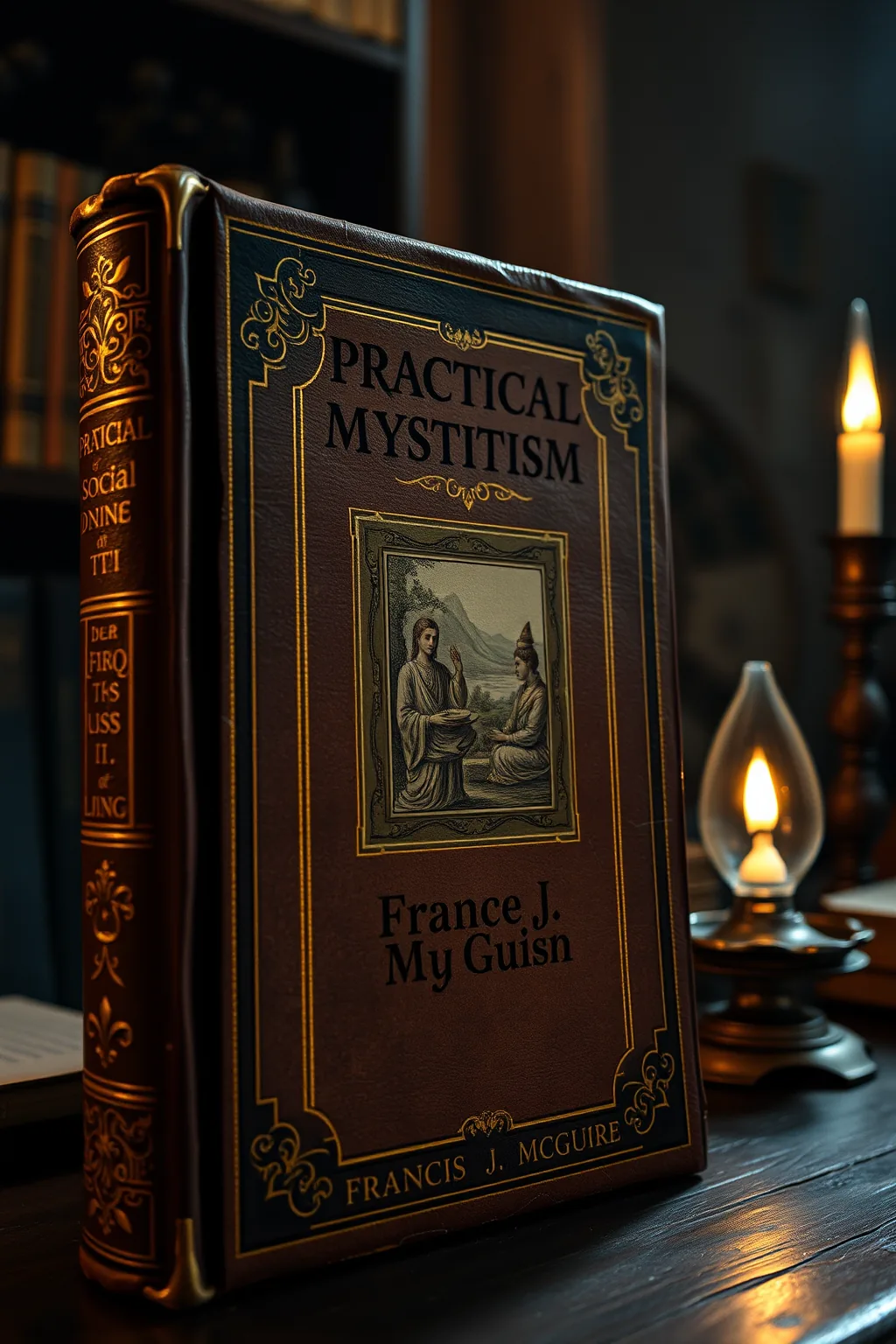
Practical Mysticism: The Psychosocial Dynamics of Change in the Mystical Tradition, Christian and Zen Buddhist 1976-10
 77
77

Practical Mysticism: The Psychosocial Dynamics of Change in the Mystical Tradition, Christian and Zen Buddhist 1976-10



Francis J. McGuire’s 'Practical Mysticism' is a revelation for the serious student of the hidden arts. By meticulously dissecting the psychosocial dynamics of spiritual change, McGuire bridges the seemingly disparate worlds of Christian contemplation and Zen austerity. His analysis of the ego's dissolution and the subsequent emergence of the higher Self is both incisive and profoundly practical. This work transcends mere academic discourse, offering a map for navigating the labyrinthine inner landscapes encountered on the mystical path. It is an indispensable resource for practitioners seeking to understand the psychological underpinnings of their transformative experiences, providing clarity and depth to the often-bewildering journey towards enlightenment. A true gem for the discerning occult scholar.
📝 Description
77
Francis J. McGuire's 1976 book examines psychosocial change in Christian and Zen mystical traditions.
Francis J. McGuire's 'Practical Mysticism' analyzes the psychosocial dynamics of change within Christian and Zen Buddhist mystical traditions. Published in 1976, the book draws connections between the contemplative practices of these seemingly disparate paths. McGuire examines how inner evolution unfolds, from initial spiritual yearning to the dissolution of the ego. He deciphers the symbolic language and processes involved in mystical awakening.
The work aims to bridge ancient contemplative disciplines with modern psychological understandings of change. It addresses the internal shifts and transformations experienced by individuals on a spiritual path. The book is intended for those seeking experiential realization rather than purely intellectual knowledge. McGuire's approach focuses on the practical application of mystical principles to personal transformation.
This book engages with the esoteric tradition by directly comparing the inner disciplines of Christian mysticism and Zen Buddhism. It treats both as practical systems for profound personal transformation, moving beyond mere theological or philosophical discussion. McGuire frames these traditions within a framework of psychosocial change, suggesting universal patterns of psychological development underlie mystical experiences. This perspective places the book within a lineage of Western esoteric thought that seeks to integrate psychological understanding with spiritual practice, a trend that gained momentum in the mid-20th century.
💡 Why Read This Book?
Uncover the universal psychosocial forces driving mystical transformation. Explore hidden connections between Christian and Zen traditions. Gain practical insights into ego dissolution and spiritual awakening. Ideal for dedicated seekers, contemplative scholars, and practitioners of esoteric disciplines yearning for deeper understanding.
⭐ Reader Reviews
Honest opinions from readers who have explored this book.
❓ Frequently Asked Questions
What is the core focus of 'Practical Mysticism'?
The book centers on the psychosocial dynamics that drive profound change within individuals on the mystical path, specifically examining parallels between Christian and Zen Buddhist traditions.
Who is the intended audience for this book?
This work is best suited for serious students of mysticism, contemplative practitioners, scholars of religion and psychology, and anyone deeply interested in the experiential aspects of spiritual transformation.
How does the book compare Christian and Zen Buddhist mysticism?
McGuire draws comparative analyses, highlighting common patterns in ego dissolution, the cultivation of inner awareness, and the psychosocial shifts that occur across these distinct yet convergent mystical traditions.
Is this book suitable for beginners in mysticism?
While offering profound insights, the depth of the psychosocial analysis may be more immediately accessible to those with some foundational understanding or experience in contemplative practices.
What is the significance of the 'Psychosocial Dynamics' aspect?
It emphasizes that spiritual growth is not solely a metaphysical event, but deeply intertwined with the psychological and social aspects of human experience and development.
🔮 Key Themes & Symbolism
The Alchemical Transformation of the Psyche
This theme examines the profound inner metamorphosis that occurs on the mystical journey. It examines how the ego, the constructed self, undergoes a process akin to alchemical transmutation, being purified, broken down, and reformed into a vessel for higher consciousness. McGuire illustrates how this internal alchemy is not a passive event but an active, often challenging, psychosocial process involving the integration of shadow aspects and the dissolution of ingrained patterns of thought and behavior, leading to a radical reorientation of one's being.
Cross-Cultural Mystical Parallels
McGuire's seminal contribution lies in his masterful comparison of seemingly divergent mystical paths. He uncovers the universal archetypes and psychosocial mechanisms that govern spiritual awakening, demonstrating how the core principles of transformation in Christian contemplative prayer and Zen Buddhist meditation share fundamental underlying dynamics. This theme explores how diverse traditions, despite their unique cultural and theological expressions, tap into the same deep wellsprings of human consciousness and the universal quest for transcendence.
The Lived Experience of Spiritual Change
This theme moves beyond abstract theory to illuminate the tangible, often arduous, lived experience of the mystic. It focuses on the practical, day-to-day challenges and breakthroughs encountered in the pursuit of spiritual realization. McGuire explores the emotional, cognitive, and relational shifts that accompany profound inner work, offering a realistic perspective on the commitment and resilience required for genuine transformation. It underscores that mysticism is not an ethereal escape, but a deeply embodied and psychosocial engagement with reality.
💬 Memorable Quotes
Direct passages from the work, attributed to the author.
“Stillness is not emptiness, but the fertile ground from which all being arises.”
— This highlights the misunderstood nature of contemplative silence. It's not a void, but a dynamic, generative space where the seeds of divine insight and true existence can germinate and flourish, a core tenet of many mystical paths.
“The path inward is the longest journey, yet it leads to the most intimate homecoming.”
— This speaks to the profound nature of introspection in mysticism. The exploration of one's inner world, though challenging and extensive, ultimately results in a deep and comforting sense of belonging and self-recognition.
“Sacrifice is not loss, but the shedding of the unreal to embrace the eternal.”
— This redefines the concept of sacrifice in a spiritual context. It's not about deprivation, but about letting go of transient, illusory attachments to make space for enduring, ultimate truths and realities.
“The awakened eye sees the divine woven into the fabric of the mundane.”
— This points to the transformative vision of the mystic. Spiritual awakening allows one to perceive the sacred and the transcendent present within ordinary life, revealing the interconnectedness of all things.
💡 Key Ideas
Editorial paraphrase of the work's core concepts — not direct quotes.
The ego is a fortress built of fear, and its siege is the beginning of liberation.
This quote captures the core challenge of mystical growth: confronting and dismantling the self-centered ego, which is seen as a protective but ultimately limiting structure born from insecurity and fear, paving the way for true freedom.
🌙 Esoteric Significance
Tradition
This work is deeply rooted in the esoteric traditions of both Christian Mysticism and Zen Buddhism, two pillars of contemplative practice. It explores the hidden, inner dimensions of these paths, focusing on the direct, experiential knowledge of the divine or ultimate reality. McGuire's analysis highlights the shared language of the soul's journey, the dissolution of the ego, and the attainment of inner peace and liberation, revealing that beneath their distinct cultural expressions lie universal esoteric principles guiding the seeker towards transcendence.
Symbolism
The book implicitly and explicitly engages with the detailed symbolism inherent in mystical traditions. It interprets the psychological states and transformative processes as symbolic representations of spiritual truths. For instance, the 'fortress' of the ego symbolizes the self-imposed limitations of ordinary consciousness, while 'stillness' becomes a symbol for the pregnant void from which creation emerges. McGuire navigates the symbolic landscapes of both Christian asceticism and Zen koans, revealing how these symbols act as keys to unlocking deeper understanding and facilitating the inner transformation of the practitioner.
Modern Relevance
In an age often characterized by external distractions and existential anxiety, 'Practical Mysticism' offers profound relevance. It provides a framework for understanding and engaging with the inner life, crucial for reading through the complexities of modern existence. The book's focus on psychosocial dynamics offers therapeutic insights for personal growth and well-being, while its cross-cultural comparisons foster a more inclusive and nuanced understanding of spiritual seeking. Its emphasis on practical application makes it a valuable resource for contemporary individuals seeking authentic spiritual depth and a more integrated, mindful way of living.
👥 Who Should Read This Book
This book is a vital resource for a diverse range of readers. **Beginners** seeking to understand the foundational psychological underpinnings of spiritual growth will find clear explanations of transformative processes. **Scholars** of comparative religion, psychology, and esoteric studies will appreciate McGuire's rigorous analysis and insightful cross-cultural comparisons. **Seekers** on a personal spiritual journey will find practical guidance and validation for their experiences, learning how to work through the inevitable challenges of inner transformation. **Practitioners** of meditation, contemplative prayer, and other mystical disciplines will gain a deeper understanding of the psychosocial mechanics at play, enhancing their practice and deepening their insights into the nature of consciousness and the Self.
📜 Historical Context
Published in 1976, 'Practical Mysticism' emerged during a period of significant cultural and intellectual ferment. The late 20th century witnessed a burgeoning interest in Eastern philosophies and alternative spiritualities in the West, often catalyzed by the counterculture movement. This era saw a growing critique of purely materialistic worldviews and a search for deeper meaning and personal fulfillment. McGuire’s work tapped into this zeitgeist, offering a sophisticated, academic yet accessible bridge between established Western mystical traditions and the rising influence of Eastern contemplative practices like Zen Buddhism. The book reflects a growing academic and public curiosity about the psychological and experiential dimensions of religion, moving beyond purely theological or historical analyses to explore the 'how-to' of spiritual transformation. Its publication contributed to a more integrated understanding of mysticism, acknowledging its deep roots in human psychology and social dynamics, and resonating with a generation seeking authentic spiritual experiences.
📔 Journal Prompts
Reflect on a time you felt your ego was a 'fortress.' What fears were you protecting, and how might you begin to dismantle it?
Consider the concept of 'stillness.' How do you currently experience stillness, and how could you cultivate it as a 'fertile ground' in your life?
What does 'shedding the unreal' mean in your current life context? What are you willing to let go of to embrace something more enduring?
Describe an experience where you perceived the 'divine woven into the fabric of the mundane.' What details stood out, and how did it make you feel?
How do the psychosocial dynamics described in the book resonate with your own experiences of personal or spiritual change?
🗂️ Glossary
Ego
In a psychological and mystical context, the ego refers to the constructed sense of self, the personality formed by experiences, beliefs, and social conditioning. It is often seen as the primary obstacle to spiritual realization.
Psychosocial Dynamics
The interplay between psychological processes (thoughts, emotions, motivations) and social factors (relationships, environment, cultural norms) that shape an individual's behavior and development, particularly within the context of spiritual transformation.
Contemplation
A form of deep, reflective prayer or meditation focused on direct experience of the divine or ultimate reality, often involving quietude, surrender, and a turning inward of consciousness.
Ego Dissolution
A key transformative process in mysticism where the boundaries of the individual self (ego) weaken or dissolve, leading to a sense of unity, interconnectedness, and expanded consciousness.
Asceticism
A spiritual discipline involving rigorous self-denial and renunciation of worldly pleasures or comforts, often undertaken to achieve spiritual purity, discipline the mind, or deepen one's connection to the divine.
This book appears in 1 collection
🔮 Readers Also Liked
Browse all →



From the “Christian Mysticism” Collection
View all →






More Free Mysticism & Contemplation Books
View all →