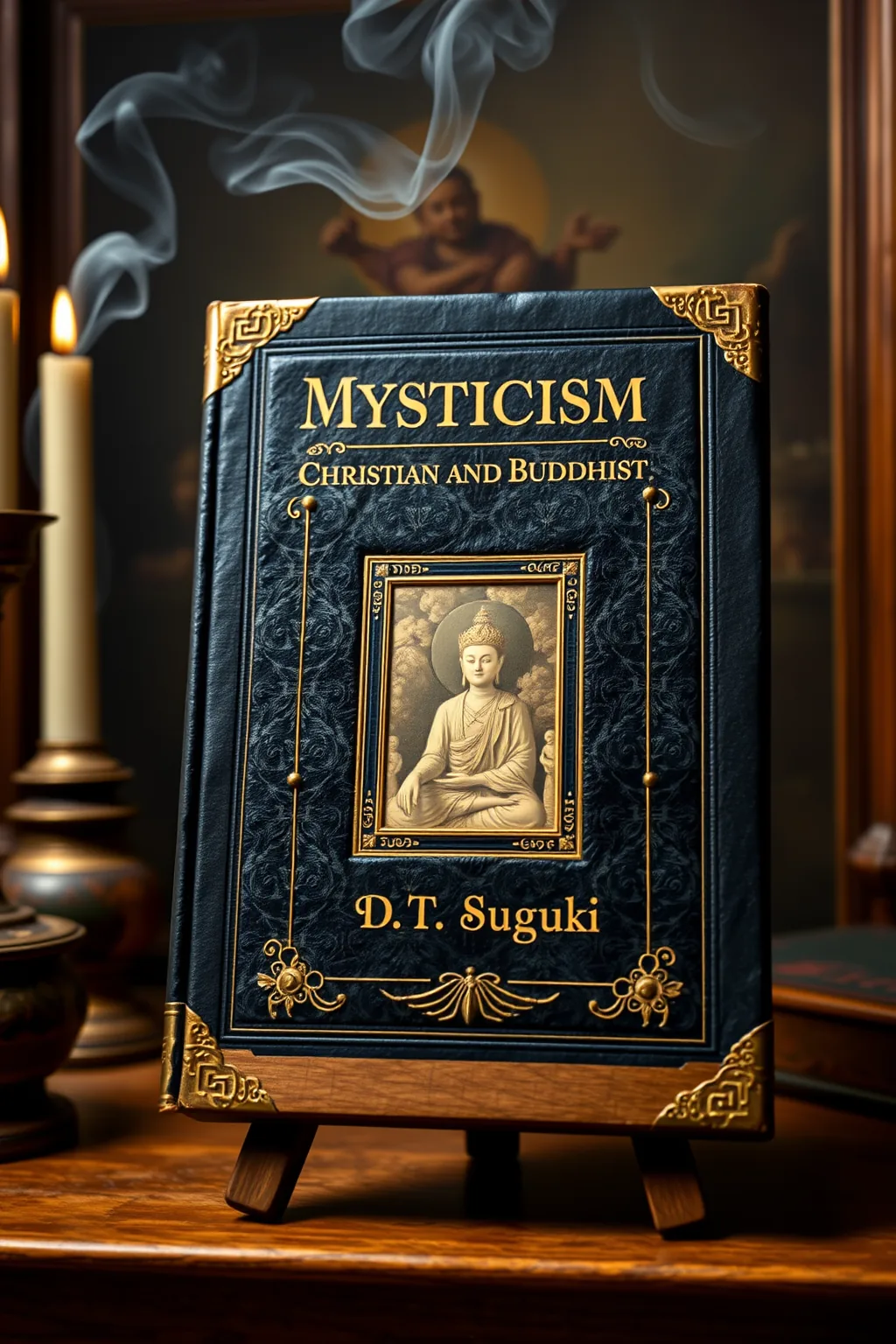
Mysticism: Christian and Buddhist
 76
76

Mysticism: Christian and Buddhist



By Cassian Rothmann (Senior Critic, Ancient Wisdom) — D. T. Suzuki's "Mysticism: Christian and Buddhist" stands as a monumental bridge between East and West, offering unparalleled insights into the shared landscape of contemplative practice. Suzuki masterfully illuminates the esoteric heart of both traditions, revealing not mere theological differences, but a common experiential ground. His profound understanding allows readers to grasp the subtle nuances of Christian apophaticism and Buddhist shunyata with striking clarity. This is essential reading for scholars of comparative religion, but more importantly, for any serious practitioner seeking to deepen their understanding of the mystical path. A truly indispensable treasure for the modern spiritual seeker.
📝 Description
76
D. T. Suzuki published "Mysticism: Christian and Buddhist" to compare two major contemplative traditions.
In "Mysticism: Christian and Buddhist," D. T. Suzuki examines the common ground between Christian and Buddhist contemplative practices. He argues that both traditions aim for a direct experience of the divine or the Absolute, a goal that transcends ordinary perception. Suzuki details the symbolic language and methods used in each path, showing how they lead to personal transformation.
The book presents these spiritual disciplines not as separate doctrines, but as expressions of a shared human impulse. Suzuki, known for his work on Zen Buddhism, brings a unique perspective to this comparative study. He invites readers to consider the underlying unity in these seemingly different mystical approaches.
This work is suited for those interested in comparative religion and the nature of mystical experience. It offers insight into how different cultures and faiths express a similar quest for ultimate reality.
D. T. Suzuki's work is situated within the broader esoteric interest in comparative mysticism that gained traction in the early 20th century. At a time when Westerners were increasingly drawn to Eastern philosophies, Suzuki acted as a bridge, explaining complex Buddhist concepts, particularly Zen, in accessible terms. This book applies that interpretive skill to the shared phenomenon of mysticism across major world religions, suggesting an underlying spiritual unity that esoteric traditions often seek to uncover. It engages with the idea that direct, intuitive knowledge of reality is possible beyond conventional religious frameworks.
💡 Why Read This Book?
Embark on a transformative journey across spiritual traditions. "Mysticism: Christian and Buddhist" unveils the universal language of the soul, revealing hidden connections between East and West. Ideal for seekers of ultimate truth, scholars of comparative spirituality, and practitioners yearning for deeper contemplative insight. Discover profound wisdom and unlock your own inner potential.
⭐ Reader Reviews
Honest opinions from readers who have explored this book.
❓ Frequently Asked Questions
What is the core thesis of "Mysticism: Christian and Buddhist"?
The book's core thesis is that despite their distinct cultural and theological frameworks, Christian and Buddhist mysticism share a fundamental, experiential core focused on direct, unmediated knowledge of ultimate reality and the dissolution of the ego.
Who was D. T. Suzuki and why is he qualified to write this book?
Daisetz Teitaro Suzuki was a preeminent scholar and popularizer of Buddhist philosophy, particularly Zen. His lifelong dedication and profound understanding of Eastern thought, combined with his engagement with Western intellectual traditions, uniquely qualify him to bridge these spiritual dialogues.
Is this book suitable for beginners in mysticism?
While it delves into complex philosophical concepts, Suzuki's accessible prose and focus on experiential aspects make it a valuable, albeit challenging, entry point for earnest beginners seeking a comparative understanding of mystical traditions.
What kind of spiritual practices might one explore after reading this book?
Readers might be inspired to explore practices like meditation (Vipassanā, Zazen), contemplative prayer, self-inquiry, and mindfulness, aiming for direct experience rather than intellectual assent.
How does this book contribute to interfaith dialogue?
It fosters interfaith understanding by highlighting the common ground and shared aspirations of seemingly disparate spiritual paths, emphasizing universal human experiences of transcendence and spiritual awakening.
🔮 Key Themes & Symbolism
The Universal Nature of Mystical Experience
This theme explores the profound idea that despite vast cultural and doctrinal differences, the core experience of mystical union—a direct, unmediated apprehension of ultimate reality—is a universal human phenomenon. Suzuki argues that the ultimate goal of both Christian and Buddhist mysticism is not intellectual comprehension but a transformative, lived realization of oneness, a state of being that transcends the dualistic perception of self and other, or sacred and profane. This common ground suggests a singular, underlying spiritual truth accessible through diverse paths.
The Role of Emptiness (Shunyata) and Divine Union
Suzuki masterfully draws parallels between the Buddhist concept of Shunyata (emptiness or voidness) and the Christian mystical experience of divine union or apophatic theology. He elucidates how the relinquishment of ego-bound perceptions and conceptualizations, central to Buddhist practice, mirrors the Christian mystic's surrender to the divine presence, often described as an experience of nothingness before God. Both traditions, in their highest forms, lead to a dissolution of the limited self into a boundless, all-encompassing reality.
Contemplative Practice and the Path to Enlightenment
The book emphasizes that mysticism is not solely a theoretical pursuit but a deeply experiential one, cultivated through rigorous contemplative practices. Suzuki details how methods such as meditation, prayer, and self-inquiry serve as vehicles to quiet the discursive mind and open the practitioner to direct insight. These practices are presented as essential tools for dismantling the illusions of the ego and awakening to the profound interconnectedness of all existence, leading to spiritual liberation or salvation.
💬 Memorable Quotes
Direct passages from the work, attributed to the author.
“The ultimate aim of both is the same.”
— This signifies the shared goal of spiritual traditions: transcending ego and experiencing ultimate reality, regardless of differing doctrines.
“To see God is to become God.”
— Highlights the transformative nature of divine encounter in Christian mysticism, where union implies a fundamental change in being.
“When the mind is emptied, it is filled.”
— A paradoxical statement reflecting the Buddhist principle of Shunyata, where letting go of self leads to a boundless awareness.
“The Absolute is not something to be intellectually apprehended.”
— Underscores the experiential and intuitive nature of mystical knowledge, surpassing mere rational understanding.
“The separation between the seeker and the sought is an illusion.”
— Points to the non-dualistic core of mysticism, where the perceived division between the individual and the divine/absolute dissolves.
🌙 Esoteric Significance
Tradition
This work is deeply rooted in the esoteric traditions of both Mahayana Buddhism (specifically Zen) and Christian mysticism. It seeks to unveil the hidden, experiential core of these paths, which often lies beneath their exoteric (outward) doctrines and rituals. The esoteric significance lies in its revelation of universal principles of consciousness transformation that are accessible through dedicated inner work, transcending specific religious dogma.
Symbolism
The symbolism explored includes the 'void' or 'emptiness' (Shunyata) in Buddhism, representing the unconditioned reality beyond form, and the 'divine dark' or 'cloud of unknowing' in Christian mysticism, signifying the ineffable nature of God. Other symbols might include the lotus flower (purity arising from mud), the cross (sacrifice and union), and the concept of 'no-mind' or 'pure consciousness,' all pointing towards a reality beyond ordinary perception.
Modern Relevance
In an age often characterized by materialism and spiritual fragmentation, "Mysticism: Christian and Buddhist" offers a potent reminder of the enduring human quest for meaning and connection to something greater. Its emphasis on direct experience, mindfulness, and the dissolution of ego remains highly relevant for contemporary seekers, therapists, and anyone grappling with existential questions. The book provides a framework for understanding the common threads of spiritual wisdom that can unite individuals across diverse backgrounds.
👥 Who Should Read This Book
This profound work is essential for anyone drawn to the deeper currents of human spirituality. Scholars of comparative religion and philosophy will find invaluable insights into cross-cultural spiritual expression. Aspiring mystics and contemplatives, regardless of their religious affiliation, will discover a guide to the universal path of inner awakening. Practitioners of meditation or prayer seeking to deepen their understanding of their own traditions, or explore the commonalities with others, will find this book particularly rewarding. It is for the earnest seeker ready to look beyond dogma and embrace the experiential truth of the spirit.
📜 Historical Context
Written in an era of burgeoning global dialogue, D. T. Suzuki's "Mysticism: Christian and Buddhist" emerged during a period when Western intellectuals and spiritual seekers were increasingly fascinated by Eastern philosophies. The post-World War I and mid-20th century saw a rise in comparative religion studies and a desire for universal spiritual truths that transcended sectarian boundaries. Suzuki, already a renowned interpreter of Zen Buddhism, was uniquely positioned to articulate these connections. His work resonated deeply with thinkers like Thomas Merton, Carl Jung, and Alan Watts, contributing significantly to the introduction and appreciation of Eastern contemplative traditions within Western thought and popular culture. This book represents an important moment in interfaith understanding, offering a bridge between seemingly disparate spiritual landscapes at a time of profound global change and introspection.
📔 Journal Prompts
Reflect on a time you experienced a sense of oneness with something larger than yourself. What were the circumstances?
How does the concept of 'emptiness' (Shunyata) resonate with your personal experiences of letting go or detachment?
Compare and contrast your understanding of prayer with the Buddhist concept of meditation. What are the similarities and differences in their aims?
Consider a personal 'illusion' of self or reality that you might be holding onto. How could a contemplative practice help you to see beyond it?
If the ultimate aim of both traditions is the same, what does this imply for your own spiritual journey and your view of other faiths?
🗂️ Glossary
Shunyata
A fundamental concept in Mahayana Buddhism, often translated as 'emptiness' or 'voidness.' It refers to the absence of inherent, independent existence in all phenomena, and the ultimate nature of reality as unconditioned and boundless.
Apophatic Theology
A theological approach that describes God by negation, stating what God is not, rather than what God is. It emphasizes the ineffability and transcendence of the divine, often associated with mystical traditions.
Contemplation
A form of prayer or meditation focused on deep, silent reflection and direct experience of the divine or ultimate reality, often involving the quieting of the mind and a passive receptivity to spiritual insight.
Ego
In a spiritual context, the sense of self that is constructed by the mind, often based on personal history, beliefs, and desires. Mystical traditions often aim for the dissolution or transcendence of the ego.
Non-duality
The philosophical or spiritual concept that reality is ultimately a single, unified whole, without fundamental divisions or distinctions such as self/other, mind/matter, or sacred/profane.
This book appears in 1 collection
🔮 Readers Also Liked
Browse all →








From the “Christian Mysticism” Collection
View all →






More Free Mysticism & Contemplation Books
View all →