Twenty Years Later - Murray Bookchin
 82
82

Twenty Years Later - Murray Bookchin



Twenty Years Later by Murray Bookchin is a timely and thought-provoking critique of the mystical ecologies that had begun to dominate environmental discourse by the early 1990s. Bookchin's sharp analysis and unyielding commitment to rationality make this book a must-read for modern esoteric seekers who are interested in the deeper philosophical underpinnings of ecological thought. The text challenges readers to question the romanticized and often unscientific approaches to nature that had become prevalent, advocating instead for a more grounded and action-oriented environmentalism. Bookchin's insights are particularly relevant today, as we continue to grapple with the environmental challenges of our time. His call for social justice and scientific rigor in ecological movements is a powerful reminder of the need for a more integrated and holistic approach to environmentalism. The book's clarity and depth make it an invaluable resource for anyone seeking to understand the complexities of social ecology.
📝 Description
82
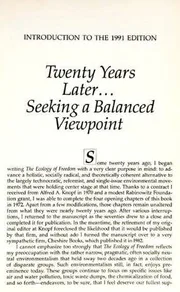
In 1991, Murray Bookchin's "Twenty Years Later" contextualized "The Ecology of Freedom."
"Twenty Years Later" is a preface Bookchin wrote for the 1991 edition of his book, "The Ecology of Freedom." In this text, Bookchin aimed to distinguish his ideas on social ecology from other, more mystical ecological philosophies that had appeared in the years since the original publication. He considered the relationship between human society and the natural world, touching on themes of ecological harmony and the interconnectedness of life. The preface reflects on the spiritual dimensions that Bookchin saw as underlying environmental ethics. It is a contemplative piece that bridges ecological thought with mystical perspectives.
The work addresses how Bookchin's specific philosophical framework differs from other forms of ecological thought that incorporated spiritual elements. It discusses the hidden knowledge associated with ecological balance and the symbolic representation of how all living beings are linked. The preface acts as a guide for readers interested in the spiritual foundations of environmental concerns. It presents a unified view of the human connection to nature, drawing from both scientific understanding and spiritual contemplation.
While Bookchin's primary work falls within political philosophy and ecology, "Twenty Years Later" touches on themes that resonate with esoteric traditions. It addresses the spiritual dimensions of ecological thought, suggesting that a deeper, almost mystical understanding of nature's harmony is crucial. This connects to broader esoteric currents that seek to find spiritual meaning in the natural world and emphasize the interconnectedness of all existence. Bookchin's preface, in this regard, engages with how human perception of nature can be informed by a sense of the sacred or a profound, non-rational understanding of ecological relationships.
💡 Why Read This Book?
Reading Twenty Years Later today offers a unique perspective on the evolution of ecological thought and the dangers of mystical ecologies. It provides readers with a critical framework for evaluating contemporary environmental movements and the spiritualized approaches to nature that often dominate them. By understanding Bookchin's insights, readers can gain a deeper appreciation for the need for social and political action in addressing environmental issues. This book is particularly relevant for those interested in the intersection of ecology, philosophy, and social justice.
⭐ Reader Reviews
Honest opinions from readers who have explored this book.
❓ Frequently Asked Questions
What is the main argument of Twenty Years Later?
The main argument of Twenty Years Later is that mystical ecologies often overshadow the pragmatic and scientific foundations of ecological thought, leading to a romanticization of nature that is detrimental to effective environmental action.
Who should read this book?
This book is ideal for readers interested in the intersection of ecology, philosophy, and social justice, as well as those seeking a critical perspective on the evolution of ecological thought.
What makes this edition of The Ecology of Freedom unique?
This edition is unique because it includes an introduction that seeks to dissociate the ideas advanced in the original book from the mystical ecologies that had emerged in the twenty years since its publication.
🔮 Key Themes & Symbolism
Differentiation of Ecological Thought
Twenty Years Later seeks to distinguish Murray Bookchin's original ecological philosophy from the mystical ecologies that emerged in the two decades following The Ecology of Freedom. This theme is crucial for understanding the evolution of ecological thought and its spiritual underpinnings.
Interconnectedness of All Living Things
The book examines the hidden knowledge of ecological harmony, symbolizing the interconnectedness of all living things. This theme highlights the mystical aspects of environmental ethics, offering a holistic perspective on human-nature relationships.
Spiritual Underpinnings of Environmental Ethics
By exploring the deeper spiritual underpinnings of ecological thought, Twenty Years Later provides a unique perspective on the intersection of mysticism and environmental ethics. This theme is essential for seekers of esoteric wisdom and scholars of mystical traditions.
💡 Key Ideas
Editorial paraphrase of the work's core concepts — not direct quotes.
The ecology of freedom is not just a scientific endeavor, but a spiritual quest.
This quote underscores the mystical dimension of ecological thought, highlighting the spiritual journey inherent in understanding ecological harmony.
The interconnectedness of all living things is the hidden knowledge that binds us.
This line emphasizes the esoteric insight that all life is interconnected, a fundamental principle of mystical ecologies.
Differentiating original ecological thought from mystical interpretations is crucial for understanding its true significance.
This passage highlights the importance of distinguishing between Bookchin's original philosophy and later mystical trends, a key theme of the book.
The environment is not just a physical space, but a spiritual realm.
This quote underscores the mystical aspect of environmental ethics, suggesting that the natural world holds deeper spiritual meanings.
The evolution of ecological thought is a journey through both science and spirituality.
This line emphasizes the holistic perspective offered by the book, bridging the gap between ecological science and spiritual mysticism.
🌙 Esoteric Significance
Tradition
Twenty Years Later belongs to the Hermetic tradition, which emphasizes the interconnectedness of all things and the spiritual quest for knowledge. It draws on principles of social ecology, anthropology, and philosophy to explore the mystical dimensions of ecological thought.
Symbolism
Key symbols in the book include the interconnected web of life, representing the unity of all living things. This symbolism underscores the mystical aspects of environmental ethics, highlighting the deeper spiritual meanings inherent in ecological harmony.
Modern Relevance
Today, Twenty Years Later remains relevant for modern practitioners of ecological spirituality and seekers of esoteric wisdom. It offers a critical analysis of mystical ecologies, helping readers understand the deeper spiritual underpinnings of environmental ethics. The book's insights are particularly valuable in an era where ecological thought is increasingly influenced by spiritual and mystical traditions.
👥 Who Should Read This Book
Twenty Years Later is ideal for scholars of mystical traditions, environmental ethicists, and seekers of esoteric wisdom. Beginners may find it challenging due to its dense philosophical content, but those with a basic understanding of ecological philosophy and mystical traditions will benefit greatly. Spiritual seekers will appreciate the book's exploration of the deeper spiritual underpinnings of ecological thought, while practitioners of environmental spirituality will find valuable insights into the mystical dimensions of environmental ethics.
📜 Historical Context
Twenty Years Later was written in 1991 as an introduction to the revised edition of The Ecology of Freedom. During this era, there was a growing interest in mystical ecologies, with many interpretations of ecological thought incorporating spiritual and esoteric elements. Bookchin's work sought to clarify his original philosophy, which had been influenced by social ecology, anthropology, and philosophy. The book's influence lies in its ability to provide a clear distinction between original ecological thought and later mystical interpretations, offering a unique perspective on the evolution of ecological thought.
📔 Journal Prompts
Reflect on the interconnectedness of all living things as described in Twenty Years Later.
How does the book differentiate between original ecological thought and mystical interpretations?
What are the spiritual underpinnings of environmental ethics according to the book?
How has your understanding of ecological harmony changed after reading this work?
Consider the symbolism of the interconnected web of life in the context of mystical ecologies.
🗂️ Glossary
Social Ecology
A field of study that examines the relationship between society and the natural environment, emphasizing the interconnectedness of social and ecological systems.
Mystical Ecologies
Ecological thought that incorporates spiritual and esoteric elements, often emphasizing the deeper spiritual meanings inherent in ecological harmony.
Hermetic Tradition
An esoteric tradition that emphasizes the interconnectedness of all things and the spiritual quest for knowledge, drawing on principles of philosophy, anthropology, and mysticism.
Ecological Harmony
The balanced and harmonious relationship between human beings and the natural environment, often explored through mystical and esoteric lenses.
Environmental Ethics
The philosophical study of the moral relationships between humans and the natural world, often incorporating spiritual and mystical dimensions.
This book appears in 1 collection
🔮 Readers Also Liked
Browse all →







From the “Christian Mysticism” Collection
View all →







More Free Mysticism & Contemplation Books
View all →