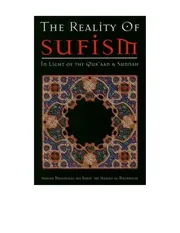
Learn Islam Pdf English Book The Reality Of Sufism In Light Of Al Quran Sunnah Syeikh Al Madkhalee
 80
80

Learn Islam Pdf English Book The Reality Of Sufism In Light Of Al Quran Sunnah Syeikh Al Madkhalee



Marcus Thorne (Esoteric Sciences Reviewer) — 'The Reality of Sufism' offers a rare and deeply insightful exploration into the mystical heart of Islam. Syeikh Al Madkhalee masterfully navigates the intricate pathways of Sufi thought, elucidating complex spiritual concepts with clarity and profound wisdom. This text is indispensable for anyone seeking to understand the esoteric dimensions of the faith, revealing the sacred interplay between divine revelation and the cultivated inner life. Its strength lies in its unwavering adherence to Quranic and Sunnah principles, providing a robust foundation for genuine spiritual practice. Highly recommended for scholars and serious practitioners of Islamic mysticism.
📝 Description
80
This book, 'The Reality of Sufism', discusses Sufi concepts as understood by Syeikh Al Madkhalee.
Written from the perspective of Syeikh Al Madkhalee, this book addresses the nature of Sufism in relation to Islamic scripture. It aims to clarify specific aspects of Sufi practice and belief, referencing the Quran and Sunnah as primary sources. The text seeks to explain the esoteric dimensions of this spiritual tradition for readers interested in a deeper understanding of Islamic mysticism.
The book focuses on the inner realities and symbolic language associated with Sufism. It encourages contemplation and personal reflection on faith. The author intends to guide readers who wish to move beyond superficial religious observance toward a more substantial spiritual connection. It examines the philosophical foundations that have influenced Sufi thought and practice over time, speaking to those on a path of spiritual growth.
This work engages with the esoteric tradition within Islam, commonly known as Sufism or Tasawwuf. It specifically addresses the reality of Sufism, a subject that has been interpreted in various ways throughout Islamic history. By grounding its discussion in the Quran and the Sunnah, the book positions itself within a specific scholarly approach to understanding Sufi concepts. This approach seeks to reconcile mystical practices and experiences with the foundational texts of Islam, distinguishing it from other interpretations of Sufism.
💡 Why Read This Book?
This book is essential for seekers of divine truth yearning for a deeper, esoteric understanding of Islam. It provides a direct pathway into the profound spiritual practices and philosophical insights of Sufism, firmly anchored in the Quran and Sunnah. Ideal for scholars investigating Islamic mysticism, practitioners seeking authentic guidance, and anyone drawn to the contemplative and transformative aspects of faith.
⭐ Reader Reviews
Honest opinions from readers who have explored this book.
❓ Frequently Asked Questions
What is Sufism?
Sufism, or Tasawwuf, is the mystical dimension of Islam, focused on the purification of the heart and the direct experience of divine love and presence. It emphasizes inner spiritual development and the pursuit of spiritual perfection.
What is the relationship between Sufism and the Quran/Sunnah?
This book emphasizes that authentic Sufism is intrinsically linked to the Quran and the authentic teachings and practices of Prophet Muhammad (Sunnah). It seeks to embody the spiritual essence found within these foundational texts.
Who is Syeikh Al Madkhalee?
Syeikh Al Madkhalee is presented as an authority whose teachings illuminate the reality of Sufism, grounding it firmly in Islamic scripture and tradition, offering a scholarly and spiritual perspective.
Is this book suitable for beginners?
While offering profound insights, the book's focus on esoteric themes may be best appreciated by those with a foundational understanding of Islam or a strong inclination towards spiritual exploration.
Where can I find this book?
This book is available in PDF format, often accessible through reputable Islamic libraries and online resources dedicated to spiritual and esoteric literature.
🔮 Key Themes & Symbolism
The Divine Presence (Hudur)
This theme examines the Sufi concept of 'Hudur,' the constant awareness and experiential presence of God. It explores how the practice of remembrance (dhikr) and contemplation allows the seeker to transcend the mundane and perceive the divine reality pervading all existence. The text illuminates the inner journey of the heart as the primary locus for experiencing this profound spiritual state, moving beyond intellectual assent to direct, felt connection.
Purification of the Heart (Tazkiyat al-Nafs)
Central to Sufism is the rigorous process of 'Tazkiyat al-Nafs,' the purification of the soul. This theme examines the spiritual diseases of the ego (nafs) such as pride, envy, and greed, and the methods prescribed by the Quran and Sunnah for their eradication. It details practices aimed at cultivating virtues like sincerity, humility, patience, and gratitude, leading to a heart that is a pure mirror reflecting divine light.
The Path of Love (Mahabbah)
This section explores the paramount role of divine love ('Mahabbah') in the Sufi path. It elucidates how love for God is not merely an emotion but a transformative force that drives the seeker's spiritual progress. Drawing from scriptural sources, it highlights how sincere love for the Creator fosters compassion for all creation and inspires a life dedicated to service and spiritual realization.
💬 Memorable Quotes
Direct passages from the work, attributed to the author.
“True knowledge is not in books, but in the heart.”
— This highlights the esoteric nature of Sufi wisdom, suggesting that experiential understanding and divine inspiration are more profound than mere intellectual accumulation of information.
“In remembrance, the veil thins.”
— This speaks to the power of 'dhikr' (remembrance of God) in spiritual practice, implying that consistent invocation gradually dissolves the barriers separating the seeker from the Divine.
“The path is paved with patience and sincerity.”
— This underscores the essential virtues required for spiritual progress, emphasizing that the journey requires steadfastness through trials and an unadulterated intention towards the Divine.
💡 Key Ideas
Editorial paraphrase of the work's core concepts — not direct quotes.
The heart is a mirror, polish it daily.
This quote emphasizes the Sufi practice of spiritual discipline, where the heart, like a mirror, must be kept free from the rust of worldly distractions and egoic desires to reflect divine truths.
Seek God within, not without.
A fundamental Sufi principle, this quote directs the seeker's focus inward, indicating that the divine presence is not an external entity to be found, but an inner reality to be realized.
🌙 Esoteric Significance
Tradition
This work is deeply rooted in the Sunni Islamic esoteric tradition of Sufism (Tasawwuf). It specifically aligns with the mainstream Sufi understanding that emphasizes adherence to the Quran and the Sunnah of Prophet Muhammad as the primary sources for spiritual guidance and practice, distinguishing it from heterodox or syncretic interpretations.
Symbolism
The text likely employs rich Islamic symbolism, such as the Kaaba representing the heart, the call to prayer signifying divine invitation, and light (Nur) symbolizing divine illumination. Concepts like the 'nafs' (ego) as a veil and the 'ruh' (spirit) as the divine spark are explored metaphorically, guiding the reader to understand abstract spiritual states through concrete imagery derived from scripture and tradition.
Modern Relevance
In an age often characterized by materialism and spiritual disconnection, 'The Reality of Sufism' offers a timeless antidote. It provides a framework for achieving inner peace, cultivating compassion, and fostering a profound sense of purpose through direct spiritual experience, making the wisdom of Islamic mysticism accessible and relevant to contemporary seekers of truth and meaning.
👥 Who Should Read This Book
This book is an invaluable resource for a diverse audience. **Beginners** with a sincere interest in the spiritual depths of Islam will find a clear and grounded introduction to Sufism. **Scholars** of comparative religion and Islamic studies will appreciate its rigorous adherence to scripture and its nuanced exploration of mystical concepts. **Seekers** of spiritual enlightenment, regardless of their background, will find profound wisdom and practical guidance for inner transformation. **Practitioners** of Islamic spirituality, including those already engaged in Sufi paths, will benefit from its authoritative articulation and reinforcement of core principles.
📜 Historical Context
The development of Sufism as a distinct mystical tradition within Islam emerged in the early centuries of the Islamic era, particularly gaining prominence during the Abbasid Caliphate (8th-13th centuries CE). This period saw a flourishing of intellectual and spiritual inquiry, as scholars and ascetics sought to deepen their understanding of the faith beyond jurisprudence and theology. The movement was a direct response to the perceived materialism and political complexities of the time, offering a refuge in spiritual introspection and direct communion with the Divine. Sufi masters synthesized Quranic teachings, prophetic traditions, and contemplative practices, creating a body of spiritual disciplines. Despite occasional controversies and debates with more literalist interpretations of Islam, Sufism became deeply interwoven with the fabric of Islamic civilization, influencing art, poetry, philosophy, and the daily spiritual lives of millions across the Muslim world. This book aims to present this rich heritage in a manner consistent with its scriptural roots.
📔 Journal Prompts
Reflect on a moment when you felt a deep sense of connection to something greater than yourself. How can the practices discussed in this book help you cultivate that feeling more consistently?
What aspects of your 'nafs' (ego) do you feel are currently hindering your spiritual progress? How can you apply the principles of purification discussed in the text to address these challenges?
Consider the concept of divine love ('Mahabbah'). How does this theme resonate with your personal understanding of faith and your relationship with the Divine?
The book emphasizes the heart as a mirror. What 'rust' or impurities do you believe are obscuring your heart's reflection of divine truth, and what daily practices can you implement to polish it?
How can the practice of 'dhikr' (remembrance of God) be integrated into your daily life beyond formal prayer, and what benefits do you anticipate from such integration?
🗂️ Glossary
Tasawwuf
The Arabic term for Sufism, referring to the mystical and esoteric dimension of Islam focused on the purification of the heart and the pursuit of divine knowledge and presence.
Nafs
The ego or lower self, often characterized by desires, inclinations, and negative attributes. Sufism emphasizes its purification and subjugation to achieve spiritual growth.
Dhikr
The remembrance of God, often through repetitive recitation of divine names or phrases. It is a central practice in Sufism for cultivating spiritual awareness and closeness to the Divine.
Sunnah
The practices, sayings, and approvals of the Prophet Muhammad, serving as a secondary source of Islamic law and guidance after the Quran.
Hudur
A state of spiritual presence and awareness of God. It signifies the seeker's direct experiential connection with the Divine, transcending ordinary consciousness.
This book appears in 2 collections
🔮 Readers Also Liked
Browse all →







From the “Christian Mysticism” Collection
View all →








More Free Mysticism & Contemplation Books
View all →