The Occult Sciences - Witchcraft and Low Magic
 74
74

The Occult Sciences - Witchcraft and Low Magic
The republication of this early 20th-century compendium on witchcraft and low magic offers a direct portal into a specific historical moment of occult inquiry. Its strength lies in its comprehensive scope, cataloging a wide array of practices from spellcraft to spirit summoning with an earnest, if somewhat dated, academic tone. The inclusion of historical records and visual illustrations, as referenced in the original blurb, provides a grounding in material culture often missing in more theoretical works. However, the work’s limitation is its inherent perspective; written from within the early 1900s, it reflects the biases and understandings of that era, which may not align with contemporary scholarship or practice. A particular passage discussing the 'symbolism' of common charms, while detailed, presumes a universal interpretation that modern critical analysis would question.
This volume serves as a valuable, albeit period-specific, historical document for the dedicated student of magical traditions.
📝 Description
74
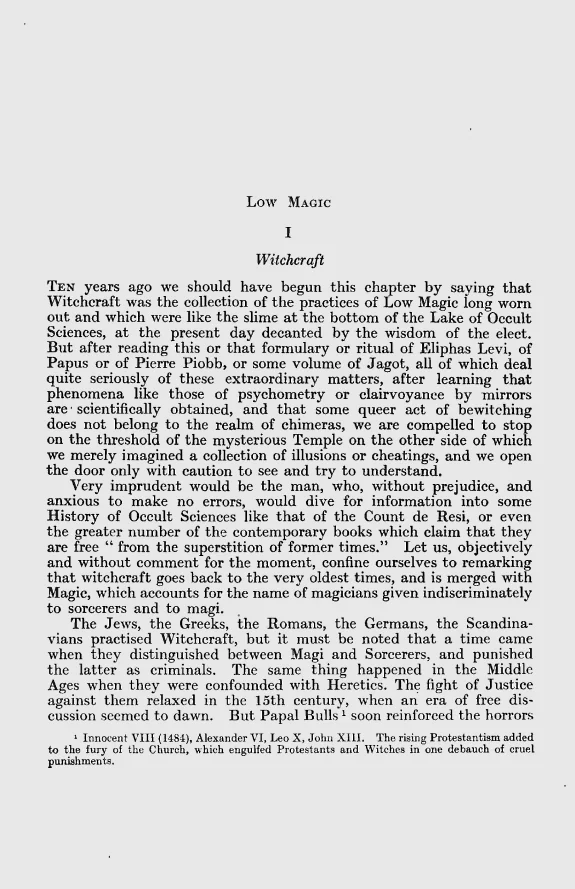
Published in the early 20th century, this volume examines witchcraft and low magic.
This volume republishes an early 20th-century study on witchcraft and low magic. It offers a survey of historical and contemporary views on these practices, as understood at the time of its original writing. The book is richly illustrated, with images complementing the text on occult traditions. Scholars of folklore, occult history, and comparative religion will find it a valuable primary source. Practitioners looking for historical context for their craft, and general readers interested in the cultural history of magic, will also find its detailed approach useful. It is especially suited for those who appreciate archival material and historical scholarship.
The work was published during a period of significant occult revival and academic interest in folklore. This era saw figures like Aleister Crowley and Arthur Machen engaging with similar themes. The book uses early anthropological methods to examine magical beliefs, distinguishing itself from earlier spiritual interpretations and later secular analyses. It systematically covers core elements of witchcraft and low magic, such as historical witchcraft accusations, spell construction, beliefs about luck and fortune, the meaning of symbols, and spirit calling. The text also addresses how magic evolved and adapted in the modern era.
This work emerged during the early 1900s, a time when Western esotericism saw a surge in both academic study and popular fascination. It reflects the era's engagement with occult revival movements and the nascent application of anthropological methods to folklore and magical practices. Unlike purely spiritualist interpretations or later secular scholarship, this book grounds its examination in historical accounts and practical applications of witchcraft and low magic, situating it within a specific moment of scholarly inquiry into these traditions.
💡 Why Read This Book?
• Gain insight into the structure of early 20th-century magical discourse by examining the book's section on 'modern magic,' understanding how practitioners viewed their evolving art. • Explore historical records of witchcraft, as presented in the text, to compare documented accusations and beliefs with contemporary occult theory and practice. • Understand the foundational concepts of low magic, including specific spell structures and the symbolism of common charms, directly from a primary source predating widespread esoteric literature.
⭐ Reader Reviews
Honest opinions from readers who have explored this book.
❓ Frequently Asked Questions
What specific types of spells are detailed in 'The Occult Sciences - Witchcraft and Low Magic'?
The book details various spells, including those for luck, protection, and influencing outcomes. It also covers the construction and application of magical formulae, reflecting early 20th-century understandings of practical magic.
Does the book discuss the historical persecution of witches?
Yes, 'The Occult Sciences' includes a section on 'Witchcraft and its records,' which addresses historical accounts and perceptions of witchcraft, offering insight into early 1900s interpretations of these events.
What is the significance of 'low magic' as presented in this text?
The text distinguishes 'low magic' from higher, more spiritual or ceremonial forms, focusing on practical, often folk-based, applications such as charms, curses, and spells intended for immediate, tangible results.
Are there illustrations in this republication?
The original publication from the early 1900s was illustrated, and this republication aims to preserve those visual elements, offering a richer understanding of the subject matter through images alongside text.
What era does 'The Occult Sciences' primarily cover regarding witchcraft?
While the book discusses historical records, its perspective and analysis are rooted in the early 1900s. It examines both ancient lore and contemporary (for the time) practices and beliefs surrounding witchcraft.
Can this book help understand modern witchcraft practices?
It provides essential historical context. By examining the 'modern magic' section and the treatment of spells and symbolism from the early 20th century, readers can trace the evolution of magical thought.
🔮 Key Themes & Symbolism
Historical Witchcraft Records
This section looks at the historical documentation and societal perceptions of witchcraft as understood in the early 20th century. It examines case studies and folklore, presenting a view of witchcraft that blends scholarly inquiry with the prevailing occult interests of the era. The work aims to catalogue and analyze the 'records' of witchcraft, providing context for both its perceived historical prevalence and its symbolic meaning within occult traditions.
The Art of Spellcraft
The book meticulously details the mechanics and philosophy behind spellcasting, encompassing both 'low magic' and broader applications. It explores the structure of spells, the importance of intent, and the use of various materials and incantations. This theme addresses the practical execution of magical workings, offering insights into how spells were conceived and employed by practitioners during the period of the original publication.
Symbolism and Its Application
Central to the work is an exploration of symbolism within occult practices. This theme examines how various signs, objects, and natural elements are imbued with magical significance and how this symbolism is utilized in rituals, spells, and general magical understanding. The text highlights the interpretive layer of magic, where mundane items gain power through their symbolic associations.
Spirit Calling and Modern Magic
The volume addresses the practice of summoning or communicating with spirits, a significant aspect of occult traditions. Alongside this, it surveys the range of 'modern magic' as it existed in the early 1900s, discussing how established practices were being adapted or reinterpreted. This theme reflects the dynamic nature of occultism, constantly evolving with new ideas and societal changes.
💬 Memorable Quotes
Direct passages from the work, attributed to the author.
“The work explores the recording of witchcraft and its historical documentation.”
— This highlights the book's focus on presenting a catalog of historical accounts and perceived evidence related to witchcraft, framing it as a subject for study and analysis.
“Spells are examined for their construction and application in achieving specific outcomes.”
— This emphasizes the practical, technical aspect of magic discussed in the book, focusing on the 'how-to' of spellcasting rather than purely theoretical considerations.
“Luck and its manipulation through magical means is a recurring subject.”
— This points to the book's engagement with the more common, everyday magical desires and practices, suggesting an interest in influencing chance and fortune.
“The symbolism inherent in occult practices is a key area of investigation.”
— This indicates the book's attention to the deeper meanings and coded language within magical traditions, suggesting that understanding symbols is crucial for comprehending occult systems.
“Spirit calling is presented as a distinct practice within the broader occult sciences.”
— This signifies the inclusion of necromancy or mediumship-related practices, positioning them as a specific, verifiable branch of occult study within the text's framework.
🌙 Esoteric Significance
Tradition
This work fits within the broader Western Esoteric Tradition, specifically touching upon folk magic and witchcraft, which often intersects with Hermeticism and pre-Christian European magical practices. It acts as a bridge, documenting traditions that might exist outside formalized schools like Theosophy or Kabbalah, yet shares the foundational belief in underlying magical forces and correspondences.
Symbolism
The book likely explores symbols such as the pentagram, various amulets, and natural elements like herbs and stones, assigning them specific meanings within the context of spellcraft and protection. The symbolism of luck, often represented by four-leaf clovers or specific numbers, would also be a focus, illustrating how mundane objects are imbued with occult power.
Modern Relevance
Contemporary practitioners of witchcraft, particularly those interested in historical witchcraft and folk magic, draw on texts like this for foundational knowledge. Modern occultists studying comparative magic or seeking to understand the lineage of current practices find value in these early 20th-century compilations of lore and technique.
👥 Who Should Read This Book
• Students of Western Esotericism: Those researching the evolution of magical practices and beliefs from the early 1900s will find this a valuable primary source. • Folklorists and Anthropologists: Researchers interested in historical magical traditions, witchcraft lore, and the cultural context of spells and charms will benefit from its detailed accounts. • Aspiring Practitioners of Low Magic: Individuals seeking to understand the historical foundations and techniques of practical, folk-based magic will find concrete examples and explanations.
📜 Historical Context
Published in the early 1900s, 'The Occult Sciences' emerged during a period of intense esoteric revival in Europe and North America. This era saw organizations like the Hermetic Order of the Golden Dawn and figures such as Aleister Crowley pushing the boundaries of ceremonial magic and occult philosophy. The work engages with this milieu by cataloging traditions often seen as more folkloric or 'low magic,' contrasting with the more structured, high-magic systems gaining prominence. Its approach, focusing on witchcraft and practical spellcraft, likely resonated with a growing public fascination fueled by anthropological discoveries and a spiritual reaction against industrialization. While specific reception details are scarce for this particular republication's source, similar texts from the period were often met with both avid interest from occult societies and skepticism or condemnation from mainstream religious and academic circles. Contemporaries like Montague Summers, though often critical, were also documenting similar historical aspects of witchcraft.
📔 Journal Prompts
Reflect on the concept of 'low magic' as distinct from ceremonial practices.
Analyze the symbolism of common charms discussed in the text.
Consider the historical records of witchcraft presented and their potential biases.
Examine the structure of spells detailed in the book.
Contemplate the practice of spirit calling as described.
🗂️ Glossary
Low Magic
Refers to magical practices focused on immediate, practical, and often mundane results, such as influencing luck, casting simple spells, or creating charms, as opposed to more complex ceremonial or spiritual magic.
Spells
A set of words, actions, or rituals performed with the intention of producing a magical effect, often involving specific ingredients, timing, and incantations.
Luck
In an occult context, luck refers to fortune or chance, often believed to be influenced or manipulated through magical means, charms, or rituals.
Symbolism
The use of objects, images, or actions to represent abstract ideas or occult principles, fundamental to understanding magical languages and rituals.
Spirit Calling
The practice of attempting to communicate with, summon, or invoke spirits, entities, or deceased individuals for information, assistance, or other purposes.
Witchcraft Records
Historical accounts, testimonies, or documentation pertaining to the beliefs, practices, and alleged activities of individuals identified as witches.
Modern Magic
As perceived in the early 20th century, this refers to the contemporary (for the time) evolution, adaptation, or reinterpretation of magical practices and occult theories.
This book appears in 1 collection
🔮 Readers Also Liked
Browse all →







From the “Low Magic” Collection
View all →








More Free Magic & Ritual Books
View all →