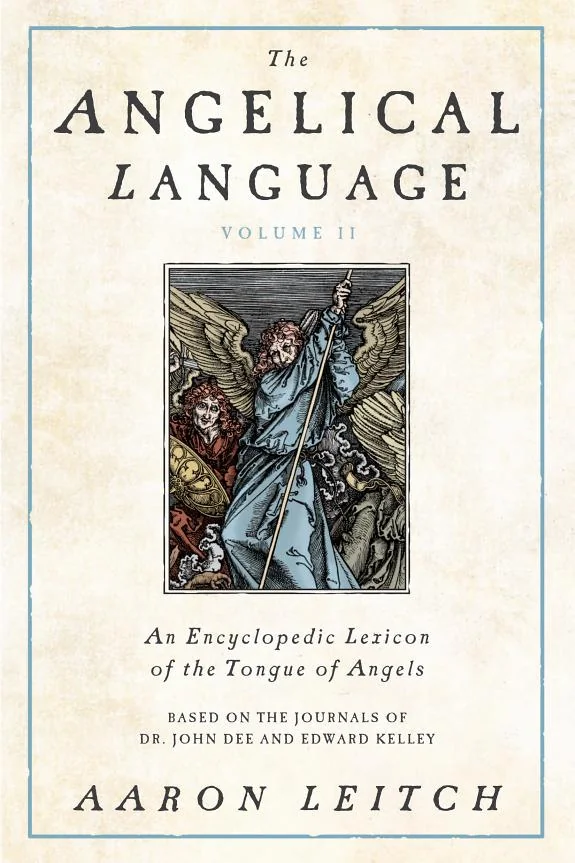
The Angelical Language, Volume II
 71
71

The Angelical Language, Volume II
Aaron Leitch’s *The Angelical Language, Volume II* is a formidable achievement in scholarly occultism, presenting a level of detail concerning John Dee’s Enochian language that has remained unmatched since its initial publication. Leitch’s meticulous cross-referencing of Dee’s diverse manuscripts—from his public journals to his private grimoire—provides an unparalleled resource. The book’s strength lies in its systematic approach, moving beyond mere transliteration to offer grammatical analysis and practical usage guidelines, a crucial step for anyone seeking to engage with the language beyond academic curiosity. A potential limitation for some readers might be the sheer density of the material; this is not a casual introduction but a serious academic text requiring dedicated study. The section detailing the phonemic values of specific Angelical letters, linking them to Dee's own notations, exemplifies the book's rigorous scholarship. Ultimately, this volume serves as an indispensable, if demanding, key to unlocking one of Western esotericism's most complex linguistic systems.
📝 Description
71
Aaron Leitch's 2010 study provides the second volume on John Dee's Angelical language.
This volume is the second part of Aaron Leitch's comprehensive examination of John Dee's Angelical language. Published in 2010, it functions as both a detailed lexicon and a practical manual for the angelic communication system developed by the Elizabethan magician.
Leitch's work meticulously scrutinizes every Angelical word found in Dee's original manuscripts, including his private grimoire. It improves upon and corrects previous research, offering a thorough resource for understanding the structure, grammar, and usage of this distinct magical language. The book is intended for serious students and practitioners of Western esotericism, especially those focused on John Dee's traditions and the Enochian system.
It caters to readers who desire not only academic comprehension but also the capability to actively use the language in their own ritual work. Individuals interested in comparative linguistics within magical frameworks or the history of occult cryptography will also find substantial benefit in this text. Leitch's analysis situates this linguistic system within the broader context of Renaissance magical philosophy and the era's intense interest in angelic hierarchies and divine knowledge.
The Angelical language, also known as Enochian, originated from the scrying sessions of John Dee and Edward Kelley in the late 16th century. Dee, a prominent mathematician and advisor to Queen Elizabeth I, claimed to receive communications from angelic beings. This linguistic system is analyzed within the broader currents of Renaissance hermeticism and the period's fascination with angelic hierarchies and access to divine knowledge. Leitch's study applies scholarly rigor to this unique corpus, addressing a long felt need in the study of Western esotericism.
💡 Why Read This Book?
• You will learn the precise grammatical rules and phonetic structures of the Angelical language as meticulously documented in John Dee's original manuscripts, allowing for accurate pronunciation and sentence construction unavailable in simpler glossaries. • You will gain practical instruction on how to employ the Angelical language in ritualistic contexts, moving beyond theoretical understanding to active engagement with the system Dee and Kelley developed in the late 16th century. • You will receive corrected and expanded interpretations of Angelical words and phrases, directly addressing discrepancies found in earlier publications and providing a more reliable lexicon for practitioners of Enochian magic.
⭐ Reader Reviews
Honest opinions from readers who have explored this book.
❓ Frequently Asked Questions
What is the primary focus of The Angelical Language, Volume II?
This book provides a comprehensive linguistic analysis and practical guide to John Dee's Angelical (Enochian) language, meticulously detailing its vocabulary, grammar, and usage based on Dee's original 16th-century manuscripts.
How does this volume differ from other books on the Enochian language?
Unlike basic word lists, Volume II offers an encyclopedic breakdown of every recorded Angelical word, correcting and expanding upon previous research, and is designed for actual practical application in magical work.
Who is Aaron Leitch, and what is his expertise?
Aaron Leitch is a respected scholar and practitioner of Western esotericism, known for his in-depth research into magical languages and systems, particularly the work of John Dee.
When was The Angelical Language, Volume II first published?
The book was first published in 2010, building upon decades of scholarly research into John Dee's occult legacy.
Can a beginner use this book to learn the Angelical language?
While comprehensive, the book is dense and best suited for serious students of esotericism. Beginners may find it challenging without some prior familiarity with John Dee's work or occult linguistics.
What specific manuscripts does the book reference?
It references John Dee's extensive collection of manuscripts, including his public journals, private grimoire, and other documents detailing his interactions with Edward Kelley and the reception of the Angelical language.
🔮 Key Themes & Symbolism
Enochian Linguistic Structure
This volume meticulously reconstructs the grammar and syntax of the Angelical language, presenting it as a fully formed linguistic system derived from John Dee's 16th-century communications. Leitch details the phonetic values, word formations, and sentence structures, moving beyond simple vocabulary lists. The work emphasizes the inherent logic within the language, suggesting it was not merely random utterances but a coherent system designed for communication with angelic intelligences, as recorded in Dee's grimoires.
Practical Application in Ritual
A central aim of this book is to equip practitioners with the knowledge to actively use the Angelical language in their magical workings. Leitch provides guidance on pronunciation, intonation, and the contextual application of specific words and phrases, particularly the 49 Angelic Keys. The goal is to enable users to replicate, with greater accuracy, the ritualistic practices associated with Dee and Edward Kelley, fostering a direct engagement with the angelic realms.
Corpus of John Dee's Work
The book is built upon an exhaustive examination of the primary source materials – John Dee's vast collection of manuscripts detailing his occult experiments. Leitch meticulously cross-references entries from Dee's journals and his personal grimoire, ensuring that every recorded Angelical word is accounted for. This comprehensive approach corrects and expands upon earlier interpretations, offering a definitive scholarly resource for understanding Dee's unique system.
Historical Esoteric Context
Leitch situates the Angelical language within the intellectual and spiritual milieu of Elizabethan England, connecting it to Renaissance Hermeticism and the era's fascination with angelic hierarchies. The work explores how Dee's linguistic discoveries represented a significant, albeit esoteric, development in Western magical traditions. By analyzing the language's origins and Dee's purported methods, the book illuminates a critical period in the evolution of occult philosophy and practice.
💬 Memorable Quotes
Direct passages from the work, attributed to the author.
“Every Angelical word recorded in Dee's books, journals, and personal grimoire is recorded and cross-referenced.”
— This statement highlights the book's encyclopedic scope, emphasizing its role as a definitive compilation and analytical tool for the entirety of known Angelical vocabulary derived directly from John Dee's primary sources.
“This masterwork is the most comprehensive analysis of John Dee's Angelical language ever undertaken.”
— This interpretation underscores the book's ambition and success in surpassing previous scholarship, positioning it as the preeminent resource for detailed study and practical engagement with the Enochian language.
“It is designed so readers can actually learn the language and use it in their own magick.”
— This signifies the book's dual nature: academic rigor combined with practical usability. It moves beyond theoretical discussion to offer a functional guide for practitioners seeking to integrate the Angelical language into their ritualistic practices.
“expands upon (and corrects) previously published information.”
— This points to the critical and revisionist nature of Leitch's work, indicating that it actively engages with and refines existing knowledge, offering a more accurate and complete understanding of the Angelical language than prior studies.
“Most Enochian dictionaries merely present word lists.”
— This phrase establishes the book's unique value proposition by contrasting its detailed analytical approach with the superficiality of simpler glossaries, emphasizing its depth in grammar and linguistic structure.
🌙 Esoteric Significance
Tradition
The Angelical language is a central to modern Enochian magic, a distinct branch within Western Esotericism. While drawing inspiration from Kabbalistic angelology and Hermetic principles, it presents a unique angelic cosmology and linguistic system supposedly revealed directly from angelic beings. It departs from purely textual traditions by emphasizing direct experiential reception and the use of a divinely inspired language as a tool for spiritual ascent and communication with higher intelligences.
Symbolism
Central to the Angelical language are the concepts of the 49 Angelic Keys, each representing a specific invocation or divine attribute. The language itself, with its unique script and phonetic structure, symbolizes a primordial or pure form of communication, untainted by earthly corruption. The act of speaking or writing in Angelical is intended to bridge the terrestrial and celestial realms, acting as a conduit for divine energy and knowledge, echoing Hermetic ideas of correspondence between macrocosm and microcosm.
Modern Relevance
Contemporary practitioners of chaos magic, ceremonial magic, and Golden Dawn-derived systems frequently incorporate elements of Enochian magic derived from Dee's work. Thinkers and magicians influenced by Aleister Crowley, who extensively studied and adapted Dee's system, continue to explore its potential. Leitch's work provides a crucial, updated resource for these modern practitioners seeking a deeper, more accurate understanding of the language's structure and application.
👥 Who Should Read This Book
• Students of John Dee and Elizabethan occultism seeking a scholarly yet practical resource to understand the linguistic foundations of his magical system. • Practitioners of ceremonial magic and Western Esotericism interested in learning and utilizing the Angelical (Enochian) language for ritualistic purposes. • Researchers of comparative linguistics within esoteric traditions or scholars of historical cryptography looking for an in-depth analysis of a unique, purportedly divinely revealed language.
📜 Historical Context
The late 16th century, the period of John Dee's purported angelic communications, was a fertile ground for occult inquiry, deeply embedded within Renaissance Hermeticism and Neoplatonism. Dee, a respected mathematician and advisor to Queen Elizabeth I, operated within a world where magic, science, and religion were not rigidly separated. His work with Edward Kelley, which produced the Angelical language, occurred during a time when figures like Giordano Bruno were exploring cosmic theories and paracelsianism was influencing alchemical thought. While Dee's contemporaries explored various forms of divination and natural magic, the systematic, complex linguistic system he developed stood apart. The reception of Dee's work was often complex; while influential in esoteric circles, its more public aspects sometimes drew suspicion. Leitch's analysis, published centuries later in 2010, addresses the need for scholarly rigor concerning this unique linguistic and magical corpus.
📔 Journal Prompts
The grammatical structure of the Angelical Keys.
Phonetic values of specific Angelical letters.
The relationship between the Angelical script and its English translation.
The practical application of an Angelic Key in a personal ritual.
Dee's methodology for recording Angelical communications.
🗂️ Glossary
Angelical Language
Also known as Enochian, this is a complex system of words, grammar, and script purportedly received by John Dee and Edward Kelley through angelic communication in the late 16th century.
Enochian Keys
The 49 primary 'calls' or invocations within the Angelical language, believed to be fundamental for communicating with specific angelic beings and accessing spiritual realms.
John Dee
A prominent Elizabethan mathematician, astronomer, geographer, and advisor to Queen Elizabeth I, who extensively documented his alleged angelic communications and the Angelical language.
Edward Kelley
The scryer and assistant to John Dee, credited with receiving the Angelical language and script through Dee's spiritual invocation sessions.
Grimoire
A textbook of magic or ceremonial magic, typically containing instructions on spell-casting, potion-making, and the invocation of spirits. Dee possessed a personal grimoire containing Angelical material.
Renaissance Hermeticism
An intellectual and spiritual movement during the Renaissance, drawing upon the purported teachings of Hermes Trismegistus, emphasizing divine knowledge, magic, and the interconnectedness of the cosmos.
Enochian Script
The unique alphabet associated with the Angelical language, visually distinct from Latin script and believed by Dee to be the original form of the angelic tongue.
This book appears in 1 collection
🔮 Readers Also Liked
Browse all →








From the “Enochian Magic” Collection
View all →





More Free Magic & Ritual Books
View all →