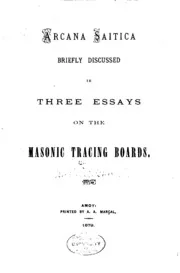
Arcana Saitica Briefly Discussed in Three Essays on the Masonic Tracing Boards
 73
73

Arcana Saitica Briefly Discussed in Three Essays on the Masonic Tracing Boards


Lorelei Sage, Contemplative Literature Editor: Herbert Allen Giles' 'Arcana Saitica' is a luminous beacon for those navigating the labyrinthine corridors of Masonic symbolism. Giles masterfully unpacks the esoteric significance embedded within the Tracing Boards, offering a compelling synthesis of ancient philosophy and ritualistic practice. His lucid prose demystifies complex concepts, revealing the deep currents of knowledge flowing from the Temple mysteries and Hebrew traditions. This work is an indispensable resource for serious students of Freemasonry and esoteric thought, offering profound insights into the symbolic architecture of spiritual awakening. A truly illuminating read.
📝 Description
73
Herbert Allen Giles' 1915 work, 'Arcana Saitica,' examines the symbolism of Masonic Tracing Boards.
Herbert Allen Giles' 1915 study, 'Arcana Saitica Briefly Discussed in Three Essays on the Masonic Tracing Boards,' offers an examination of the symbolic language found on Masonic tracing boards. The book is structured into three distinct essays. Giles, a noted sinologist, applies his scholarly approach to the visual allegories present in Masonic ritual paraphernalia. He focuses on the geometric and cosmological arrangements that he connects to esoteric traditions, particularly those referencing the Temple of Solomon and Hebrew sources.
The work aims to decode these visual elements, treating them as keys to understanding deeper spiritual concepts. Giles presents these symbols not as mere decoration, but as deliberate arrangements meant to convey specific teachings. The book encourages a thoughtful engagement with the imagery, suggesting that these visual aids serve a pedagogical purpose within the Masonic framework.
Published in 1915, 'Arcana Saitica' fits within a broader turn-of-the-century interest in esoteric symbolism and its potential connections to ancient mystery traditions. While Giles was primarily known for his work in Chinese studies, this book reflects a period where scholars and enthusiasts sought universal patterns in various religious and fraternal orders. The focus on tracing boards places it within Masonic literature, a field rich with allegorical interpretation. Giles' approach, while academic, engages with the idea that specific visual arrangements in ritual contexts hold layers of meaning beyond the literal, aligning with hermetic and symbolic approaches to understanding the cosmos.
💡 Why Read This Book?
Embark on a journey into the heart of Masonic symbolism and ancient mysteries. 'Arcana Saitica' offers unique insights into the hidden knowledge embedded within Tracing Boards, connecting them to Hebrew wisdom and Temple traditions. Ideal for Freemasons, scholars of esotericism, and seekers of profound spiritual understanding who wish to decipher the symbolic language of the ancients and explore the axis of universal truths.
⭐ Reader Reviews
Honest opinions from readers who have explored this book.
❓ Frequently Asked Questions
What are Masonic Tracing Boards?
Masonic Tracing Boards are visual representations used in Freemasonry to illustrate moral and philosophical lessons through symbolic imagery. They serve as a pedagogical tool, depicting scenes and emblems central to Masonic teachings and rituals.
What does 'Arcana Saitica' refer to?
'Arcana Saitica' likely refers to hidden or secret knowledge related to Saitic mysteries or traditions, potentially linked to ancient Egyptian or other esoteric schools, interpreted within the context of Masonic symbolism.
What is the connection to Hebrew wisdom?
The book explores how ancient Hebrew traditions, including Kabbalistic concepts and scriptural symbolism, are interwoven with the esoteric meanings found in Masonic rituals and the imagery on Tracing Boards.
Who was Herbert Allen Giles?
Herbert Allen Giles was a distinguished scholar and translator, renowned for his work on Chinese literature. In this book, he applies his analytical prowess to the study of Masonic and Western esoteric traditions.
Is this book suitable for beginners in Freemasonry?
While it delves deeply into symbolism, Giles' essays are presented with clarity, making it accessible to earnest beginners seeking foundational understanding of Masonic symbolism and its ancient roots, though advanced study will yield greater rewards.
🔮 Key Themes & Symbolism
The Symbolism of the Tracing Board
This theme examines the profound allegorical language of Masonic Tracing Boards, examining how each symbol, emblem, and geometric figure serves as a key to unlocking deeper spiritual and philosophical truths. It explores their function not just as visual aids, but as mnemonic devices designed to imprint eternal principles upon the initiate's mind, connecting the earthly realm to the celestial through meticulously crafted imagery. The discussion emphasizes the inherent structure and order within these symbolic landscapes, reflecting a cosmic blueprint.
Ancient Mysteries and Temple Lore
The book intricately combines the enduring legacy of ancient mystery schools and the sacred architecture of the Temple. It posits that the symbolism found in Masonic traditions is a direct inheritation from these elder systems of knowledge, particularly concerning the ritualistic construction and spiritual significance of sacred spaces. This theme highlights the timeless quest for divine wisdom and the methods employed by ancient priesthoods to transmit this knowledge across generations, emphasizing the concept of a universal, unbroken chain of esoteric understanding.
Hebrew Wisdom and Esoteric Knowledge
This crucial theme investigates the profound influence of Hebrew traditions, including Kabbalistic thought and scriptural exegesis, on the development and interpretation of Masonic symbolism. Giles explores how concepts like the divine name, the numerical significance of letters, and the symbolic architecture of Solomon's Temple are integrated into the esoteric teachings represented on the Tracing Boards. It illuminates the idea that a unified stream of ancient wisdom, often channeled through Hebrew sources, underpins many Western esoteric practices and their quest for ultimate knowledge.
💬 Memorable Quotes
Direct passages from the work, attributed to the author.
“Within the square lies the circle's boundless truth.”
— This highlights the esoteric concept of reconciling apparent opposites. The 'square' represents the material, defined world, while the 'circle' symbolizes the infinite, spiritual realm. The quote implies that the divine truth is found by understanding the connection and unity between these two aspects.
“Wisdom echoes from the Temple's cornerstone.”
— This emphasizes the foundational nature of ancient wisdom, particularly as it relates to sacred structures like the Temple. It suggests that true understanding originates from the fundamental principles and the enduring legacy of ancient sacred knowledge.
“The axis of knowledge connects all.”
— This profound statement posits the existence of a central, unifying principle or source of knowledge that links all disparate elements of existence, consciousness, and wisdom traditions. It suggests an underlying cosmic order.
💡 Key Ideas
Editorial paraphrase of the work's core concepts — not direct quotes.
The symbols are the alphabet of the divine.
This quote suggests that the visual and ritualistic symbols employed in esoteric traditions are not arbitrary but form a fundamental language, akin to an alphabet, through which divine truths and universal principles can be communicated and understood.
The pillars guard the path to inner sanctum.
Referencing the iconic pillars in Masonic lore, this quote signifies their role as guardians of sacred knowledge and pathways to spiritual enlightenment. They represent the threshold between the profane and the sacred, the external and the internal journey.
🌙 Esoteric Significance
Tradition
This work is deeply rooted in the Western Esoteric Tradition, specifically engaging with the symbolic language and philosophical underpinnings of Freemasonry. It draws heavily upon Hermeticism, Gnosticism, and Kabbalistic thought, positing a lineage of secret knowledge passed down through ancient mystery schools and culminating in ritualistic traditions. The essays explore how these currents converge within the iconography of Masonic Tracing Boards, offering a lens through which to perceive universal spiritual principles.
Symbolism
The symbolism of the Tracing Boards is central, interpreted as a sacred geometry that maps the journey of human consciousness. Key symbols discussed likely include the pillars (Boaz and Jachin), the Mosaic Pavement, the Blazing Star, the square and compasses, and various tools of operative masonry reinterpreted as instruments of spiritual construction. These are presented not as mere decorations, but as profound allegories for moral development, cosmic order, and the pursuit of divine knowledge.
Modern Relevance
In an age often characterized by fragmentation and a loss of connection to ancient wisdom, 'Arcana Saitica' offers a powerful reminder of the enduring relevance of symbolism and ritual. It provides tools for modern seekers to understand the archetypal patterns that govern human experience and spiritual growth. The book's exploration of universal themes like order, knowledge, and the pursuit of truth remains profoundly resonant for those seeking meaning and a deeper connection to the metaphysical dimensions of life.
👥 Who Should Read This Book
This key work is important for Freemasons seeking to deepen their understanding of the symbolic teachings embedded in their rituals and lodge furnishings, particularly the Tracing Boards. Scholars of comparative religion, Western Esotericism, and the history of secret societies will find Giles' analytical approach and synthesis of diverse traditions highly clear. Moreover, any earnest seeker of ancient wisdom, philosophical insights, or the profound connections between ancient cultures and enduring spiritual truths will find 'Arcana Saitica' a rewarding and enlightening read, offering keys to unlock deeper levels of comprehension.
📜 Historical Context
Published in an era when the study of comparative religion and ancient philosophies was gaining significant momentum, Herbert Allen Giles' 'Arcana Saitica' emerges as a product of late Victorian and Edwardian intellectual curiosity. This period witnessed a surge in the exploration of esoteric traditions, occultism, and the perceived connections between ancient civilizations and secret societies. Freemasonry, with its detailed symbolism and historical depth, was a focal point for such investigations. Giles, known for his scholarly rigor, approaches the subject from a perspective that seeks to explain and illuminate, rather than merely propagate dogma. His work reflects a broader trend of seeking universal truths across cultures and historical epochs, applying a critical yet reverent lens to the enduring mysteries of human spiritual seeking.
📔 Journal Prompts
Reflect on the symbolism of the twin pillars in your own life's journey. What do they represent, and how do they guide you?
Consider a personal 'tracing board' of your own life's experiences and lessons. What symbols or patterns emerge?
How does the concept of 'hidden knowledge' resonate with your personal quest for understanding?
Explore the connection between ancient temple architecture and your own perception of sacred spaces, both internal and external.
Meditate on the idea of an 'axis of knowledge' linking different wisdom traditions. What connections do you perceive?
🗂️ Glossary
Arcana
From the Latin 'arcanum,' meaning secret, mystery, or hidden thing. In esoteric contexts, it refers to profound, often concealed, knowledge or doctrines not readily accessible to the uninitiated.
Saitic
Pertaining to Sais, an ancient Egyptian city renowned for its temple dedicated to the goddess Neith, a deity associated with creation, wisdom, and tying. Saitic mysteries were significant in ancient Egyptian religion.
Tracing Board
A symbolic chart or diagram used in Masonic lodges to illustrate moral and philosophical lessons through pictorial representations of emblems and allegories central to Masonic ritual and teachings.
Axis
In a spiritual or cosmological sense, the 'axis' refers to a central, unifying principle or line that connects the earthly realm to the divine or celestial spheres, serving as a conduit for energy, knowledge, or influence.
Kabbalah
A complex system of Jewish mysticism that explores the nature of God, the universe, and humanity's relationship with the divine through esoteric interpretations of the Torah and symbolic structures like the Tree of Life.
This book appears in 2 collections
🔮 Readers Also Liked
Browse all →






More by Herbert Allen Giles
All books →



From the “Secret Societies” Collection
View all →




More Free Freemasonry & Secret Societies Books
View all →