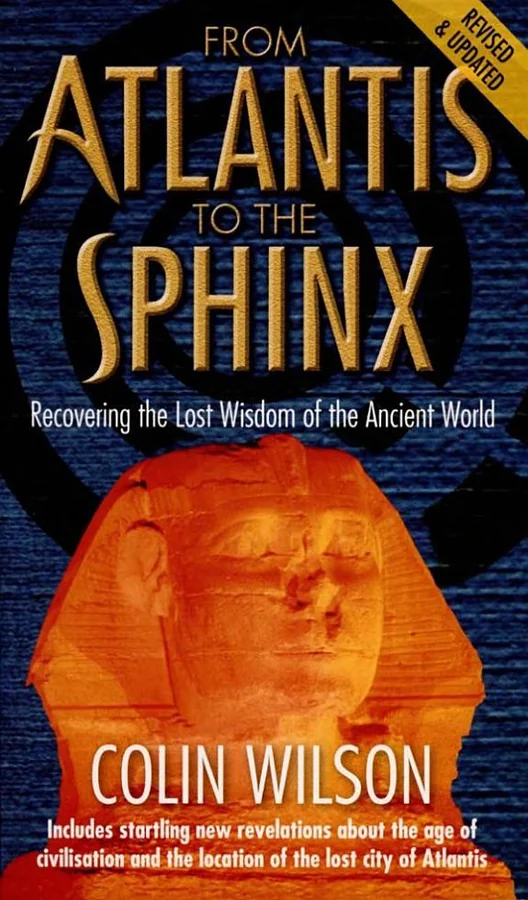
From Atlantis to the Sphinx
 83
83

From Atlantis to the Sphinx
Colin Wilson's "From Atlantis to the Sphinx" is less a rigorous academic treatise and more a sprawling speculative investigation, characteristic of the author's expansive style. He attempts to connect the dots between paleontology, ritual practices, and monumental architecture, positing a lost global esoteric tradition. The book's strength lies in its sheer audacity; Wilson is unafraid to link seemingly disparate phenomena, from the "tortuous interior shafts" of the pyramids to prehistoric American cities. However, this is also its weakness. The connections can feel tenuous, and the lack of strict demarcation between conjecture and established fact can be frustrating for the critical reader. A particularly arresting idea is the exploration of ancient sea maps that allegedly depict Antarctica before its ice cover, suggesting a far older, advanced civilization. While Wilson offers a stimulating overview of historical enigmas, the reader must be prepared to sift through a great deal of conjecture to find the kernels of genuine insight.
📝 Description
83
### What It Is From Atlantis to the Sphinx is Colin Wilson's ambitious exploration of humanity's forgotten knowledge, tracing esoteric traditions and historical anomalies across millennia. Wilson examines evidence ranging from paleontological findings and purported ritual cannibalism to the architectural enigmas of ancient civilizations. The work seeks to reconstruct a lost understanding of the cosmos and human potential, drawing connections between disparate historical and mythological accounts. It questions conventional timelines and accepted narratives, positing a continuous stream of esoteric wisdom.
### Who It's For This book is for readers interested in alternative histories, forgotten civilizations, and the speculative connections between mythology, archaeology, and consciousness. It appeals to those who question mainstream historical interpretations and are drawn to grand theories about ancient knowledge. Individuals fascinated by the mysteries of ancient Egypt, pre-Columbian America, and the potential for lost technologies will find particular interest. It is also for followers of Colin Wilson's broader philosophical inquiries into human potential and the nature of reality.
### Historical Context Published in 2007, From Atlantis to the Sphinx emerged during a period of continued interest in alternative history and esoteric studies, building on the legacy of authors like Graham Hancock and Ignatius Donnelly. Wilson, a prolific writer known for his work on altered states of consciousness and existentialism, applied his characteristic broad-brush approach to ancient mysteries. The book engages with theories concerning the Giza pyramids, ancient sea charts, and the possibility of advanced prehistoric cultures. It exists within a lineage of speculative archaeology that often contrasts with academic consensus, particularly regarding the dating of civilizations and the interpretation of archaeological evidence.
### Key Concepts The book posits the existence of a coherent, ancient global tradition of knowledge, referred to as "Ancient Wisdom." This tradition is presented as the source behind many later religious, philosophical, and mystical systems. Wilson explores how this knowledge may have been preserved through esoteric practices and symbols, often hidden in plain sight within the architecture and myths of ancient cultures. Concepts like the "Great Year" and cyclical views of history are examined, alongside the potential purpose of megalithic structures and their alignment with celestial events. The work suggests that certain anomalies in the historical and archaeological record point to a more complex and sophisticated human past than commonly accepted.
💡 Why Read This Book?
• Understand the speculative connections Colin Wilson draws between the Giza pyramids' interior shafts and potential lost prehistoric technologies, offering a unique perspective on ancient engineering. • Explore the concept of "Ancient Wisdom" as a unifying thread through disparate global myths and megalithic sites, challenging conventional historical timelines. • Consider the implications of alleged ancient sea maps showing Antarctica's pre-ice form, prompting reflection on early cartography and lost polar civilizations.
⭐ Reader Reviews
Honest opinions from readers who have explored this book.
❓ Frequently Asked Questions
What is Colin Wilson's primary thesis in "From Atlantis to the Sphinx"?
Wilson's central argument is that a sophisticated "Ancient Wisdom" existed globally in prehistory, influencing later civilizations. He seeks to reconstruct this lost knowledge through examination of archaeological anomalies, mythology, and esoteric practices.
What kind of evidence does Wilson use to support his theories?
He draws on a wide array of evidence, including paleontological findings, interpretations of ritual cannibalism, the architecture of the pyramids, ancient sea charts, and myths from various cultures worldwide.
Does the book discuss the construction of the pyramids?
Yes, "From Atlantis to the Sphinx" specifically examines the structure of the pyramids and speculates on the purpose of their complex interior shafts, suggesting they held esoteric or technological significance.
Are there any connections made to prehistoric American civilizations?
Indeed, the book traverses to prehistoric cities in America, linking them thematically and chronologically to the broader narrative of lost ancient knowledge and global connections.
When was "From Atlantis to the Sphinx" first published?
The book was first published in 2007, making it a later work in Colin Wilson's extensive bibliography, reflecting his continued engagement with esoteric and historical mysteries.
What is the significance of the Sphinx in the book's title?
The Sphinx, like the pyramids, serves as a symbol of ancient mystery and enduring wisdom. Its presence in the title signals the book's deep dive into the enigmas of ancient Egypt and their connection to global esoteric traditions.
🔮 Key Themes & Symbolism
The Unified Ancient Wisdom
Wilson posits a singular, coherent body of "Ancient Wisdom" that predates recorded history, influencing all subsequent major civilizations. This knowledge encompassed cosmology, human potential, and the underlying structure of reality. He argues that remnants of this wisdom persist in myths, rituals, and monumental architecture worldwide, suggesting a common source. The book traces this tradition from the possible existence of Atlantis to the enigmatic structures of Egypt and the Americas, suggesting a global network of ancient understanding.
Architectural Enigmas and Purpose
The book dedicates significant attention to the architectural mysteries of ancient sites, particularly the Giza pyramids. Wilson focuses on the purpose behind their complex internal shafts and chambers, suggesting they were not merely tombs but part of a larger esoteric or technological system. He connects these structures to celestial alignments and potentially lost scientific knowledge, questioning conventional archaeological interpretations and proposing advanced capabilities for ancient builders.
Paleontology and Early Human Consciousness
Wilson integrates findings from paleontology and anthropology, including controversial theories about ritual cannibalism, to explore the development of early human consciousness and its connection to esoteric practices. He suggests that these early forms of ritual and belief were not primitive superstitions but contained seeds of the later "Ancient Wisdom." This perspective challenges the linear progression of human intellectual and spiritual development, positing a more complex and perhaps cyclical journey.
Lost Cartography and Prehistoric Geography
A striking element of the book involves the examination of ancient sea maps, particularly those that purportedly depict Antarctica with its ice-free landmass. Wilson uses this as evidence for a highly advanced prehistoric global civilization with sophisticated navigational skills and knowledge of geography far exceeding current academic understanding. This concept links to theories of a lost Golden Age and suggests a global catastrophe that erased much of this advanced past.
💬 Memorable Quotes
“The purpose of their tortuous interior shafts...”
— This phrase points to Wilson's focus on the hidden functions of ancient structures. He implies these complex internal passageways in places like the Great Pyramid served an esoteric or technological purpose beyond simple burial, hinting at lost sciences or spiritual disciplines.
“Prehistoric cities of America by way of ancient sea maps...”
— This links geographically diverse ancient mysteries. It suggests Wilson sees a common thread between advanced civilizations in the Americas and sophisticated ancient cartography, possibly indicating global contact or a shared root civilization.
“Via paleontology and ritual cannibalism, Wilson's tour through time and space sets out to reconstruct that ancient knowledge.”
— This highlights Wilson's unconventional methodology. He uses seemingly disparate fields like the study of ancient bones and ritual practices as starting points to piece together a grand, lost body of esoteric understanding from humanity's distant past.
“Ancient sea maps apparently showing the outlines of Antarctica before it was covered by ice.”
— This refers to specific, controversial pieces of evidence Wilson examines. The implication is that such maps suggest an advanced civilization with knowledge of geography and polar regions far predating accepted historical timelines.
“Reconstruct that ancient knowledge.”
— This encapsulates the book's core objective. Wilson aims not just to describe ancient mysteries but to actively piece together a lost system of understanding – a coherent body of wisdom he believes underlies human history.
🌙 Esoteric Significance
Tradition
Wilson's work draws broadly from Western esoteric traditions, particularly Hermeticism and Gnosticism, emphasizing a hidden, universal knowledge stream. It aligns with the Theosophical concept of ancient root races and lost wisdom cycles. However, Wilson synthesizes these with existential psychology and theories of consciousness, departing from stricter adherence to any single lineage. His aim is less about preserving a specific tradition and more about revealing a universal, underlying spiritual science accessible through the study of human history and consciousness.
Symbolism
The Sphinx itself is a potent symbol of ancient mystery, guardianship, and the enigmatic nature of hidden knowledge, representing the intersection of human and animal, the conscious and unconscious. The "tortuous interior shafts" of the pyramids symbolize hidden paths to initiation or understanding, representing esoteric knowledge that is not readily apparent. The concept of "Ancient Wisdom" functions as an overarching symbol for a lost, unified truth that Wilson believes is encoded within myths, structures, and human potential.
Modern Relevance
Contemporary thinkers exploring consciousness studies, archaeoastronomy, and speculative history find resonance in Wilson's work. His ideas inform discussions on the nature of intelligence, the potential for lost advanced technologies in antiquity, and the universality of certain archetypal myths. While not always cited directly, his influence can be seen in circles that question mainstream narratives about human origins and societal development, particularly those interested in the psychological and spiritual dimensions of ancient civilizations.
👥 Who Should Read This Book
• Students of comparative mythology and ancient religions seeking connections between global belief systems and potential underlying esoteric truths. • Enthusiasts of speculative archaeology and alternative history interested in challenging conventional timelines and exploring theories of lost advanced civilizations. • Readers of Colin Wilson's broader philosophical works interested in his application of psychological insights to historical enigmas and the study of human potential.
📜 Historical Context
Published in 2007, Colin Wilson's "From Atlantis to the Sphinx" emerged within a vibrant landscape of alternative history and esoteric inquiry, a field he had significantly influenced over decades. This period saw sustained public fascination with topics like ancient astronaut theories, lost continents, and suppressed historical knowledge, often fueled by authors like Graham Hancock. Wilson's work builds upon this, offering his unique synthesis of psychology, philosophy, and speculative archaeology. While academic archaeology largely adheres to established timelines and interpretations, Wilson engaged with competing ideas, particularly those challenging conventional views on the antiquity and capabilities of early civilizations. His approach, characterized by broad connections and a focus on human potential, positioned him as a key figure for readers seeking deeper, more mysterious explanations for historical enigmas, contrasting with more materialist or narrowly focused scholarly pursuits.
📔 Journal Prompts
The purpose of the "tortuous interior shafts" within the pyramids.
Connections between paleontology and the reconstruction of "Ancient Wisdom".
The implications of ancient sea maps depicting Antarctica.
Reconstructing the "Ancient Wisdom" from disparate global myths.
The Sphinx as a symbol of hidden knowledge.
🗂️ Glossary
Ancient Wisdom
Colin Wilson's term for a hypothesized unified body of esoteric knowledge possessed by ancient global civilizations, believed to underlie many subsequent religious and philosophical systems.
Great Year
A concept referring to a long astronomical cycle, often associated with precession, during which celestial configurations repeat. Wilson explores its potential significance in ancient cosmologies and cyclical views of history.
Esoteric Knowledge
Knowledge that is intended for or likely to be understood by only a small number of people with a specialized background or interest, often pertaining to spiritual or mystical matters.
Paleontology
The scientific study of fossil animals and plants, providing insights into prehistoric life. Wilson uses paleontological findings to contextualize theories about early human development and consciousness.
Ritual Cannibalism
The practice of humans eating the flesh of other human beings, often within a ritualistic or ceremonial context. Wilson explores its potential role in early human spiritual development and the transmission of knowledge.
Archaeoastronomy
The study of how people in the past understood and used astronomical phenomena. Wilson examines celestial alignments in ancient structures as evidence of sophisticated ancient knowledge.
Atlantis
A legendary island or continent mentioned in Plato's dialogues. Wilson, like many esoteric writers, considers it a historical reality representing a highly advanced precursor civilization.