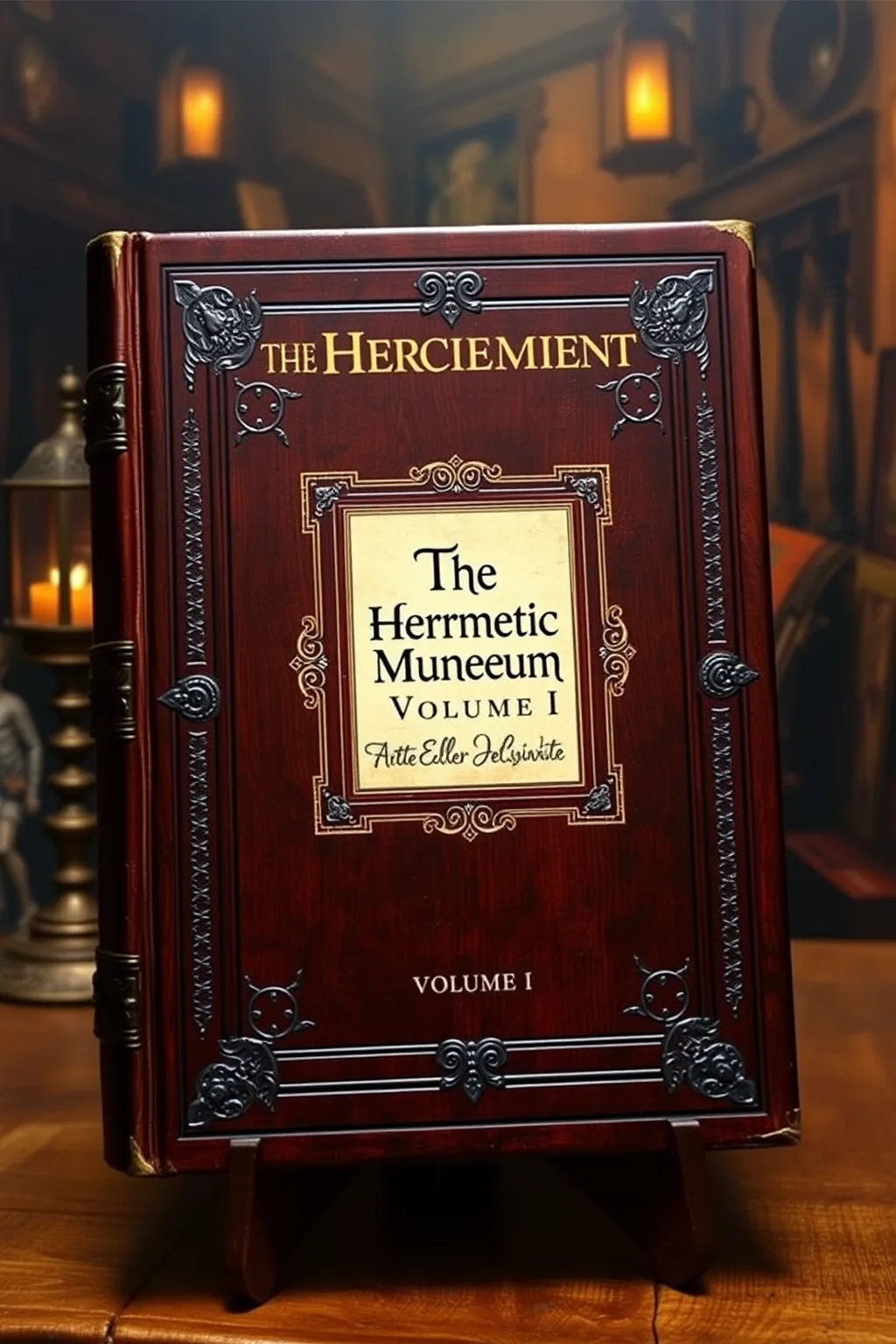
The Hermetic Museum, Volume I
 71
71

The Hermetic Museum, Volume I



Arthur Edward Waite's translation of 'The Hermetic Museum, Volume I' is an indispensable cornerstone for any serious student of alchemy and Hermetic philosophy. Waite, a scholar of immense repute in occult studies, provides not just a linguistic bridge to these ancient texts but imbues them with an interpretive clarity that illuminates their profound esoteric depth. The volume masterfully compiles foundational alchemical treatises, offering a panoramic view of the symbolic language, ritualistic practices, and philosophical inquiries that defined the Hermetic tradition for centuries. Its strength lies in its comprehensive nature and Waite's scholarly dedication, making it an authoritative resource for both neophytes seeking a solid introduction and seasoned practitioners delving into the nuances of the Great Work. This is essential reading for anyone committed to understanding the spiritual underpinnings of alchemical pursuit.
📝 Description
71
Arthur Edward Waite translated 'The Hermetic Museum, Volume I' in 1903.
This volume presents a collection of alchemical texts, translated by Arthur Edward Waite. It includes writings that discuss the philosophical and symbolic aspects of alchemy, focusing on the transformation of both material substances and the human spirit. The book details allegorical stories and cryptic imagery associated with the alchemical quest, often referred to as the Great Work. Waite's translation aims to make these historical alchemical doctrines comprehensible to those interested in the subject.
The content addresses concepts central to Hermetic philosophy and its alchemical interpretations. It examines the relationship between the physical and spiritual realms, as understood by practitioners of alchemy. The work is intended for individuals seeking knowledge of ancient traditions concerning spiritual development and a deeper understanding of existence.
This book falls within the Western esoteric tradition, specifically concerning Hermeticism and alchemy. These traditions often involve symbolic interpretations of natural processes, aiming for spiritual or intellectual enlightenment. The texts within 'The Hermetic Museum' likely reflect a historical understanding of alchemy not just as a proto-chemical practice, but as a system of spiritual discipline and philosophical inquiry. It connects to a lineage of thought that sought hidden knowledge through coded language and allegorical representation.
💡 Why Read This Book?
Uncover the veiled wisdom of alchemical transformation and spiritual evolution. 'The Hermetic Museum, Volume I' offers direct access to the esoteric heart of Hermeticism, providing a rich source of symbolism and philosophical insight. Ideal for seekers of hidden knowledge, students of ancient traditions, and practitioners looking to deepen their understanding of the Great Work and its mystical implications.
⭐ Reader Reviews
Honest opinions from readers who have explored this book.
❓ Frequently Asked Questions
What is the primary focus of 'The Hermetic Museum, Volume I'?
The primary focus is the exploration of alchemical principles and Hermetic philosophy, delving into the symbolic language, theoretical concepts, and spiritual aspirations of ancient alchemists.
Who was Arthur Edward Waite?
Arthur Edward Waite was a prolific scholar and occultist, renowned for his translations and writings on Freemasonry, Rosicrucianism, and various mystical traditions, including alchemy.
Is this book suitable for beginners in alchemy?
Yes, while dense with symbolism, Waite's translation and the foundational nature of the texts make it an excellent, albeit challenging, starting point for dedicated beginners interested in the theoretical aspects of alchemy.
What kind of knowledge can one expect to gain?
Readers can expect to gain insights into the philosophical, spiritual, and symbolic dimensions of alchemy, understanding it not just as a proto-chemistry but as a path of personal transformation and spiritual enlightenment.
What makes this translation significant?
Waite's translation is significant for its scholarly rigor, interpretive depth, and its role in making these complex ancient texts accessible to a wider English-speaking audience interested in esoteric studies.
🔮 Key Themes & Symbolism
The Great Work and Spiritual Transformation
This volume illuminates the alchemical 'Great Work' not merely as a physical process of transmuting metals, but as a profound metaphor for spiritual purification and the elevation of human consciousness. It explores the stages of this arduous journey, from the dissolution of the base self to the eventual attainment of spiritual gold—enlightenment and divine union. The texts within reveal the intricate symbolism and philosophical frameworks that guided alchemists in their quest for inner perfection, emphasizing that the true laboratory was the alchemist's own soul.
Alchemical Symbolism and Allegory
A central theme is the deciphering of the rich and often cryptic symbolic language employed by alchemists. From the Ouroboros to the Philosopher's Stone, each symbol carries layers of meaning, representing cosmic principles, psychological states, and stages of transformation. 'The Hermetic Museum' meticulously presents these symbols, inviting readers to engage in interpretive practices that unlock the hidden messages embedded within alchemical texts. Understanding this allegorical dimension is crucial to grasping the true, non-literal intent of these ancient teachings.
Hermetic Philosophy and Esoteric Wisdom
Beyond alchemy, the volume studies the broader Hermetic philosophy, a tradition rooted in the teachings attributed to Hermes Trismegistus. This encompasses a worldview that sees the microcosm (man) as a reflection of the macrocosm (universe), emphasizing divine unity, the correspondence between the spiritual and material realms, and the pursuit of gnosis (direct spiritual knowledge). The texts serve as conduits to this ancient esoteric wisdom, offering insights into the nature of reality, the divine, and humanity's place within the cosmos.
💬 Memorable Quotes
Direct passages from the work, attributed to the author.
“Seek, and ye shall find; knock, and it shall be opened unto you.”
— A timeless adage underscoring the principle of diligent spiritual seeking and the receptivity of the universe to those who earnestly pursue truth and divine wisdom.
“The Stone is one, yet it hath three principal parts.”
— This cryptic statement alludes to the many-sided nature of the Philosopher's Stone, suggesting it has distinct components or stages of manifestation, both material and spiritual.
“As above, so below, as within, so without.”
— A fundamental Hermetic axiom illustrating the interconnectedness of all realms, from the celestial to the terrestrial, and the inner spiritual world to the outer material manifestation.
“Through the understanding of the principles, the Great Work is accomplished.”
— This emphasizes that mastery of the fundamental laws and concepts of alchemy is the key to achieving the ultimate goal of spiritual and material perfection.
💡 Key Ideas
Editorial paraphrase of the work's core concepts — not direct quotes.
The Art is not to be learned from books alone.
This quote highlights that true alchemical knowledge transcends mere theoretical study, emphasizing the necessity of practical experience, intuition, and direct spiritual insight.
🌙 Esoteric Significance
Tradition
This volume is intrinsically linked to the Hermetic tradition, a perennial philosophy drawing from ancient Egyptian, Greek, and Gnostic sources, famously attributed to Hermes Trismegistus. It forms a central to Western esoteric thought, influencing alchemy, astrology, Kabbalah, and various mystical orders. The texts within explore the Hermetic worldview of unity, correspondence, and the cyclical nature of existence, positing a universe governed by immutable laws accessible through contemplation and spiritual discipline.
Symbolism
The esoteric significance lies heavily in its dense alchemical symbolism. Each element, mineral, celestial body, and mythical figure represents profound psychological and spiritual concepts. The 'Great Work' itself is a symbolic journey of purification and integration, transforming the 'base' aspects of the self into the 'noble' or enlightened state. The Philosopher's Stone, the Elixir of Life, and the stages of calcination, dissolution, separation, conjunction, fermentation, distillation, and coagulation are all allegorical representations of this transformative process.
Modern Relevance
In an age often characterized by materialism and spiritual disconnection, 'The Hermetic Museum, Volume I' offers a potent antidote. Its exploration of inner transformation, the interconnectedness of all things, and the pursuit of a deeper reality resonates powerfully with contemporary seekers of meaning. The psychological and spiritual insights embedded in alchemical symbolism provide a framework for personal growth, self-understanding, and the integration of fragmented aspects of the psyche, making its ancient wisdom profoundly relevant to modern challenges.
👥 Who Should Read This Book
This key work is essential for serious students of Western esotericism, particularly those focused on alchemy and Hermetic philosophy. Scholars of ancient traditions will find it an invaluable primary source. Spiritual seekers yearning to understand the deeper metaphysical underpinnings of transformation will be richly rewarded. Practitioners of occult arts and contemplative disciplines seeking to enrich their understanding of symbolic processes and the Great Work will discover clear insights. While challenging, it is a foundational text for anyone committed to the path of esoteric wisdom.
📜 Historical Context
Emerging from the intellectual ferment of the Renaissance and continuing through the Enlightenment, the alchemy documented in 'The Hermetic Museum' was a complex synthesis of proto-scientific inquiry, philosophical speculation, and spiritual seeking. This era saw a fervent interest in ancient wisdom traditions, with Hermeticism and alchemy being central to many esoteric circles. These texts were not merely historical curiosities but were actively studied and practiced by individuals who saw in them a path to understanding the universe's deepest secrets and achieving personal or spiritual perfection. Arthur Edward Waite's translation and compilation reflect a late 19th/early 20th-century revival of occult studies, aiming to preserve and disseminate these foundational alchemical works for a new generation of seekers and scholars.
📔 Journal Prompts
Reflect on a personal transformation you have undergone. How might the alchemical stages described in this text relate to your experience?
What alchemical symbol from this volume most speaks to your current inner state or aspirations? Explore its potential meanings.
Consider the Hermetic principle 'As above, so below.' How does this concept manifest in your daily life or in the broader world?
If the alchemical quest is a metaphor for spiritual enlightenment, what 'base metal' within yourself do you wish to transmute, and what 'gold' do you seek?
How can the pursuit of 'hidden knowledge' in alchemy be balanced with practical, grounded living?
🗂️ Glossary
Prima Materia
The primordial, undifferentiated substance from which all things are said to originate in alchemy. It represents the raw, unformed potential awaiting transformation.
Philosopher's Stone
The legendary alchemical substance believed to transmute base metals into gold and to bestow immortality or eternal youth. Symbolically, it represents perfected spiritual consciousness.
Great Work (Major work)
The entire alchemical process of transformation, both material and spiritual. It encompasses the stages leading to the creation of the Philosopher's Stone and ultimate enlightenment.
Calcination
An alchemical process involving heating a substance to high temperatures to reduce it to ash or powder. Symbolically, it represents the purification and breakdown of the ego or gross matter.
Azoth
A universal solvent or life-giving principle in alchemy, often associated with the Mercurial or vital force that facilitates transformation and the Great Work.
This book appears in 2 collections
🔮 Readers Also Liked
Browse all →








From the “Hermeticism” Collection
View all →







More Free Alchemy & Hermeticism Books
View all →