Stephen Gersh
Proclus was a late antique Neoplatonist philosopher who developed an elaborate philosophical system influencing later thought.
Proclus, born in Constantinople in 412 AD, was a prominent Greek Neoplatonist philosopher and one of the last significant classical thinkers of late antiquity. He established a highly detailed Neoplatonist system that profoundly influenced subsequent philosophical traditions, including Byzantine, early Islamic, scholastic, and German idealist thought. His successor, Marinus, documented his life, portraying him as a virtuous individual who achieved eudaimonia. Proclus initially pursued a legal career but found philosophy more compelling, leading him to study extensively in Alexandria and later Athens, where he became the head of the Neoplatonic Academy. He lived a vegetarian, celibate life in Athens, dedicating himself to writing and philosophical instruction until his death in 485 AD, despite a brief exile due to Christian pressure. His philosophical contributions involved elaborating on the Neoplatonic concepts of The One, The Intellect, and The Soul, introducing the idea of 'henads' as intermediaries between the divine and the material world.
Philosophical System and Key Concepts
Proclus developed one of the most comprehensive Neoplatonist systems, building upon the foundational concepts of The One, The Intellect (nous), and The Soul (psyche). A distinctive element of his philosophy was the elaboration of 'henads,' individual divine principles existing between the ultimate, pre-being One and the realm of intelligible divinity. These henads, which Proclus identified with the Greek gods, were seen as existing 'superabundantly' beyond being and served as the originators of causal chains extending into the material world. Each henad was understood to possess a unique character, influencing its respective chain of causation, and participated in all other henads. Proclus viewed philosophy as a path to liberate the soul from bodily passions, reconnect it with its divine origins, and prepare it for spiritual ascent, aligning with the Neoplatonic practice of theurgy, which used rituals and sacred objects to facilitate this ascent by tapping into the divine powers that permeate the material realm.
Commentaries and Systematic Works
The majority of Proclus's surviving writings are extensive commentaries on dialogues of Plato, including works like the Alcibiades, Cratylus, Parmenides, Republic, and Timaeus. Within these commentaries, he presented his own philosophical doctrines as a faithful interpretation of Plato's divinely inspired texts, believing Plato's writings concealed profound truths requiring careful exegesis. His commentary on Plato's Timaeus, for instance, details the Soul's role in mediating the Forms from the Intellect to the material world through mathematically structured proportions. Beyond commentaries, Proclus authored two major systematic treatises: 'Elements of Theology,' a structured exposition of 211 propositions detailing his metaphysical system from the One to the soul's descent, and 'Platonic Theology,' which synthesized Platonic dialogue material to elucidate the divine orders.
Influence on Mathematics and Legacy
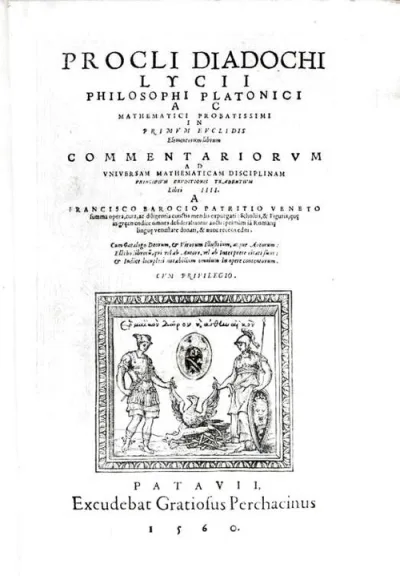
Proclus also made significant contributions to the history of mathematics through his commentary on Euclid's Elements. This work includes a historical sketch of early geometry, drawing on Eudemus of Rhodes, which provides valuable dating information for ancient mathematicians. He identified key figures associated with Plato, categorizing them by their generational proximity to the philosopher. His Platonic perspective on the status of mathematical objects within this commentary also proved influential. Proclus's philosophical system, though complex, exerted a considerable indirect influence on later intellectual traditions, including Byzantine, early Islamic, and scholastic philosophy, and notably on German idealism, with G. W. F. Hegel recognizing his work as a pivotal transition in philosophical history.
Key Ideas
- Elaboration of henads as intermediaries between The One and intelligible divinity
- Identification of henads with Greek gods and their role in causal chains
- Philosophy as a means of soul liberation and spiritual ascent
- Theurgy as a practice to reconnect with divine powers
- Plato's writings as divinely inspired and containing hidden truths
Notable Quotes
“the true turning point or transition from ancient to modern times, from ancient philosophy to Christianity.”
Books by Stephen Gersh
8 free public domain books · Read online or download