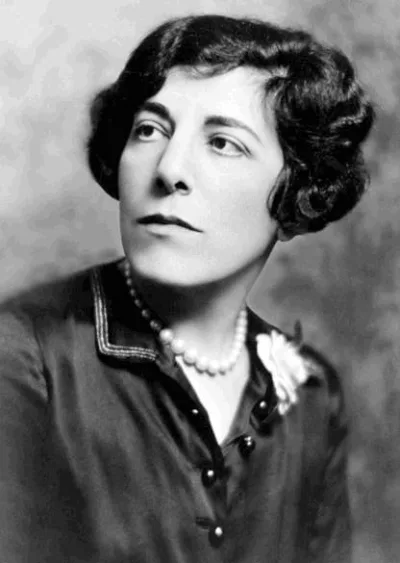
Edna Ferber was a celebrated American novelist and playwright whose works explored diverse American life and faced discrimination.
Edna Ferber (1885-1968) was an American author, known for her novels, short stories, and plays that often depicted various facets of American life and highlighted themes of discrimination. Born in Michigan to Hungarian Jewish immigrants, her childhood was marked by frequent moves and experiences with anti-Semitism, which she stated influenced her outlook. Ferber began her career in journalism before transitioning to fiction, publishing her first novel in 1911. She achieved significant critical and commercial success, earning a Pulitzer Prize for "So Big" in 1925. Many of her novels, including "Show Boat," "Cimarron," and "Giant," were adapted into successful films and stage productions. Ferber never married and had no children, but she took an active interest in her niece's acting career. She was outspoken and demonstrated a strong stance against anti-Semitism, notably leaving a party due to the host's views. Her experiences with rising anti-Semitism in Europe also deeply affected her and influenced her writing. Ferber was a member of the Algonquin Round Table, a group of New York literary figures, and collaborated with playwright George S. Kaufman on several plays.
Early Life and Journalism Career
Edna Ferber was born in Kalamazoo, Michigan, in 1885. Her parents were Jewish immigrants, her father from Hungary and her mother of German Jewish descent. The family relocated several times during her childhood, including to Chicago and Ottumwa, Iowa. In Ottumwa, Ferber experienced significant anti-Semitism, which she later attributed to shaping her negative view of the world. Her family eventually settled in Appleton, Wisconsin, where she completed high school and briefly attended college. Initially interested in elocution and acting, financial constraints prevented further formal education. She began her professional life as a journalist, working for newspapers like the Appleton Daily Crescent and the Milwaukee Journal. Although she later covered national political conventions, her early newspaper experiences informed her first novel, "Dawn O'Hara, The Girl Who Laughed."
Literary Success and Adaptations
Ferber found success as a writer of short stories and novels. Her early short story collection, "Buttered Side Down" (1912), drew attention for its direct style, with some reviewers initially mistaking the author for a man. Her novel "So Big" earned her the Pulitzer Prize in 1925 and was subsequently adapted into multiple films. Following this success, her 1926 novel "Show Boat" was transformed into a groundbreaking musical in collaboration with Jerome Kern and Oscar Hammerstein II, premiering on Broadway in 1927. Other notable novels adapted for film include "Cimarron" (1930), which inspired an Academy Award-winning film, and "Giant" (1952). Ferber was known for her business acumen, reportedly being the first author to use short-term contracts for film rights, necessitating regular renegotiation.
Themes and Personal Stance
Ferber's literary works often featured strong female characters and explored specific segments of American culture, sometimes set in locations she had visited. A recurring theme was the experience of discrimination, whether ethnic or otherwise, often embodied by secondary characters. Her travels in Europe during the 1920s and 1930s exposed her to the rise of Nazism and reinforced her concerns about anti-Semitism. This deeply influenced her writing, as seen in her autobiography "A Peculiar Treasure." Ferber was also known for her sharp wit and outspoken nature. She actively opposed anti-Semitism, famously leaving a social gathering when she discovered the host held such views. She was a member of the influential Algonquin Round Table, a group of New York writers and artists, and frequently collaborated with playwright George S. Kaufman.
Key Ideas
- Exploration of diverse American life and culture
- Themes of discrimination and prejudice, particularly anti-Semitism
- Strong female protagonists
- The impact of personal experience on writing
Notable Quotes
“According to Ferber, her years in Ottumwa "must be held accountable for anything in me that is hostile toward the world".”
“In that day, and for a girl in her early twenties, they were rather hard tough stories... The book got good reviews. I was startled and grimly pleased when some of the reviewers said that obviously these stories had been written by a man who had taken a feminine nom de plume as a hoax. I have always thought that a writing style should be impossible of sex determination; I don't think the reader should be able to say whether a book has been written by a man or a woman.”
“It was a fearful thing to see a continent – a civilization – crumbling before one's eyes. It was a rapid and seemingly inevitable process to which no one paid any particular attention.”
“To Adolf Hitler, who has made me a better Jew and a more understanding human being, as he has of millions of other Jews, this book is dedicated in loathing and contempt.”
“Being an old maid was a great deal like death by drowning – a really delightful sensation when you ceased struggling.”
Books by
3 free public domain books · Read online or download