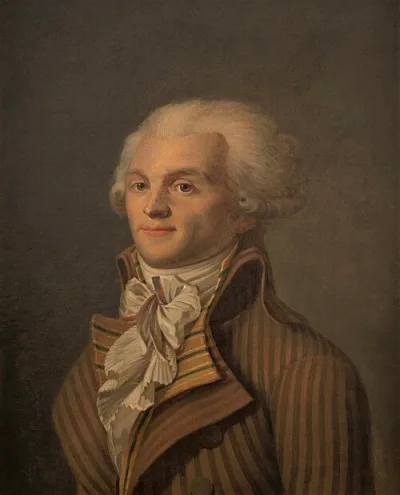
Maximilien Robespierre was a French lawyer and revolutionary leader, known for his role in the French Revolution and the Reign of Terror.
Maximilien Robespierre was a lawyer and statesman who became a prominent figure during the French Revolution. He championed voting rights for all men, the right to bear arms, and the abolition of the slave trade. As a radical Jacobin leader, he was elected to the National Convention and later served on the Committee of Public Safety. His increasing disillusionment with fellow revolutionaries led him to advocate for the severe measures of the Reign of Terror. Ultimately, Robespierre was arrested and executed without trial. His legacy remains a subject of debate, influenced by his role in repressing opponents of the revolution, yet also noted for his progressive ideas for his era.
Early Life and Education
Born in Arras in 1758, Maximilien Robespierre was the eldest of four children. His mother died when he was young, and his father later left the family. Robespierre and his brother were raised by their maternal grandparents. He displayed early literacy and, at age eight, began his education at the Arras College. A scholarship allowed him to attend the prestigious Collège Louis-le-Grand in Paris, where he excelled and developed an admiration for classical figures like Cicero and Cato. His education fostered an appreciation for Roman virtues and the philosophies of thinkers such as Rousseau, particularly the concept of the general will as the basis of political legitimacy.
Legal and Political Formation
Robespierre studied law at the Sorbonne, graduating in 1780. He was admitted to the bar and briefly served as a judge but resigned due to his opposition to capital punishment. He became a member of the literary Academy of Arras and was recognized for an essay on collective punishment. During the 1780s, he spoke out against legal inequalities, including those affecting illegitimate children, and criticized practices like arbitrary imprisonment and the exclusion of women from academic spheres. His social circle grew to include influential figures who would later play roles in the Revolution. He also connected with François-Paul de Barras, a land surveyor and future revolutionary.
Entry into the Revolution and Advocacy
In anticipation of the Estates-General in 1789, Robespierre argued for more representative electoral methods. He began to exert political influence locally and secured a position as a deputy for French Flanders. In the Estates-General, he initially focused on the hierarchical structure of the church and aligned with deputies who would form the National Assembly. Robespierre advocated for universal male suffrage, opposing property qualifications for voting and officeholding. He also drew attention to marginalized groups, championing ideals of equality and citizenship, though his views often lacked majority support among his peers. He maintained a formal, 18th-century style of dress throughout this period.
Jacobin Leadership and Political Philosophy
Robespierre became associated with the Jacobin Club, finding a receptive audience for his ideas on legal equality. He consistently argued against restrictions on suffrage, asserting that sovereignty resides in the people and that every individual has the right to participate in lawmaking. He demanded that all Frenchmen be eligible for public office based on merit rather than status. Elected president of the Jacobin Club in 1790, he also served as secretary of the National Assembly. He was seen as a leader within the radical faction of the Assembly, advocating for principles of "fraternal equality" and the right to self-defense through arms.
Key Ideas
- Universal male suffrage
- Right to bear arms for self-defense
- Abolition of the Atlantic slave trade
- Equality before the law
- Sovereignty of the people
- Virtue in the context of revolution
Books by
5 free public domain books · Read online or download