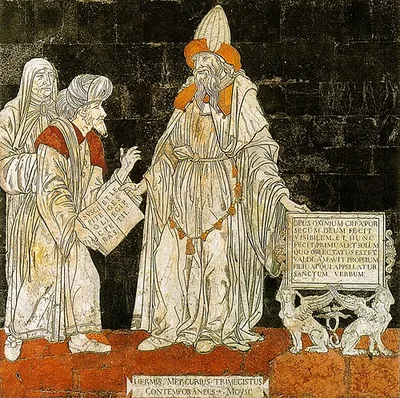
Hermes Trismegistus is a legendary figure, a blend of Greek and Egyptian deities, credited with esoteric philosophical writings.
Hermes Trismegistus is a legendary figure from the Hellenistic period, formed by merging the Greek god Hermes with the Egyptian god Thoth. He is considered the author of the Hermetica, a collection of diverse ancient and medieval texts that formed the basis for Hermeticism, a philosophical system. The wisdom attributed to him encompassed both the material and spiritual realms, making his writings significant for understanding the connection between the physical and the divine. This figure also appears in Islamic and Baháʼí traditions, often identified with the prophet Idris.
Historically, the syncretism occurred in Ptolemaic Egypt, where Greek settlers identified Thoth with Hermes. This fusion created a deity embodying wisdom and communication. Early references, like those by Cicero, suggest this syncretism originated in Hellenistic Egypt. The Hermetic literature itself dealt with spiritual practices, alchemy, and astrology, and its philosophical aspects have sometimes been conflated with Gnosticism. The epithet "thrice great" is thought to derive from an Egyptian epithet for Thoth. Later Christian scholars viewed Hermes Trismegistus as a pagan prophet who foresaw Christianity, fitting him into a concept of ancient, true theology. The dating of the Hermetic writings has been debated, with modern scholarship suggesting they were written by various unknown Greek authors rather than an ancient Egyptian priest.
Origins and Identity
Hermes Trismegistus emerged from the Hellenistic period in Egypt as a fusion of the Greek messenger god Hermes and the Egyptian god of wisdom, Thoth. This syncretism, known as interpretatio graeca, occurred when Greeks in Ptolemaic Egypt identified Thoth with their own deity. They were then worshipped together, particularly in Hermopolis, the former Temple of Thoth. Hermes, the god of communication, was combined with Thoth, the god of wisdom, who himself had assimilated other deified figures like Imhotep, Amenhotep, and Teôs. Ancient texts, such as those by Cicero, allude to multiple figures named Hermes, with some interpretations suggesting a dual perspective on this syncretism: one from the Egyptian viewpoint of Hermes as a native deity, and another from the Greek perspective of Hermes arriving from Greece. This fusion of Greek and Egyptian divine elements is considered the origin of the figure known as Hermes Trismegistus.
The Epithet 'Thrice Great'
The epithet "thrice great" associated with Hermes Trismegistus has ancient roots. While its earliest datable occurrences are debated, some scholars point to its first appearance in specific texts from the early centuries CE. A strong contender for its origin is an epithet for Thoth found at the Temple of Esna, which translates to "Thoth the great, the great, the great." This repetition signifies immense wisdom and power. Many later Christian writers, including Augustine and Pico della Mirandola, viewed Hermes Trismegistus as a wise pagan prophet who predated Christianity, fitting him into a concept of a singular, ancient divine truth. They believed this wisdom was passed down through ancient sages. Some interpretations, like one from the 10th-century Suda, suggest the "trice great" epithet refers to his praise of a trinity, signifying one divine nature within three aspects.
Hermetic Writings and Tradition
The corpus of texts attributed to Hermes Trismegistus, known as the Hermetica, held significant prestige throughout the Middle Ages and Renaissance, particularly among alchemists and astrologers. The "Hermetic tradition" thus became closely associated with alchemy, magic, and astrology. These texts explore complex philosophical ideas, often concerning the relationship between the material and spiritual worlds, and the potential for human spiritual ascent. The practice of hermetically sealing, used in alchemy to create the Philosopher's Stone, derives its name from this tradition. While Renaissance scholars believed Hermes Trismegistus was a contemporary of Moses, later research by Isaac Casaubon in 1614 demonstrated that the Hermetic writings postdate Christianity. Modern scholarship suggests these texts were written by various unknown Greek authors, blending Platonic and Stoic philosophy with influences from Jewish and Persian thought, rather than by a single ancient Egyptian figure.
Presence in Islamic and Baháʼí Traditions
Hermes Trismegistus holds a recognized place within Islamic tradition, though his name is not explicitly mentioned in the Qur'an. Islamic scholars and chroniclers often identified him with the prophet Idris, who is also equated with the Biblical Enoch. In this context, Hermes Trismegistus is sometimes referred to as "Thrice-Wise" and seen as a civilizing figure who introduced divine science and wisdom, inscribing sacred knowledge in hieroglyphs. He is also credited with initiating Pythagoras and being the first teacher of alchemy. Pierre Lory notes that Hermes in this tradition is a faceless prophet, lacking specific characteristics. The star-worshipping Sabians of Harran also traced their doctrines back to Hermes Trismegistus. Furthermore, in the Baháʼí Faith, Baháʼu'lláh identifies Idris with Hermes in his writings, linking him to the concept of uncompounded reality.
Key Ideas
- Syncretism of Greek and Egyptian deities
- Hermeticism as a philosophical system
- Interrelationship between material and spiritual worlds
- Alchemy, magic, and astrology within Hermetic tradition
- Spiritual ascension and personal transformation