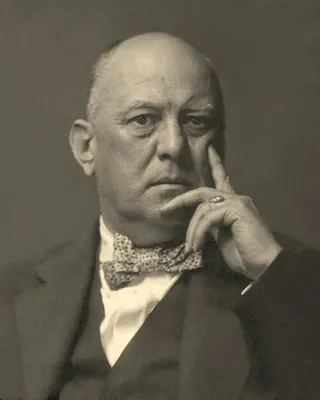
Aleister Crowley was an English occultist, magician, and poet who founded the religion of Thelema.
Born Edward Alexander Crowley in 1875 to a wealthy religious family, he rejected his upbringing to pursue Western esotericism. After studying at Cambridge, where he excelled in mountaineering and poetry, he became deeply involved in occult societies. He was initiated into the Hermetic Order of the Golden Dawn, studying ceremonial magic. His spiritual path led him to India and Egypt, where he received The Book of the Law in 1904, forming the basis of his religion, Thelema. He established esoteric orders and promoted his beliefs globally, gaining notoriety for his unconventional lifestyle and writings.
Crowley was a prolific author of poetry, novels, and occult texts. He co-founded the A∴A∴ order and became a leader in the Ordo Templi Orientis, adapting it to Thelemic principles. During World War I, he lived in the United States, engaging in painting and alleged espionage. He later founded the Abbey of Thelema in Sicily, a religious commune that was eventually shut down by the Italian government. Throughout his life, Crowley was a controversial figure, known for his drug use, individualism, and social criticism, but he remains influential in Western esotericism and is considered a prophet within Thelema.
Early Life and Rejection of Faith
Edward Alexander Crowley was born in 1875 into a prosperous family with strong evangelical Christian beliefs. He experienced a turning point with his father's death at age eleven, inheriting a significant fortune. This period marked a shift in his behavior and a growing skepticism towards Christianity, leading him to question religious teachings and explore forbidden activities. He attended several boarding schools, which he largely disliked, and developed interests in chess, poetry, and mountaineering. His early travels included climbing in the Alps and joining the Scottish Mountaineering Club, showcasing an early dedication to physical and intellectual pursuits outside his religious upbringing.
Cambridge and Occult Awakening
At Trinity College, Cambridge, Crowley adopted the name Aleister and pursued studies in philosophy and English literature. While excelling in mountaineering and poetry, he also cultivated a vigorous social life, including relationships with prostitutes and, reportedly, same-sex encounters. A significant mystical experience in 1896, possibly linked to his bisexuality, coincided with his growing interest in Western esotericism. He abandoned thoughts of a diplomatic career after a brush with mortality and began actively seeking occult literature. This period saw the publication of some of his early, controversial poetry, such as 'White Stains,' printed abroad due to its erotic content.
Founding Thelema and Esoteric Orders
Crowley's immersion in the occult led him to the Hermetic Order of the Golden Dawn in 1898, where he was trained in ceremonial magic. He adopted the magical motto 'Frater Perdurabo' ('Brother I shall endure to the end'). He furthered his magical studies with Allan Bennett, exploring ritual drug use and Goetia. In 1904, while honeymooning in Cairo, he received The Book of the Law from a supernatural entity named Aiwass, which became the foundational text for his religion, Thelema. This book proclaimed the start of the Æon of Horus and advocated the principle of 'Do what thou wilt,' interpreted as aligning with one's True Will.
Global Influence and Controversies
Following the creation of The Book of the Law, Crowley co-founded the esoteric order A∴A∴ to propagate Thelema. He later joined and rose to leadership within the Ordo Templi Orientis (O.T.O.), restructuring it according to Thelemic principles. Thelemite groups spread internationally through the O.T.O. During World War I, he resided in the United States, where he painted and, according to some accounts, engaged in espionage for the British. In 1920, he established the Abbey of Thelema in Sicily, a commune for his followers, but was expelled by the Italian government due to his lifestyle and public denunciations. He continued to promote Thelema until his death in 1947, leaving a legacy as a highly influential, albeit controversial, figure in Western esotericism and counterculture.
Key Ideas
- Thelema: A spiritual philosophy centered on the principle of 'Do what thou wilt,' interpreted as aligning with one's True Will.
- Æon of Horus: An astrological and spiritual era proclaimed by The Book of the Law, succeeding the Æon of Osiris.
- Ceremonial Magic: A system of ritual magic practiced and taught by Crowley, often involving the use of drugs and symbolic actions.
Books by
3 free public domain books · Read online or download