Zen Buddhism
 84
84

Zen Buddhism
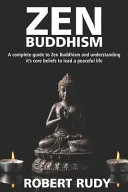
Robert Rudy's "Zen Buddhism" attempts to distill a vast spiritual tradition into accessible principles. The book's strength lies in its directness, mirroring Zen's own emphasis on immediate apprehension over abstract theorizing. Rudy effectively conveys the aspiration to see existence clearly, unburdened by intellectualization. However, the work sometimes struggles to fully capture the experiential depth that defines Zen practice. For instance, while the concept of "non-being" is introduced, its experiential implications are not always fully elaborated. The initial blurb promises enlightenment for everyday life, a lofty claim that the content, while informative, doesn't entirely fulfill. The book serves as a decent primer but may leave seasoned practitioners wanting more.
📝 Description
84
Robert Rudy's 2020 book examines Zen Buddhism's focus on immediate experience.
Robert Rudy's "Zen Buddhism" directly addresses a spiritual discipline prioritizing immediate experience over rigid dogma. The book clarifies Zen's central aim: to achieve a clear understanding of existence, free from conceptual frameworks or linguistic limitations. It emphasizes looking past superficial differences to discover an inherent state of peace and unity with all phenomena.
This work is suitable for individuals wishing to cultivate a more present and centered awareness in their daily lives. It will appeal to those interested in Eastern philosophies, contemplative practices, and methods for stilling the mind. Readers seeking practical applications of spiritual principles to reduce mental noise and encourage inner harmony will find value here.
Zen Buddhism's exploration in Western literature grew significantly in the mid-20th century, partly due to figures like D.T. Suzuki introducing its concepts internationally. Rudy's 2020 publication enters this ongoing discussion, presenting a modern viewpoint on ancient teachings. The book addresses Zen's apprehension of reality from "non-being," a concept challenging common ideas about creation and existence, and the Buddhist principle of recognizing the interconnectedness of all things.
💡 Why Read This Book?
• Understand the core Zen principle of perceiving all things from "non-being," a concept explored by Rudy to challenge conventional existence and reality. • Grasp how Zen practice aims to transcend superficial differences, fostering complete peace and harmony with the world, as detailed in the book's examination of unity. • Discover practical methods to bring clarity and reduce mental confusion in everyday life, as Rudy outlines the Zen approach to direct insight.
⭐ Reader Reviews
Honest opinions from readers who have explored this book.
❓ Frequently Asked Questions
What is the primary goal of Zen Buddhism as presented by Robert Rudy?
The primary goal is to achieve a clear understanding of existence, free from the confusion of abstract thought or words. It focuses on direct experience and immediate insight into reality.
When was Robert Rudy's 'Zen Buddhism' first published?
Robert Rudy's 'Zen Buddhism' was first published on April 6, 2020.
What does Zen Buddhism say about the origin of things, according to the book?
The book explores the Zen notion that all things originate from 'non-being,' a concept central to understanding existence beyond conventional material or conceptual frameworks.
How does Zen Buddhism aim to affect one's mental peace?
By encouraging the ignoring of all differences and finding complete peace and harmony, Zen seeks to calm the mind and foster a sense of unity with all phenomena.
Is 'Zen Buddhism' by Robert Rudy suitable for beginners?
Yes, the book is presented as an accessible introduction to Zen concepts and practices for those new to the philosophy or seeking to understand its principles.
What is the significance of 'harmony with all' in Zen?
Harmony with all signifies a state of interconnectedness and acceptance, where one perceives no fundamental separation between oneself and the rest of existence.
🔮 Key Themes & Symbolism
Non-Being as Source
The work studies the provocative Zen concept that all phenomena manifest from a state of 'non-being.' This is not nihilism but a pointer towards an ultimate reality or ground of existence that precedes conceptualization and material form. Rudy's text frames this as essential for grasping the true nature of things, urging readers to look beyond perceived existence to its fundamental, unmanifest source.
Unity and Harmony
A central tenet explored is the Zen practice of perceiving the fundamental unity underlying all apparent diversity. The book highlights how this realization leads to a profound sense of peace and harmony with the entirety of existence. By recognizing the interconnectedness of all things, the practitioner is encouraged to move beyond dualistic thinking and embrace a holistic view of reality.
Direct Experience Over Intellect
Rudy's 'Zen Buddhism' emphasizes the superiority of direct, intuitive experience over discursive thought or intellectual understanding. The text posits that true insight into existence cannot be achieved through abstract reasoning alone. Instead, it advocates for practices that cultivate present-moment awareness, allowing for unmediated apprehension of reality as it is.
Clarity of Existence
The book articulates Zen's aspiration for a clear, unclouded perception of existence. This clarity is attained by shedding mental constructs, biases, and the limitations of language. The ultimate aim is to see things as they truly are, fostering a liberated and enlightened perspective on life and the cosmos.
💬 Memorable Quotes
Direct passages from the work, attributed to the author.
“All things come from non-being.”
— This statement points to the concept that the ultimate reality or ground of all existence is not a tangible 'something' but rather an unmanifest, potential state from which all perceived forms arise.
“Ignoring all differences.”
— This refers to the Zen practice of seeing past superficial distinctions and recognizing the underlying unity and interconnectedness of all phenomena, leading to a more harmonious perception of reality.
“Finding complete peace and harmony with all.”
— This expresses the ultimate aim of Zen practice: to achieve an internal state of tranquility and alignment with the natural order of the universe, free from internal conflict.
“Grasp the meaning of existence clearly.”
— This highlights the core objective of Zen: to attain direct, unmediated insight into the true nature of reality, unhindered by conceptual filters or intellectual limitations.
“Without being confused by abstract thought or words.”
— This emphasizes Zen's approach to knowledge, prioritizing intuitive understanding and direct experience over reliance on intellectual constructs and linguistic definitions.
🌙 Esoteric Significance
Tradition
While Zen Buddhism is primarily a Mahayana Buddhist school, its emphasis on direct experience, emptiness (sunyata), and the attainment of enlightenment through non-conceptual means aligns with certain esoteric currents. Esoterically, Zen's focus on inner transformation and the realization of a non-dual reality can be seen as a path distinct from exoteric religious practice, emphasizing direct gnosis or intuitive wisdom.
Symbolism
Key symbols in Zen include the circle (enso), representing enlightenment, emptiness, and the universe, often drawn with a single brushstroke. The lotus flower symbolizes purity and spiritual awakening, rising unstained from muddy waters. The empty bowl can represent receptivity, non-attachment, and the potential for abundance when one is open.
Modern Relevance
Contemporary mindfulness practices, secular Buddhism, and various forms of contemplative psychology draw heavily on Zen principles. Thinkers and practitioners exploring consciousness, non-dual awareness, and the application of meditative states for mental well-being often reference or implicitly utilize Zen concepts popularized over the last century.
👥 Who Should Read This Book
['• Students of comparative religion seeking to understand the philosophical underpinnings of Zen Buddhism and its place within Eastern spiritual traditions.', '• Individuals interested in contemplative practices and mindfulness who want to explore the roots of these techniques in a structured philosophical framework.', '• Seekers of personal growth and mental clarity who are drawn to philosophies that emphasize direct experience and non-conceptual understanding.']
📜 Historical Context
The Western engagement with Zen Buddhism intensified significantly in the mid-20th century, particularly after World War II. Scholars like D.T. Suzuki were instrumental in introducing Zen's philosophical and meditative practices to a global audience, influencing fields from psychology to art. This period saw a surge of interest in Eastern contemplative traditions as a counterpoint to the perceived materialism and intellectualism of Western thought. Suzuki's lectures and writings, beginning in the 1950s, made concepts like satori (enlightenment) and koans accessible. Rudy's work, published in 2020, emerges in a landscape already shaped by these earlier introductions, offering a contemporary synthesis for a digitally connected world, though it doesn't engage directly with specific earlier Western Zen scholars by name.
📔 Journal Prompts
The nature of 'non-being' as a source for existence.
Perceiving unity amidst apparent differences.
Cultivating clarity beyond abstract thought.
The role of immediate experience in understanding reality.
Achieving peace through non-dual awareness.
🗂️ Glossary
Non-being
In Zen context, this refers not to nothingness but to the unmanifest, primordial state from which all phenomena arise, a ground of existence prior to conceptualization or material form.
Existence
The state or fact of having objective reality or being. In Zen, the clear apprehension of existence is sought, free from conceptual distortion.
Abstract thought
Concepts or ideas removed from concrete reality or specific instances; mental constructs that Zen seeks to transcend for direct understanding.
Peace
A state of mental or spiritual tranquility, often achieved in Zen by transcending dualistic thinking and recognizing interconnectedness.
Harmony
A state of agreement or concord with oneself and the external world, fostered by the Zen understanding of unity.
Differences
Distinctions or variations perceived between things. Zen practice encourages looking beyond these to realize underlying unity.
Words
Linguistic symbols used for communication. Zen emphasizes that direct experience often surpasses the limitations of verbal description.