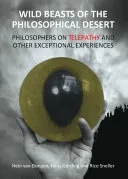
Wild Beasts of the Philosophical Desert
 78
78

Wild Beasts of the Philosophical Desert
Hein van Dongen and Hans Gerding's "Wild Beasts of the Philosophical Desert" performs a necessary excavation of philosophical attitudes toward the anomalous. The strength lies in its detailed examination of how figures like Immanuel Kant, despite his critical stance, engaged with Swedenborg's claims about the spirit world, revealing a more nuanced engagement than often acknowledged. The limitation, however, is that the collection's academic rigor can sometimes obscure the raw experiential dimension of the phenomena discussed, making it feel more like a dissection than an exploration of lived mystery. A particularly compelling section details Kant's correspondence regarding Swedenborg, demonstrating how even a foundational figure in empiricism wrestled with reports of clairvoyance. This work succeeds in repositioning certain 'fringe' topics within the serious philosophical tradition.
📝 Description
78
Hein van Dongen and Hans Gerding's 2011 collection examines philosophers' historical engagement with paranormal phenomena.
This scholarly work scrutinizes how prominent philosophers, from Immanuel Kant to Jacques Derrida, engaged with phenomena often labeled 'paranormal.' It moves past modern dismissals to investigate their specific philosophical frameworks for concepts like telepathy and clairvoyance. The collection traces a lineage of philosophical inquiry into what William James termed 'wild beasts of the philosophical desert' – subjects that defied easy categorization within the scientific and philosophical paradigms of their times.
Central to the work is the deconstruction of the 'paranormal' as a modern construct. The authors show how earlier philosophers treated these experiences not as inherently supernatural, but as challenging data points requiring philosophical re-evaluation of mind, matter, and perception. The book examines specific philosophical texts and arguments, highlighting the intellectual courage needed to address such subjects. It is intended for academic readers, advanced students of philosophy and the history of consciousness, and those interested in the intersection of empiricism and anomalous experiences.
This collection engages with a long tradition of philosophical thought that has, at various times, grappled with phenomena that lie outside conventional empirical understanding. From ancient discussions of divination and prophecy to later philosophical attempts to integrate psychic experiences into broader metaphysical systems, thinkers have consistently encountered 'wild beasts' that challenge established worldviews. The book situates this inquiry within a specific historical and philosophical lineage, acknowledging that the study of consciousness and perception has often included an examination of experiences resistant to purely materialistic explanations.
💡 Why Read This Book?
• Understand how philosophers from Kant to Derrida engaged with telepathy and clairvoyance, moving beyond modern dismissal by examining specific textual evidence from the 18th century onwards. • Gain insight into William James's concept of 'wild beasts of the philosophical desert' and its implications for evaluating challenging phenomena within intellectual history. • Discover how philosophical systems have historically attempted to accommodate or critique anomalous experiences, offering a unique perspective on the mind-body problem.
⭐ Reader Reviews
Honest opinions from readers who have explored this book.
❓ Frequently Asked Questions
What philosophical tradition does "Wild Beasts of the Philosophical Desert" primarily engage with?
The book engages primarily with Western philosophical traditions, tracing engagements with anomalous phenomena from Enlightenment thinkers like Immanuel Kant through to later figures such as Jacques Derrida, examining how empiricism and idealism grappled with such topics.
Who coined the term 'wild beasts of the philosophical desert' in relation to paranormal experiences?
The phrase 'wild beasts of the philosophical desert' was coined by William James, a pioneering American psychologist and philosopher, who extensively studied mediumistic phenomena and found them challenging to categorize.
Does this book present evidence for the paranormal?
No, the book does not aim to present evidence for or against paranormal phenomena. Instead, it critically analyzes how significant philosophers engaged with reports of such experiences as subjects for philosophical inquiry.
What is the historical period covered by the book's philosophical analysis?
The book covers a broad historical period, starting with Enlightenment philosophers like Immanuel Kant and extending through to modern and contemporary thinkers such as Jacques Derrida, discussing their engagement with anomalous experiences.
What specific phenomena are discussed in relation to philosophical inquiry?
The book focuses on phenomena like telepathy and clairvoyance, examining how philosophers treated these and other controversial experiences not as mere superstition but as topics demanding intellectual consideration within their respective systems.
Is "Wild Beasts of the Philosophical Desert" suitable for beginners in philosophy?
While accessible to dedicated beginners interested in the history of ideas, the book's scholarly approach and detailed philosophical analysis are best suited for advanced students or those with a background in philosophical discourse.
🔮 Key Themes & Symbolism
Philosophical Engagement with Anomalies
This theme explores how established philosophical traditions, often rooted in rationalism and empiricism, have historically grappled with phenomena that defy conventional explanation. It highlights that figures like Immanuel Kant and later thinkers did not always dismiss reports of telepathy or clairvoyance outright, but instead incorporated them into their critiques of perception and reality. The collection demonstrates that these 'wild beasts' were often seen as crucial test cases for the limits of philosophical systems.
The Construction of the 'Paranormal'
The work examines the historical emergence and categorization of 'paranormal' experiences. It argues that the very concept is a relatively modern construct, and that earlier philosophers engaged with similar phenomena under different labels or as part of broader discussions on mind, consciousness, and the supernatural. This theme questions the anachronistic application of contemporary labels to historical philosophical debates, revealing a more complex intellectual landscape.
William James's Legacy
Central to the book's framing is the influential concept introduced by William James, who described challenging phenomena as 'wild beasts of the philosophical desert.' This theme analyzes how James's perspective legitimized the serious study of such experiences within academic philosophy and how subsequent thinkers have built upon or reacted to his approach, particularly concerning mediumship and anomalous perception.
Textual Analysis of Philosophical Discourse
This theme focuses on the methodology of analyzing primary philosophical texts to uncover discussions of anomalous phenomena. The authors meticulously examine writings from figures spanning centuries, identifying specific arguments, critiques, and philosophical frameworks used to address experiences like telepathy. It emphasizes the importance of rigorous scholarship in understanding the historical intellectual reception of these topics.
💬 Memorable Quotes
Direct passages from the work, attributed to the author.
“William James labelled phenomena defying easy categorization as 'wild beasts of the philosophical desert.'”
— This highlights James's acknowledgment that certain experiences presented significant challenges to established philosophical and scientific frameworks, likening them to elusive and potentially dangerous creatures encountered in a barren intellectual landscape.
“Philosophers from Kant to Derrida took controversial phenomena like telepathy and clairvoyance seriously.”
— This assertion underscores the book's central argument: that rather than being a fringe topic, the serious philosophical consideration of extrasensory perception has a deep and respected lineage within Western thought, contradicting modern assumptions.
“The concept of the 'paranormal' did not exist in philosophy in the recent past.”
— This points to the historical contingency of the term 'paranormal,' suggesting that philosophical engagement with similar experiences predates this specific label and occurred within different conceptual categories, requiring careful historical contextualization.
“The authors have studied relevant texts that have...”
— This signifies a commitment to evidence-based analysis within the book, indicating that its arguments are grounded in the direct examination of primary philosophical writings rather than secondary interpretations or broad generalizations.
“Scientists rarely take ‘paranormal experiences’ seriously.”
— This observation sets up the contrast for the book's project: highlighting a perceived gap between contemporary scientific skepticism and the historical philosophical willingness to engage with anomalous phenomena, thereby justifying the collection's focus.
🌙 Esoteric Significance
Tradition
While not strictly adhering to a single esoteric lineage, this work situates its inquiry within the broader Western esoteric tradition's long-standing concern with consciousness, perception, and phenomena beyond the mundane. It aligns with Hermetic and Theosophical tendencies to explore the hidden potentials of the mind and the nature of reality as perceived through altered states or non-ordinary means, challenging purely materialistic philosophical frameworks.
Symbolism
The title itself, 'Wild Beasts of the Philosophical Desert,' serves as a potent symbol. The 'wild beasts' represent the untamed, often frightening, phenomena that lie outside the controlled garden of established philosophy, while the 'philosophical desert' signifies the arid, rationalistic landscape where such experiences are often left to wither. It evokes a sense of venturing into unknown territories of consciousness and knowledge.
Modern Relevance
Contemporary interest in consciousness studies, parapsychology, and altered states of awareness finds a historical anchor in this book. Thinkers exploring embodied cognition, non-dualistic philosophies, and transpersonal psychology can draw upon the historical philosophical dialogues presented, demonstrating a continuous thread of inquiry into the nature of subjective experience and its potential extensions beyond conventional sensory input.
👥 Who Should Read This Book
• Advanced philosophy students and scholars seeking to understand the historical integration of anomalous phenomena into Western thought, particularly the engagement of figures like Kant. • Researchers in consciousness studies and parapsychology interested in the intellectual history and philosophical justifications for studying non-ordinary experiences. • Individuals curious about the philosophical underpinnings of esoteric traditions, exploring how concepts like telepathy have been addressed by mainstream thinkers.
📜 Historical Context
Published in 2014, "Wild Beasts of the Philosophical Desert" emerged in an intellectual climate where the scientific study of consciousness was gaining traction, yet the philosophical legacy of engagement with anomalous experiences remained largely underexplored. The book revisits the period from the Enlightenment onwards, a time when figures like Immanuel Kant, though often critical, nonetheless engaged deeply with accounts of clairvoyance and spiritualism, as seen in his extensive writings and correspondence concerning Emanuel Swedenborg. This era was marked by burgeoning scientific materialism but also a persistent interest in idealism and transcendentalism. The collection specifically challenges the notion that such topics were always outside the philosophical pale, contrasting with the more strictly empirical or positivist philosophies that gained prominence in the late 19th and 20th centuries. The authors implicitly engage with the legacy of thinkers like William James, who actively championed the serious investigation of psychic phenomena, positioning their work as a recovery of a neglected philosophical tradition.
📔 Journal Prompts
The 'wild beasts of the philosophical desert' encountered by William James—how might they challenge your current understanding of consciousness?
Reflect on Immanuel Kant's approach to phenomena like clairvoyance; what does this reveal about the boundaries of Enlightenment thought?
Consider the historical absence of the term 'paranormal' in philosophy; what does this imply about how anomalous experiences were previously framed?
Analyze how a philosopher's core tenets (e.g., empiricism, idealism) might influence their reception of telepathic claims.
Explore the tension between scientific skepticism and philosophical inquiry regarding consciousness as presented in the book.
🗂️ Glossary
Telepathy
The supposed communication of thoughts or ideas by means other than the known senses; a phenomenon frequently discussed in philosophical and parapsychological contexts.
Clairvoyance
The alleged ability to perceive things or events in the future or beyond normal sensory contact; a key example of anomalous experience examined in the book.
Paranormal
Relating to or deviating from what is normal, especially concerning phenomena that are outside the scope of conventional scientific understanding.
Empiricism
A theory that states that knowledge comes only or primarily from sensory experience, a philosophical stance often contrasted with or challenged by discussions of anomalous phenomena.
Mediumistic phenomena
Experiences associated with spiritualism and mediumship, often involving alleged communication with spirits or the channeling of information from non-physical sources, studied by William James.
Philosophical Desert
A metaphor, used by William James, for the arid, rationalistic intellectual landscape where phenomena defying conventional explanation (the 'wild beasts') are often marginalized or dismissed.
Enlightenment Philosophy
An intellectual and philosophical movement that dominated the world of ideas in Europe during the 17th and 18th centuries, emphasizing reason and individualism, exemplified by thinkers like Kant.