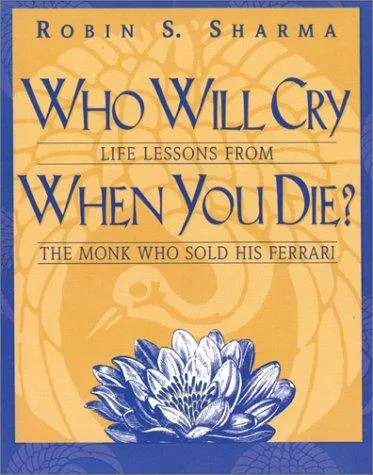
Who Will Cry When You Die?
 73
73

Who Will Cry When You Die?
Sharma’s "Who Will Cry When You Die?" offers a direct, no-nonsense approach to life's big questions, bypassing much of the spiritual jargon that can alienate newcomers. Its strength lies in its accessible prose and the sheer practicality of its advice, particularly the "90/90 Rule" which is a concrete action item rather than a vague aspiration. However, the book occasionally leans into a tone that, while intended to be motivational, can feel prescriptive, bordering on simplistic for those already well-versed in philosophical inquiry. The chapter on cultivating "absolute focus" provides a sharp reminder of how easily our attention is fractured in the contemporary world, highlighting the urgency of intentionality. Sharma's work serves as a robust primer for those seeking to reorient their lives toward purpose and presence.
📝 Description
73
Robin S. Sharma's 2018 book asks readers to consider their mortality to improve their lives.
Robin S. Sharma's "Who Will Cry When You Die?" offers practical reflections and advice for living a more meaningful life. Published in 2018, the book moves beyond typical self-help by urging a serious examination of personal values and priorities. Its structure consists of short, direct chapters designed to prompt thought and encourage daily change. Rather than complex theories, Sharma provides straightforward guidance for finding inner peace and purpose.
This book is for people who feel a gap between their daily actions and their desire for a fulfilling existence. It suits those seeking to use their time and energy more deliberately, especially if feeling overwhelmed by modern life. Readers who appreciate philosophical introspection without dense academic language will find its style accessible. It appeals to anyone questioning their legacy and wanting to live with more awareness and gratitude, regardless of their background in spiritual or philosophical reading.
Published in 2018, "Who Will Cry When You Die?" touches on perennial philosophies concerning mortality and the pursuit of a well-lived life. It echoes sentiments found in Stoicism and Eastern contemplative traditions, which have seen renewed interest in popular culture. The work addresses a broad desire for inner peace and conscious living, aligning with contemporary movements focused on personal development and existential reflection.
💡 Why Read This Book?
• Gain the "90/90 Rule" for morning productivity, a specific method to dedicate focused time to personal development that can be implemented immediately after reading about it. • Understand Sharma's concept of "Life Force" and learn practical techniques for conserving and enriching this vital energy, offering a tangible framework for self-care. • Develop a clearer perspective on your personal legacy, moving beyond abstract notions to concrete actions and daily choices that align with your ultimate values, as discussed in the text.
⭐ Reader Reviews
Honest opinions from readers who have explored this book.
❓ Frequently Asked Questions
What is the "90/90 Rule" from Robin S. Sharma's book?
The "90/90 Rule" suggests dedicating the first 90 minutes of your day to personal growth activities, such as reading, meditation, or exercise, before engaging with routine work or distractions.
When was "Who Will Cry When You Die?" first published?
The book "Who Will Cry When You Die?" by Robin S. Sharma was first published in 2018.
Does the book offer spiritual or secular advice?
Sharma’s work blends practical, secular self-improvement strategies with philosophical reflections on life's purpose, drawing from various wisdom traditions without adhering strictly to one.
What is the concept of "Life Force" in Sharma's writing?
Life Force, as presented by Sharma, refers to the essential energy that animates and sustains an individual, emphasizing the importance of managing one's energy consciously.
Is "Who Will Cry When You Die?" suitable for beginners in self-help?
Yes, its accessible language and actionable advice make it highly suitable for individuals new to self-help or personal development literature.
What is the main objective of Sharma's book?
The book aims to guide readers toward living a more intentional, fulfilling life by examining their priorities, managing their time effectively, and cultivating inner peace.
🔮 Key Themes & Symbolism
Intentional Living
The work champions a deliberate approach to existence, urging readers to move beyond passive consumption of life's events. Sharma emphasizes the importance of conscious decision-making, particularly concerning how one spends their time and energy. This theme is explored through practical frameworks like the "90/90 Rule," designed to reclaim the morning hours for personal growth and reflection, thereby setting a purposeful tone for the entire day and countering the drift into aimless activity.
Legacy and Mortality
A central pillar of the book is the contemplation of one's eventual death and the legacy left behind. Sharma prompts readers to consider what impact they wish to have, not just in grand achievements but in daily interactions and contributions. This existential framing serves as a powerful motivator, encouraging individuals to align their present actions with their deepest values and to live in a way that honors their finite time, fostering a sense of urgency and significance.
Cultivating Inner Peace
Sharma presents inner peace not as an elusive state but as a cultivated practice. He advocates for strategies such as "absolute focus," gratitude, and managing one's "Life Force" to build resilience against external chaos. The book offers tangible methods for reducing mental clutter and enhancing emotional well-being, suggesting that a fulfilling life is one characterized by internal calm and a strong connection to one's authentic self, regardless of external circumstances.
Personal Growth Mastery
The book is fundamentally a guide to continuous self-improvement. Sharma posits that personal growth is not a phase but a lifelong pursuit, essential for a vibrant existence. He introduces concepts like the "Daily Ritual" and emphasizes the power of small, consistent actions to create significant long-term change. This theme encourages readers to view challenges as opportunities for learning and to actively engage in their own development.
💬 Memorable Quotes
Direct passages from the work, attributed to the author.
“The "90/90 Rule" suggests dedicating the first 90 minutes of your day to personal growth.”
— This principle is presented as a reference for reclaiming one's time and prioritizing self-development before the demands of the external world intervene.
“Focus on what truly matters and let go of the trivial.”
— This highlights the importance of discernment in energy allocation, advising readers to concentrate their efforts on high-impact activities and relationships.
“Your "Life Force" is your most precious asset; guard it well.”
— This concept underscores the idea that personal energy is finite and requires conscious management, akin to safeguarding a valuable resource for sustained well-being.
“Live in such a way that when you die, the world will cry.”
— This provocative statement serves as a call to action, encouraging readers to make a significant positive impact on others and live a life of purpose and contribution.
“Practice gratitude daily for the gifts you have received.”
— Gratitude is positioned as a fundamental practice for cultivating happiness and perspective, shifting focus from lack to abundance.
🌙 Esoteric Significance
Tradition
While not explicitly aligning with a single esoteric tradition, Sharma's work draws implicitly from perennial philosophies that emphasize inner transformation and the pursuit of wisdom. It echoes Stoic principles regarding control over one's reactions and focus on virtue, as well as Eastern contemplative practices that advocate for mindfulness and detachment. The emphasis on "Life Force" can be seen as a modern, accessible interpretation of vitalistic concepts found in various mystical traditions, presented without adherence to specific dogma.
Symbolism
The book utilizes the concept of a "legacy" as a symbolic representation of one's ultimate impact and the meaning derived from a life well-lived. Mortality itself serves as a potent symbol, urging readers to confront their finitude as a catalyst for present action and value clarification. The "90/90 Rule" can be interpreted symbolically as the "sacred morning hour," a time set apart for cultivating the inner self before engaging with the profane world, thereby imbuing daily life with ritualistic significance.
Modern Relevance
Sharma's pragmatic approach to personal growth and well-being remains highly relevant today. Contemporary figures and platforms focused on mental health, productivity, and conscious living often echo themes found in his work. His emphasis on managing energy and focus appeals to modern challenges of information overload and burnout. The book's principles are frequently referenced in corporate wellness programs and by life coaches who seek actionable frameworks for clients aiming to enhance their personal effectiveness and find greater fulfillment.
👥 Who Should Read This Book
• Individuals feeling overwhelmed by modern life and seeking practical methods to regain control and purpose, particularly those drawn to Sharma's "90/90 Rule" for structuring their mornings. • Aspiring leaders and entrepreneurs who want to cultivate "absolute focus" and understand how to manage their "Life Force" for sustained high performance and impact. • Those contemplating their life's purpose and legacy, who can benefit from the book's direct prompts to examine their values and make choices aligned with a meaningful existence.
📜 Historical Context
Robin S. Sharma's "Who Will Cry When You Die?" arrived in 2018, a period marked by a significant cultural emphasis on mindfulness, productivity hacks, and the search for meaning amidst digital saturation. Sharma's work taps into a lineage of self-help and personal development literature that gained momentum in the late 20th century, influenced by thinkers like Stephen Covey and Brian Tracy. It emerged in dialogue with the growing popularity of figures like Tony Robbins and, more recently, Jay Shetty, who also bridge motivational speaking with philosophical underpinnings. Unlike the more academic or spiritual traditions like Transcendentalism or New Thought, Sharma's approach is highly pragmatic and action-oriented. The book's reception was largely within the self-help and business leadership spheres, resonating with individuals seeking actionable strategies for life improvement, rather than engaging with specific esoteric doctrines or historical movements.
📔 Journal Prompts
Your "legacy"—what specific actions today will build it?
The "90/90 Rule"—how can you implement it starting tomorrow?
Reflect on your "Life Force": what depletes it, and what replenishes it?
Consider the practice of "absolute focus": what distractions will you minimize?
What are you most grateful for today, and why?
🗂️ Glossary
90/90 Rule
A principle suggesting dedicating the first 90 minutes of each day to personal growth activities before attending to other demands.
Life Force
The vital energy or animating principle within an individual, which Sharma emphasizes needs to be consciously managed and replenished.
Absolute Focus
The practice of concentrating one's attention entirely on a single task or objective, minimizing distractions to enhance effectiveness.
Legacy
The lasting impact or impression an individual leaves behind, often considered in terms of contributions, values, and influence on others.
Gratitude
The quality of being thankful; a readiness to show appreciation for and to return kindness, presented as a key to happiness.
Daily Ritual
A consistent, planned set of activities performed regularly, especially in the morning, to support personal growth and well-being.
Personal Mastery
The ongoing process of developing one's capabilities, character, and potential to achieve a higher level of personal effectiveness and fulfillment.
🔮 Readers Also Liked
Browse all →







More by Robin S. Sharma
All books →





More Free Spiritual Development Books
View all →