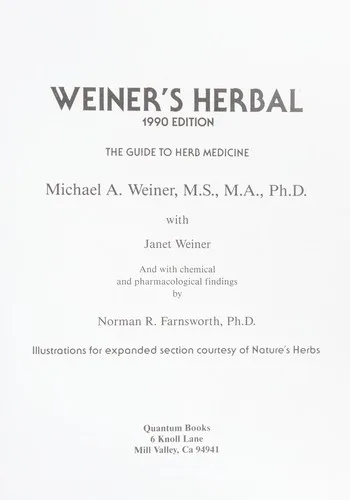
Weiner's herbal
 82
82

Weiner's herbal
Michael A. Weiner and Janet A. Weiner’s herbal compendium offers a sober, academic approach to plant lore that is both its greatest strength and, at times, a point of frustration. The work excels in its meticulous detailing of historical uses, particularly its exploration of plant signatures – the doctrine that a plant's physical characteristics hint at its medicinal purpose. For instance, the description of how liverwort was historically used for liver ailments due to its leaf shape is illuminating. However, the text occasionally feels dry, prioritizing comprehensive cataloging over narrative engagement. A notable limitation is its lack of modern scientific correlation, focusing almost exclusively on historical accounts. Despite this, Weiner's Herbal stands as an indispensable reference for understanding the deep historical roots of botanical medicine.
📝 Description
82
Published in 1980, Weiner's Herbal is a scholarly compendium of historical plant uses.
Weiner's Herbal, by Michael A. Weiner and Janet A. Weiner, is a detailed examination of botanical knowledge, focusing on the historical and esoteric applications of plants. It is not a guide for identifying plants in the wild. Instead, the book acts as a scholarly study of herbalism, covering medicinal, magical, and cultural uses across different traditions. The authors meticulously document plant properties, methods of preparation, and their historical applications, drawing on a wide range of old texts and practices. This work is for serious students of ethnobotany, historical medicine, and traditional Western herbalism. Researchers interested in the connections between botany and folklore, or those wanting to grasp the historical roots of current herbal practices, will find its depth useful. It appeals to academics, researchers, and practitioners who value a precise, historically-grounded approach to plant lore, moving past simple remedies to examine complex uses.
When it appeared in 1980, Weiner's Herbal coincided with a growing interest in natural healing and alternative medicine. While popular herbalism at the time often concentrated on easy remedies, this book stood out for its academic depth and historical breadth. It offered a vital counterpoint to more general guides. The book provides a resource for those interested in the specific effects and historical accounts of individual herbs, often addressing practices that had faded from common knowledge. It details historical preparation techniques, from simple infusions to more complex tinctures and poultices, stressing traditional methods used before modern pharmacology.
Weiner's Herbal engages with traditions where plants hold significance beyond their material properties. It examines historical beliefs, such as the doctrine of signatures, which suggested a plant's appearance indicated its healing powers. The book also touches upon the magical applications of herbs, a common thread in many Western esoteric traditions from folk magic to ceremonial practices. By detailing these historical and often hidden uses, the work connects to a lineage of herbalism that viewed plants as potent allies in both physical and spiritual well-being, differing from purely scientific or modern medicinal approaches.
💡 Why Read This Book?
• Understand the doctrine of plant signatures, a historical concept where a plant's appearance suggested its medicinal use, as detailed in the book's catalog of herbs. • Learn about historical preparation methods, such as the specific techniques for creating tinctures and decoctions described in the text, offering insight into pre-modern pharmacopeia. • Explore the historical medicinal applications of common plants, referencing ancient Greek and Roman texts to trace their therapeutic evolution across centuries.
⭐ Reader Reviews
Honest opinions from readers who have explored this book.
❓ Frequently Asked Questions
What is the primary focus of Weiner's Herbal?
Weiner's Herbal focuses on the historical and cultural uses of plants, particularly their medicinal and sometimes esoteric applications, drawing heavily on ancient and medieval texts.
Who authored Weiner's Herbal?
The book was authored by Michael A. Weiner and Janet A. Weiner, with its first publication dating back to 1980.
Does Weiner's Herbal include identification guides for plants?
No, it is not a field guide for plant identification. Its primary purpose is to document the historical knowledge and applications of herbs.
What historical periods does Weiner's Herbal cover?
The work draws upon a wide range of historical sources, including ancient Greek, Roman, and medieval European texts, to detail plant lore.
Is Weiner's Herbal relevant for modern herbal practitioners?
Yes, for practitioners interested in the historical lineage of herbal medicine and understanding the context behind traditional uses, it provides valuable depth.
What is the 'doctrine of signatures' discussed in the book?
The doctrine of signatures is a historical belief system that suggested a plant's physical characteristics, like shape or color, indicated the ailment it could treat.
🔮 Key Themes & Symbolism
Historical Medicinal Applications
The compendium meticulously details how various plants were historically employed for therapeutic purposes, tracing their use from ancient civilizations through medieval Europe. It highlights specific ailments treated and the preparation methods documented in primary sources. This focus provides a crucial link to understanding the evolution of pharmacopoeia and the empirical knowledge gathered over centuries before modern scientific validation.
Doctrine of Plant Signatures
A significant concept explored is the doctrine of signatures, the historical belief that a plant's morphology—its shape, color, or habitat—indicated the human organ or condition it was suited to treat. The book examines examples like the use of liverwort for liver complaints due to its lobed leaf structure, illustrating a form of sympathetic magic in botanical medicine.
Traditional Preparation Techniques
Weiner's Herbal studies the practical knowledge of preparing herbal remedies as practiced historically. It describes methods such as infusions, decoctions, tinctures, and poultices, emphasizing the precise techniques and proportions detailed in older texts. This offers insight into the alchemical and artisanal aspects of historical herbalism, distinct from modern industrial extraction.
Ethnobotany and Cultural Lore
Beyond pure materia medica, the work touches upon the cultural significance and folklore associated with plants. It illustrates how botanical knowledge was interwoven with societal beliefs, rituals, and magical practices across different eras. This aspect positions herbalism not just as medicine but as a fundamental part of human history and cultural expression.
💬 Memorable Quotes
Direct passages from the work, attributed to the author.
“Infusions and decoctions were primary methods for extracting plant properties.”
— This statement underscores the fundamental techniques for preparing herbal remedies detailed in the text, differentiating them from modern pharmaceutical processes and emphasizing historical craft.
“Ancient texts often described plants for ailments like fevers and wounds.”
— This interpretation points to the historical scope of the book, indicating its reliance on classical sources to detail the empirical, though pre-scientific, observations of plant efficacy.
“The liverwort's leaf shape was historically linked to liver treatments.”
— This specific example illustrates the doctrine of signatures in practice, showing how a plant's visual characteristics directly informed its perceived medicinal application in historical contexts.
“Medieval apothecaries relied on a specific set of botanical preparations.”
— This points to the book's examination of historical pharmacy, detailing the established practices and remedies used by practitioners in the medieval period.
💡 Key Ideas
Editorial paraphrase of the work's core concepts — not direct quotes.
The doctrine of signatures suggests a plant's physical appearance indicates its use.
This paraphrased concept highlights a core principle discussed in the book: the historical belief that nature provides visual cues for medicinal applications, linking a plant's form to its therapeutic function.
🌙 Esoteric Significance
Tradition
While not explicitly aligned with a single esoteric lineage like Hermeticism or Gnosticism, Weiner's Herbal engages with the foundational elements of Western esotericism through its detailed exploration of historical plant lore. The emphasis on the doctrine of signatures, for instance, taps into a vein of sympathetic magic and correspondences prevalent in Renaissance Hermeticism and earlier alchemical traditions. It acts as a historical repository for knowledge that informed magical botany and early folk medicine, often imbued with spiritual or magical beliefs.
Symbolism
The book implicitly engages with plant symbolism by detailing their historical uses, which were often tied to symbolic meanings. For example, plants associated with healing wounds might carry symbolic connotations of regeneration or life force. The doctrine of signatures itself is a form of symbolic interpretation, where a plant's form is seen as a divine or natural symbol pointing to its purpose. The very act of classifying and describing plants reflects a desire to understand the symbolic language of the natural world.
Modern Relevance
Contemporary practitioners of traditional Western herbalism, ethnobotanists, and scholars of medical history draw upon works like Weiner's Herbal. Researchers exploring the historical roots of pharmacognosy and the cultural history of medicine find its detailed cataloging invaluable. Modern pagan traditions and ecopsychology also find resonance in its depiction of the deep historical connection between humans and plants, often seeking to revive or understand these ancestral relationships.
👥 Who Should Read This Book
• Students of historical medicine and ethnobotany seeking a scholarly foundation in plant lore, who will benefit from the detailed documentation of ancient and medieval uses. • Researchers of Western esoteric traditions interested in the historical application of botanical knowledge in magic and early pharmacopeia, gaining insight into sympathetic magic and correspondences. • Aspiring herbalists focused on understanding the deep historical context of their practice, learning about traditional preparation methods and the evolution of plant-based remedies.
📜 Historical Context
When Weiner's Herbal was first published in 1980, the field of herbalism was experiencing a resurgence, largely driven by a counter-cultural interest in natural living and a skepticism towards conventional medicine. This period saw a proliferation of popular guides, but Weiner’s work distinguished itself through its scholarly rigor and historical depth. It engaged with a tradition stretching back to Dioscorides' *De Materia Medica* (circa 70 AD) and medieval herbals. While figures like Rudolf Steiner were exploring anthroposophical approaches to plants around the same time, Weiner's focus remained firmly on documented historical applications rather than speculative spiritual interpretations. The book provided a crucial academic counterpoint, grounding the burgeoning interest in herbalism in verifiable historical research and offering a resource for those seeking to understand the lineage of botanical medicine.
📔 Journal Prompts
The doctrine of plant signatures and its application to a specific herb.
Historical preparation methods: contrast infusions versus decoctions.
A plant's historical use for treating ailments of the skin.
The connection between a plant's physical form and its perceived medicinal properties.
How ancient Greek texts describe the use of a common garden herb.
🗂️ Glossary
Doctrine of Signatures
A historical belief system suggesting that a plant's physical characteristics (shape, color, habitat) indicate the human organ or condition it is intended to treat.
Infusion
A method of preparing herbal remedies by steeping plant material, typically leaves or flowers, in hot water.
Decoction
A method of preparing herbal remedies by simmering harder plant materials, such as roots or bark, in water for an extended period.
Tincture
A concentrated liquid herbal extract made by soaking plant material in alcohol or another solvent.
Materia Medica
The body of scientific, especially medical, knowledge concerning the properties of drugs and their uses, often referring historically to the cataloging of medicinal substances.
Ethnobotany
The scientific study of the relationships between people and plants, focusing on how cultures use plants for medicine, food, and other purposes.
Apothecary
A historical term for a person who prepared and sold medicines and drugs; a pharmacist.
🔮 Readers Also Liked
Browse all →









More by Michael A. Weiner, Janet A. Weiner
All books →
More Free Occult Philosophy Books
View all →