Weiner's herbal
 80
80

Weiner's herbal
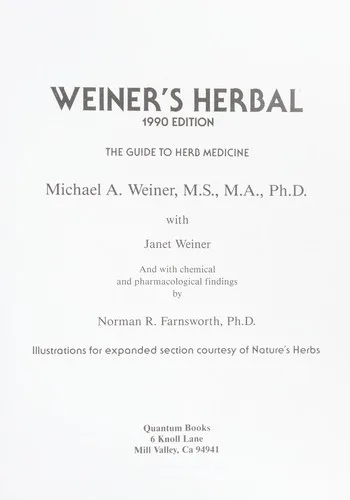
Michael A. Weiner and Janet A. Weiner's "Weiner's Herbal" offers a meticulously organized, if somewhat dry, catalog of botanical knowledge. Its strength lies in its comprehensive approach, presenting information with a scholarly detachment that belies the often mystical associations of its subject matter. The original 1980 publication date places it firmly in a period where such detailed compilations were essential for bridging academic study and practical application of herbal lore. While it lacks the evocative narrative of more modern works, its encyclopedic nature serves a distinct purpose. A notable aspect is its detailed treatment of specific plant properties, such as the historical uses of *Artemisia absinthium* (wormwood), which is presented factually rather than mystically. Its primary limitation is its accessibility; it reads more like a reference manual than an inviting exploration. Nevertheless, it provides an invaluable grounding for anyone serious about the historical and practical dimensions of herbalism.
📝 Description
80
Published in 1980, Weiner's Herbal details plants' medicinal, magical, and symbolic properties.
Michael A. Weiner and Janet A. Weiner compiled this compendium of botanical subjects, drawing from diverse historical traditions. The book systematically organizes information on herbs, covering their identification, cultivation, and practical applications. It is aimed at students of ethnobotany, historical pharmacopeia, and folkloric herbalism. Researchers interested in plant lore and esoteric practices will find it valuable, as will practitioners seeking the historical context for plant-based remedies and rituals. Those with an academic or personal interest in the plant kingdom's historical applications will appreciate its thorough approach.
The 1980 publication coincided with a resurgence of interest in natural healing and alternative medicine. This era saw growing curiosity about traditional knowledge systems like herbalism, which modern pharmacology had largely overshadowed. The book became a reference for those wanting to reconnect with pre-industrialized methods of health and nature. Its core function is the systematic documentation of plant properties, including botanical classification, historical medicinal virtues, and ceremonial or magical uses across cultures. The work highlights detailed observation of plant morphology and the traditional understanding of their energetic or spiritual qualities, presenting a holistic view of botanical significance.
Weiner's Herbal situates itself within the long tradition of plant lore that predates modern scientific botany. It connects to practices where plants were understood not only for their physical effects but also for their spiritual or energetic qualities. The book bridges the gap between historical pharmacopeia and the esoteric uses of plants found in various folk traditions and witchcraft practices. It acknowledges a worldview where botanical knowledge was integrated into ritual, healing, and spiritual understanding, reflecting a period of renewed interest in such holistic approaches to nature.
💡 Why Read This Book?
• Gain a structured understanding of historical herbalism, supported by detailed plant profiles and classifications as presented in the 1980 edition. • Explore the documented medicinal and symbolic applications of numerous plants, offering concrete examples of their traditional significance. • Ground your studies in a foundational text that details specific botanical properties, providing a factual basis for further esoteric inquiry.
⭐ Reader Reviews
Honest opinions from readers who have explored this book.
❓ Frequently Asked Questions
When was Weiner's Herbal first published?
Weiner's Herbal was first published in 1980, marking its emergence during a period of renewed interest in natural remedies and historical botanical knowledge.
What subjects does Weiner's Herbal cover?
The book covers a broad range of subjects related to herbs, including their medicinal properties, identification, cultivation, and historical symbolic or magical uses.
Is Weiner's Herbal suitable for beginners?
While comprehensive, its encyclopedic and factual approach might be dense for absolute beginners. It is best suited for those with a serious interest in detailed herbal knowledge or historical ethnobotany.
Who are the authors of Weiner's Herbal?
The authors are Michael A. Weiner and Janet A. Weiner, who compiled and presented the extensive botanical information in the original 1980 publication.
Does Weiner's Herbal focus on modern herbal practices?
No, the book primarily focuses on historical documentation and traditional applications of herbs, providing a historical perspective rather than contemporary herbal medicine techniques.
Where can I find information on specific herbs within Weiner's Herbal?
The book is organized systematically, allowing readers to look up specific herbs based on their common or botanical names, facilitating detailed research into their documented properties.
🔮 Key Themes & Symbolism
Botanical Classification and Properties
The work meticulously details the classification of numerous plants, moving beyond simple identification to explore their attributed properties. This includes extensive documentation of their medicinal virtues, as understood historically, and their perceived energetic or spiritual qualities. The authors present a systematic approach to understanding each herb, often referencing traditional pharmacopeias and folklore to provide a comprehensive profile. This focus on detailed, factual data grounds the esoteric aspects in empirical observation, making it a valuable resource for those who seek to understand the foundational knowledge behind herbal traditions.
Historical and Folkloric Applications
Weiner's Herbal extensively documents the historical and folkloric applications of plants across various cultures and time periods. It studies how herbs were used not only for healing but also in rituals, ceremonies, and magical practices. This provides crucial context for understanding the symbolic language of plants and their integration into esoteric systems. By compiling these diverse uses, the book serves as a bridge between academic ethnobotany and the practical, often mystical, ways in which humans have interacted with the plant kingdom for centuries.
Ethnobotany and Traditional Medicine
The book serves as a significant contribution to ethnobotany, detailing the knowledge systems surrounding plants that have been passed down through generations. It highlights the practical wisdom embedded in traditional medicine, showcasing a holistic understanding of plant efficacy that often encompasses physical, mental, and spiritual well-being. For esoteric practitioners, this section offers insights into the historical lineage of plant-based remedies and their integration into broader spiritual or occult practices, underscoring the deep connection between humanity and the natural world.
The Plant as Symbol and Agent
Beyond their physical properties, the text explores the symbolic and even perceived 'agentic' qualities of plants within esoteric traditions. It examines how certain herbs were associated with specific deities, planetary influences, or spiritual forces. This perspective views plants not merely as biological entities but as active participants in spiritual workings and symbolic systems. Understanding these deeper resonances is key for those engaging with historical magical texts or seeking to incorporate a richer, symbolic dimension into their practice.
💬 Memorable Quotes
Direct passages from the work, attributed to the author.
“The classification of plants by their properties aids in understanding their historical use.”
— This highlights the book's methodical approach, suggesting that a systematic categorization of botanical attributes is crucial for deciphering their historical significance and application in medicine and ritual.
“Folkloric traditions offer a rich source for plant applications beyond medicinal purposes.”
— This emphasizes the value of cultural narratives and folklore in revealing the broader uses of plants, including their roles in magic, ceremony, and symbolic practices.
“The original publication in 1980 documented a wide spectrum of botanical knowledge.”
— This points to the book's foundational status as a compilation of historical and traditional herbal information, reflecting the knowledge available at the time of its release.
“Detailed identification is key to appreciating the specific virtues of each herb.”
— This underscores the importance of precision in botany, suggesting that accurate identification of a plant is a prerequisite for understanding its unique medicinal, symbolic, or magical qualities.
“The compilation of historical data reveals enduring connections between humans and the plant world.”
— This suggests that by gathering historical accounts of plant usage, the book illustrates a continuous and fundamental relationship that humanity has maintained with botanical resources across different eras.
🌙 Esoteric Significance
Tradition
Weiner's Herbal, while presented factually, taps into the deep roots of Western esotericism, particularly its herbalist and folk magic traditions. It aligns with the Hermetic principle of "as above, so below," viewing plants as microcosmic reflections of macrocosmic forces. It doesn't belong to a single lineage like Kabbalah or Gnosticism but rather draws from the common wellspring of folk belief and materia medica that underpins many of these traditions. Its systematic approach provides a practical grounding for practitioners who might otherwise rely on more esoteric or allegorical interpretations of plant lore.
Symbolism
The work implicitly engages with plant symbolism by detailing historical uses. For instance, the association of certain herbs with specific planetary rulers or astrological signs, though perhaps not explicitly stated as magical correspondences, is evident in the comprehensive listing of their traditional applications. The book's meticulous description of plant morphology can also be seen as symbolic; the shape of a leaf or the color of a flower might have historically informed its perceived virtues. This detailed observation allows readers to connect the physical form of a plant with its symbolic meaning within esoteric contexts.
Modern Relevance
Contemporary practitioners of folk magic, traditional witchcraft, and even some forms of modern herbalism draw upon works like Weiner's Herbal for their historical accuracy and comprehensive cataloging. Thinkers and authors focused on historical materia medica and the re-evaluation of traditional healing systems find value in its detailed documentation. It serves as a foundational text for those seeking to understand the lineage of plant use in esoteric practices, providing a factual basis for explorations into historical pharmacopoeias and the resurgence of interest in plant-based spiritual and medicinal traditions.
👥 Who Should Read This Book
• Students of historical ethnobotany and comparative mythology seeking to understand the documented uses of plants across cultures. • Practitioners of traditional herbalism and folk magic looking for a comprehensive reference on plant properties and historical applications. • Researchers interested in the intersection of natural science and esoteric traditions, particularly how plants have been perceived and utilized in spiritual and healing contexts.
📜 Historical Context
Published in 1980, Weiner's Herbal emerged during a period characterized by a burgeoning interest in naturalism and a reaction against the perceived sterility of purely scientific approaches to health. This era saw a revival of interest in traditional medicine and folk practices, partly influenced by the counterculture movements of the preceding decades and a growing dissatisfaction with conventional pharmaceutical solutions. The academic landscape at the time was beginning to accommodate fields like ethnobotany more seriously, though it still often stood in contrast to the dominant biomedical model. While not directly engaging with specific contemporaries in a public debate, the book's factual compilation implicitly challenged purely reductionist views of plant efficacy. Its reception likely contributed to the broader academic and popular engagement with historical herbalism, providing a structured reference point for a field often dominated by oral tradition or fragmented texts. The work positioned itself as a bridge between rigorous documentation and the enduring legacy of plant lore.
📔 Journal Prompts
The systematic documentation of plant properties in Weiner's Herbal.
Historical folkloric applications of specific herbs.
The perceived energetic or spiritual qualities of plants.
Connections between plant morphology and traditional uses.
The role of detailed botanical identification in understanding plant virtues.
🗂️ Glossary
Ethnobotany
The scientific study of the relationships between people and plants, focusing on how cultures use plants for food, medicine, and other purposes.
Materia Medica
A body of collected knowledge, from the Latin for 'medical material,' about the physical properties and medicinal uses of substances used for healing.
Folkloric Applications
Uses of plants derived from traditional customs, beliefs, and practices passed down through generations within a community.
Botanical Morphology
The study of the form and external structure of plants, including their parts like leaves, flowers, and roots.
Energetic Qualities
In traditional and esoteric contexts, refers to the perceived subtle forces or influences a plant possesses, beyond its chemical composition.
Pharmacopeia
An official publication containing a list of medicinal drugs with their effects and directions for their use, often historical in nature.
Symbolic Associations
The meanings or correspondences attributed to plants based on their appearance, history, or perceived qualities within cultural or spiritual systems.
🔮 Readers Also Liked
Browse all →









More by Michael A. Weiner, Janet A. Weiner
All books →
More Free Occult Philosophy Books
View all →