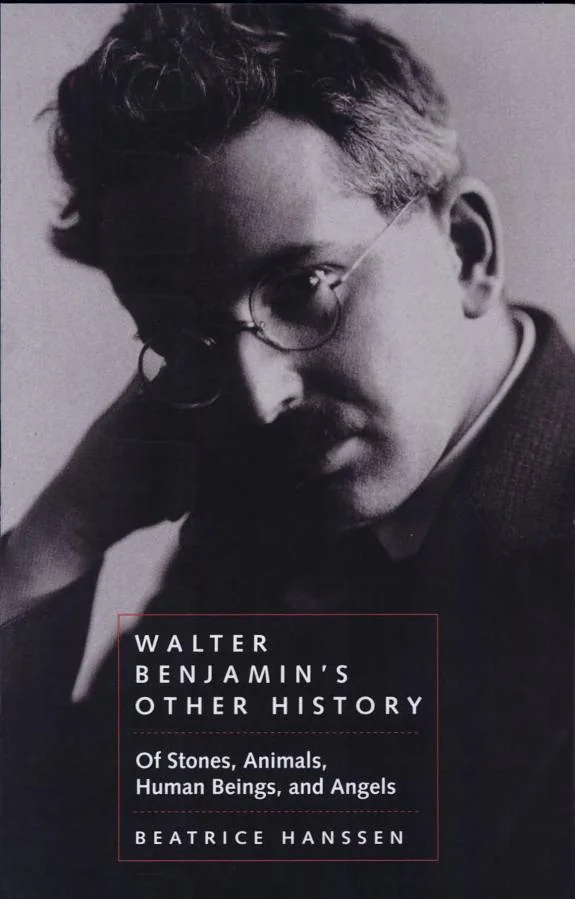
Walter Benjamin's Other History
 78
78

Walter Benjamin's Other History
Beatrice Hanssen's "Walter Benjamin's Other History" offers a necessary corrective to the common dismissal of Benjamin's "The Origin of German Tragic Drama" as inaccessible. Hanssen succeeds remarkably in untangling the dense philosophical arguments, particularly Benjamin's radical reinterpretation of historical time and his critique of historical narrative. The book's strength lies in its meticulous scholarship and its ability to connect Benjamin's 1928 work to his later, more widely discussed writings. A particularly illuminating section examines Benjamin's use of Baroque tragedy as a lens for understanding historical experience, demonstrating how allegorical fragmentation can offer an alternative to teleological progress narratives. However, the dense prose, while precise, may still present a barrier for those not already steeped in Benjaminian exegesis. Despite this, the work is indispensable for anyone serious about grasping the full scope of Benjamin's philosophical project. Hanssen provides a vital key to unlocking one of the 20th century's most complex thinkers.
📝 Description
78
Beatrice Hanssen's 1998 study reframes Walter Benjamin's "The Origin of German Tragic Drama."
In 1998, Beatrice Hanssen published "Walter Benjamin's Other History," a work that reassesses the philosopher's 1928 text, "The Origin of German Tragic Drama." Hanssen argues against viewing Benjamin's early work as obscure or confined to academic circles. Instead, she positions it as a crucial component for understanding his larger intellectual framework, especially his ideas on historical materialism and messianic thought. This book is intended for advanced students and scholars specializing in Walter Benjamin, critical theory, and German literature. A prior familiarity with Benjamin's other writings, such as "Theses on the Philosophy of History" and "Illuminations," is beneficial. It does not serve as an introduction but rather as an in-depth examination of the interpretive difficulties and philosophical depth found within Benjamin's significant early publication.
Hanssen's study is situated within late 20th-century scholarship that moved beyond earlier Marxist readings of Benjamin's collected works. The book considers how "The Origin of German Tragic Drama" was received, a text often seen as diverging from standard Marxist analysis. Hanssen places her research within ongoing discussions about Benjamin's connection to Surrealism and his distinct approach to historical critique, contrasting it with prevailing Hegelian or Lukácsian historical methods. The analysis focuses on Benjamin's ideas of "history as a catastrophe," his critique of "progress," and the concept of the "monad" as a method for historical representation. Hanssen demonstrates how these ideas, present in "The Origin of German Tragic Drama," are fundamental to grasping Benjamin's later thoughts on art, technology, and memory. The book also looks at Baroque drama and its allegorical structure as a lens through which Benjamin understood historical time.
Hanssen's work engages with the reception of Walter Benjamin's "The Origin of German Tragic Drama," a text that, while formally academic, contains elements often interpreted through an occult or messianic lens. The book examines Benjamin's critique of historical progress and his use of concepts like the 'monad' and allegory, which resonate with traditions seeking hidden meanings in historical events and cultural artifacts. By connecting these ideas to Benjamin's broader critique of historical materialism, Hanssen situates his early work within a lineage of thought that looks beyond conventional historical narratives for deeper, often esoterically inflected, understandings of time and redemption.
💡 Why Read This Book?
• Gain a lucid understanding of Walter Benjamin's "The Origin of German Tragic Drama," a text published in 1928, and its philosophical underpinnings regarding history and memory. • Grasp Benjamin's critique of historical progress and its connection to his analysis of Baroque allegorical drama, as detailed by Hanssen. • Understand how concepts like the "monad" and "history as catastrophe" articulate Benjamin's unique approach to historical materialism and cultural critique.
⭐ Reader Reviews
Honest opinions from readers who have explored this book.
❓ Frequently Asked Questions
What is Beatrice Hanssen's primary argument about Walter Benjamin's "The Origin of German Tragic Drama"?
Hanssen argues that Benjamin's 1928 work is not merely an obscure treatise but a foundational text crucial for understanding his entire philosophical project, particularly his views on history and materialism.
When was Beatrice Hanssen's book on Walter Benjamin first published?
Beatrice Hanssen's "Walter Benjamin's Other History" was first published on March 27, 1998.
What specific aspect of Benjamin's work does Hanssen focus on to re-interpret his "The Origin of German Tragic Drama"?
Hanssen focuses on Benjamin's analysis of German Baroque drama and its allegorical structures, using this as a key to unlock his broader philosophical concepts concerning history and time.
Is "Walter Benjamin's Other History" suitable for beginners in Benjamin studies?
No, the book is intended for advanced scholars and students of philosophy, requiring prior knowledge of Benjamin's other works and critical theory.
What historical context is important for understanding Hanssen's re-evaluation?
Hanssen's work engages with the late 20th-century scholarly debates surrounding Benjamin, particularly the re-evaluation of his early writings beyond purely Marxist interpretations.
Does Hanssen discuss Benjamin's concept of historical materialism?
Yes, a core aspect of Hanssen's argument is how "The Origin of German Tragic Drama" illuminates Benjamin's unique formulation of historical materialism, especially his critique of progress.
🔮 Key Themes & Symbolism
Allegory and Ruin
Hanssen meticulously unpacks Benjamin's fascination with allegory in German Baroque drama, viewing it not as mere literary style but as a profound method for understanding history. This approach allows Benjamin to dissect historical moments as ruins, revealing fragmented truths and the decay of meaning under the weight of time, a concept crucial for his critique of historical progress.
Critique of Progress
Central to Hanssen's interpretation is Walter Benjamin's challenge to the linear, teleological conception of historical progress. By analyzing the "The Origin of German Tragic Drama," she shows how Benjamin posited history not as a smooth unfolding towards a better future, but as a series of catastrophes, offering a messianic counter-narrative.
The Monad as Historical Form
Hanssen highlights Benjamin's use of the Baroque "monad" as a concept to grasp historical phenomena. This complex notion, explored in his 1928 work, represents a singular, concentrated point of historical experience that expresses the totality of time and historical forces, serving as an alternative to grand historical narratives.
Materialism and Messianism
The study bridges what might seem like disparate elements in Benjamin's thought: historical materialism and messianic redemption. Hanssen demonstrates how Benjamin's analysis of "The Origin of German Tragic Drama" reveals a profound synthesis, where the material conditions of history are imbued with a redemptive, albeit fragmented, potential.
💬 Memorable Quotes
Direct passages from the work, attributed to the author.
“The work explores the Baroque Trauerspiel as a model for historical understanding.”
— This interpretation refers to Benjamin's deep engagement with German Baroque mourning plays, which he used to analyze the allegorical nature of history and the experience of time.
“Hanssen elucidates Benjamin's critique of the concept of historical progress.”
— This highlights a core argument of the book, focusing on how Benjamin, through his analysis of tragic drama, dismantled notions of linear historical advancement in favor of a catastrophic model.
“Allegory reveals the ruinous nature of history.”
— This interpretation captures Benjamin's view, as detailed by Hanssen, that allegory in art and history exposes the decay, fragmentation, and ephemerality inherent in temporal existence.
💡 Key Ideas
Editorial paraphrase of the work's core concepts — not direct quotes.
Benjamin's "The Origin of German Tragic Drama" is not an impenetrable treatise but a key to his entire work.
This paraphrased concept emphasizes Hanssen's central thesis: that Benjamin's complex 1928 study is foundational, not peripheral, to understanding his philosophical evolution and mature ideas.
The monad serves as a structure for understanding historical time and experience.
This paraphrased concept points to Benjamin's theoretical tool, the monad, as a means to grasp concentrated moments of historical significance that contain broader temporal and existential weight.
🌙 Esoteric Significance
Tradition
While Benjamin's work is not explicitly aligned with a single esoteric tradition, Hanssen's analysis reveals deep resonances with Gnostic and Kabbalistic thought. Benjamin's concept of "history as catastrophe" and his focus on fragmented, ruinous historical experience echo Gnostic ideas of a fallen world and the search for hidden knowledge. The "monad" as a redemptive, concentrated historical point can be seen as analogous to Kabbalistic concepts of divine sparks or concentrated mystical insight.
Symbolism
Key symbolic motifs explored include the Baroque "Trauerspiel" (mourning play), which Benjamin uses to represent historical time as allegorical and decaying, rather than progressive. The "ruin" itself becomes a potent symbol, signifying the fragmented nature of historical memory and the ephemeral quality of existence. The "monad," a complex philosophical symbol, represents a singular point that contains universal time and historical totality.
Modern Relevance
Contemporary thinkers exploring post-structuralist theory, trauma studies, and critical messianism often draw upon Benjamin's ideas as re-interpreted by scholars like Hanssen. His critique of linear time and progress remains relevant for ecological thought and critiques of technological accelerationism. Practices focused on memory studies, archival theory, and the philosophy of history continue to engage with Benjamin's method of historical analysis.
👥 Who Should Read This Book
• Advanced students of philosophy and critical theory seeking to understand Walter Benjamin's complex early work, "The Origin of German Tragic Drama." • Scholars of German literature and cultural history interested in Benjamin's engagement with Baroque drama and its allegorical significance. • Researchers in historical studies and political philosophy looking for alternative frameworks to understand historical progression beyond teleological models.
📜 Historical Context
Beatrice Hanssen's "Walter Benjamin's Other History" was published in 1998, a period of intense scholarly re-engagement with Walter Benjamin's vast and often challenging body of work. Benjamin himself died in 1940, leaving behind writings that spanned literary criticism, philosophy, art theory, and urban studies. His "The Origin of German Tragic Drama," published in 1928, had long been considered a difficult text, often overshadowed by his later essays like "The Work of Art in the Age of Mechanical Reproduction" or the "Theses on the Philosophy of History." Hanssen's study emerged within a milieu that sought to move beyond purely Marxist readings of Benjamin, acknowledging the influence of figures like Gershom Scholem and the existentialist undertones in his thought. The book addressed the reception of Benjamin's 1928 work, which, while recognized as significant, struggled for interpretive clarity, particularly in contrast to the more accessible Hegelian historical narratives prevalent at the time.
📔 Journal Prompts
Benjamin's concept of the 'monad' as a historical singularity.
The allegorical structure of Baroque Trauerspiel.
History as catastrophe versus the idea of progress.
The significance of ruins in Benjamin's philosophy of history.
Connecting Benjamin's materialism with messianic thought.
🗂️ Glossary
Trauerspiel
German term for "mourning play" or "tragedy," specifically referring to the Baroque drama that Walter Benjamin extensively analyzed in his 1928 work.
Allegory
In Benjamin's context, a mode of interpretation and representation that reveals the decay and fragmentation of meaning within historical phenomena, contrasting with symbolic unity.
Monad
A philosophical concept, particularly from Leibniz and adapted by Benjamin, representing a singular, self-contained entity that can embody universal time and historical totality.
History as Catastrophe
Walter Benjamin's view of historical progression not as linear advancement, but as a series of destructive events and moments of crisis.
Historical Materialism
A Marxist theoretical approach that emphasizes the role of material conditions, particularly economic production, in shaping history and society. Benjamin offered a distinctive, non-orthodox interpretation.
Messianism
A theological or philosophical concept related to a savior or redeemer; in Benjamin's work, it refers to a potential for redemption or a break in historical continuity.
Progress
The concept of linear, continuous forward movement towards improvement or development, which Benjamin critically examined and largely rejected.
This book appears in 1 collection
🔮 Readers Also Liked
Browse all →









From the “Angels” Collection
View all →





More Free Occult Philosophy Books
View all →