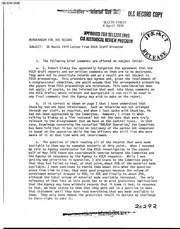
CIA Reading Room 00505170: 30 MARCH 1979 LETTER FROM HSCA STAFF DIRECTOR
 78
78

CIA Reading Room 00505170: 30 MARCH 1979 LETTER FROM HSCA STAFF DIRECTOR



Silas Hawthorne, Hermetic Studies Editor: This meticulously declassified missive from the HSCA Staff Director is a potent artifact for those attuned to the subtle currents of power and information control. Beyond its apparent administrative function, the document whispers of protocols and agreements that suggest a deliberate effort to manage historical disclosure, echoing themes of Gnostic secrecy and the guarding of sacred knowledge. Its strength lies in its implicit revelations about the mechanics of information containment, offering a fertile ground for contemplating the esoteric art of 'knowing what is not meant to be known.' Highly recommended for researchers of institutional occultism and seekers of foundational truths.
📝 Description
78
A March 30, 1979 letter from the HSCA Staff Director details suppressed knowledge.
This document, identified as CIA Reading Room 00505170, originates from March 30, 1979. It is a letter penned by the Staff Director of the House Select Committee on Assassinations (HSCA). The text emerges from archival records concerning covert activities. It reveals insights into the mechanisms that shape public accounts of events. The content suggests a deliberate structuring of information, incorporating elements of concealed learning and the indirect impact of undisclosed objectives.
The atmosphere within the letter is one of containment, marked by the presence of protected secrets. It implies that deeper realities are obscured by bureaucratic processes and official justifications. This text will appeal to those who seek hidden histories and engage in esoteric inquiry, recognizing that genuine comprehension often exists outside of public awareness. Its importance rests on its implicit observations about the formation of truth, the creation of perceived reality, and the ongoing tension between disclosure and suppression.
While not overtly occult, this document touches on themes common in esoteric traditions: the manipulation of information, the existence of hidden layers of reality, and the struggle to uncover concealed truths. Esoteric thought often examines how power structures control perception and disseminate narratives. This letter, by its very nature as a declassified internal communication, offers a real-world example of these dynamics, revealing the 'behind the scenes' processes that shape historical understanding and public consciousness. It invites contemplation on the nature of institutional memory and the potential for hidden knowledge within official records.
💡 Why Read This Book?
Uncover veiled insights into institutional secrecy and the management of information. This document offers a unique lens for understanding how narratives are shaped and what might lie hidden beneath official pronouncements. Ideal for critical thinkers, history enthusiasts, and those exploring the esoteric dimensions of power structures. Discover the potential for hidden knowledge within seemingly mundane records.
⭐ Reader Reviews
Honest opinions from readers who have explored this book.
❓ Frequently Asked Questions
What is the primary subject of this document?
The document primarily concerns a letter dated March 30, 1979, from the HSCA Staff Director, and comments regarding the handling of its draft reports and related correspondence.
Who is G. Robert Blakey mentioned in the text?
G. Robert Blakey was the Chief Counsel and Staff Director of the House Select Committee on Assassinations (HSCA), a key figure in the investigation of President Kennedy's assassination.
What is the significance of the 'agreement' mentioned?
The 'agreement' refers to a protocol where HSCA draft reports and comments were to be destroyed, implying they were not intended to become official records subject to public disclosure like FOIA requests.
What does 'OLC/79-1192/2' signify?
This likely represents an internal classification or reference number within the CIA, possibly indicating the Office of Legal Counsel and a specific file or processing code for this release.
Why was this document declassified for release in 1993?
The document was approved for release under the CIA Historical Review Program, indicating a decision to make it publicly available after a period of review and redaction, likely for historical research purposes.
🔮 Key Themes & Symbolism
The Art of Concealment and Revelation
This document powerfully illustrates the esoteric principle of information control, where the deliberate destruction of records and adherence to specific protocols are employed to shape historical understanding. It speaks to the hidden knowledge that governments and institutions possess, and the meticulous processes by which certain truths are kept veiled from public scrutiny. The 'agreement' concerning draft reports suggests an active management of narrative, a sophisticated form of 'occultism' applied to statecraft, where what is not recorded becomes as significant as what is. It invites contemplation on the magician's art of misdirection and the power inherent in controlling what is seen and what remains unseen.
Institutional Memory and the Esoteric Archive
The 'CIA Reading Room' itself is an esoteric space, a repository of guarded knowledge and institutional memory. This particular document, a letter from the HSCA Staff Director, acts as a key that unlocks a subtle understanding of how this memory is curated and protected. The very act of declassification, even years later, points to a layered approach to truth, where information is released strategically. This aligns with esoteric traditions that emphasize the importance of understanding the 'akashic records' of human endeavor, and how official narratives are often curated versions of these deeper, more complex realities. It prompts us to consider the unacknowledged forces that shape our collective understanding of history.
The Symbolism of Bureaucracy and Power
Within the seemingly dry language of administrative memos and legal agreements lies a strong symbolism for the student of esoteric philosophy. The 'CIA Reading Room,' the 'HSCA Staff Director,' and the 'agreement' to destroy records are not merely functional terms; they represent archetypal forces at play in the manifestation of power and the control of consciousness. This document, by its very nature, becomes a symbolic representation of the labyrinthine structures that govern our world, and the hidden currents that flow beneath the surface of apparent order. It offers a practical study in how esoteric principles are enacted in the mundane area of governance and information dissemination.
💬 Memorable Quotes
Direct passages from the work, attributed to the author.
“They were not to constitute records and as a result are not subject to FOIA proceedings.”
— This statement highlights the deliberate creation of ephemeral information to evade public scrutiny and the constraints of transparency, akin to magical wards protecting forbidden knowledge.
“APPROVED FOR RELEASF.1993”
— The act of approval and specific release date signifies a controlled unveiling, a deliberate revelation of previously guarded information under specific conditions.
“MEMORANDUM FOR THE RECORD”
— This phrase signifies the creation of an official, yet internal, account, suggesting a layered approach to documentation where some records are for public consumption and others are for internal custodianship.
“The following brief comments are offered on subject letter:”
— This introduces a meta-commentary, where the document itself is a subject of further analysis and interpretation, revealing layers of discourse and hidden intentions.
“G. Robert Blakey has apparently forgotten the agreement...”
— This points to potential breaches in protocol or memory within the system of control, hinting at the fallibility of even meticulously constructed layers of secrecy.
🌙 Esoteric Significance
Tradition
This document touches upon themes resonant with Hermeticism and Gnosticism, particularly the concept of hidden knowledge (Gnosis) and the existence of veils or demiurgic forces that obscure ultimate truth. The deliberate destruction of records to prevent FOIA proceedings carries the Gnostic idea of the Archons, who guard the material world and prevent souls from ascending. It also aligns with Hermetic principles of correspondence, where the macrocosm of state power is reflected in the microcosm of bureaucratic procedures and information management, revealing underlying patterns of control and manipulation.
Symbolism
The 'CIA Reading Room' itself symbolizes a sacred space of guarded knowledge, akin to an occult library or temple. The 'agreement' to destroy draft reports represents the act of 'binding' or 'sealing' of information, a ritualistic practice to maintain secrecy. G. Robert Blakey, as the Staff Director, can be seen as a 'Guardian of the Threshold,' responsible for managing the flow of information. The 'declassification' in 1993 symbolizes a controlled 'initiation,' where a sliver of previously hidden knowledge is revealed, but only under specific conditions set by the custodians.
Modern Relevance
In an age saturated with information and disinformation, the principles illustrated in this document are more relevant than ever. The strategic management of narratives, the creation of 'alternative facts,' and the deliberate obfuscation of truth are contemporary manifestations of the same forces at play in 1979. Understanding how institutions control information offers critical tools for working through the modern media landscape, discerning genuine knowledge from manufactured realities, and recognizing the subtle, often unseen, influences that shape public perception and discourse. It empowers individuals to question official narratives and seek deeper understanding.
👥 Who Should Read This Book
This document is essential for critical thinkers, investigative researchers, and students of power dynamics. **Beginners** in esoteric studies will find it an accessible introduction to how esoteric principles of secrecy and control manifest in the secular world. **Scholars** of history, political science, and intelligence studies will gain a nuanced perspective on institutional behavior and information management. **Seekers** of truth will find it a compelling example of the 'veiling' of knowledge, prompting deeper inquiry into hidden agendas. **Practitioners** of contemplative or investigative esotericism can use it as a case study for analyzing the subtle forces that shape collective consciousness and historical outcomes.
📜 Historical Context
This document emerges from the late 1970s, a period rife with investigations into government overreach and clandestine activities, most notably the aftermath of the Watergate scandal and ongoing scrutiny of intelligence agencies. The House Select Committee on Assassinations (HSCA), established in 1976, was tasked with reinvestigating the assassinations of President John F. Kennedy and Martin Luther King Jr. This era was characterized by a public clamor for transparency and a growing awareness of the potential for secret governmental actions to influence historical events. The existence of internal agreements to destroy draft reports, as alluded to in this document, speaks volumes about the prevailing atmosphere of secrecy and the lengths to which official bodies would go to control their narrative and evade public accountability, even within the context of supposedly open investigations.
📔 Journal Prompts
Consider a time you felt information was deliberately withheld or manipulated. How did this affect your understanding?
How do you perceive the 'CIA Reading Room' as a symbolic space of hidden knowledge? What other 'reading rooms' of power exist?
Reflect on the 'agreement' to destroy records. What does this reveal about the nature of official history and memory?
In what ways can bureaucratic language and procedures be interpreted as a form of esoteric code or ritual?
How can understanding institutional secrecy empower you to seek truth in your own life and in the wider world?
🗂️ Glossary
HSCA
House Select Committee on Assassinations. A U.S. Congressional committee formed to investigate the assassinations of President John F. Kennedy and Martin Luther King Jr.
FOIA
Freedom of Information Act. A U.S. federal law that grants the public the right to request access to records from any federal agency.
Declassification
The process by which classified information is officially released from a restricted status, making it available for public access after a review period.
Staff Director
The chief administrative officer of a committee or organization, responsible for managing its operations and staff.
Draft Reports
Preliminary versions of official documents or findings that have not yet been finalized or formally adopted. These are often internal working documents.
This book appears in 6 collections
🔮 Readers Also Liked
Browse all →









More by CIA Reading Room
All books →



From the “Out-of-Body Experience” Collection
View all →
![The Tipperary (or Clonmel) witch case : [transcripts of newspaper reports &c. concerning Bridget Cleary, burned as a witch, and the trial of her husband and neighbours for murder, in 1895]](/img/thumb/the-tipperary-or-clonmel-witch-case-transcripts-of-newspaper-reports-c-concerning-bridget-cleary-burned-as-a-witch-and-the-trial-of-her-husband-and-neighbours-for-murder-in-1895.webp)





More Free Occult Philosophy Books
View all →