Tutankhamun
 76
76

Tutankhamun
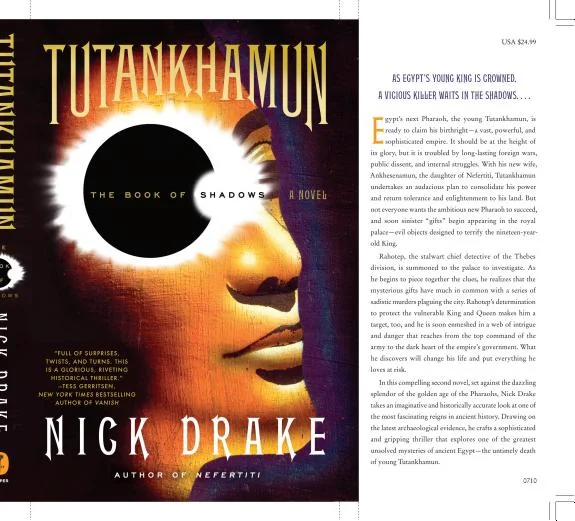
Nick Drake’s *Tutankhamun* offers a familiar yet satisfying return to the world of Rahotep, the detective introduced in *Nefertiti*. The strength of this novel lies in Drake's meticulous research, which underpins a narrative that feels both historically plausible and dramatically engaging. Rahotep, the 'seeker of mysteries,' is a wonderfully realized character, his keen observations cutting through the opulent yet dangerous atmosphere of the 18th Dynasty court. The novel succeeds in portraying the precarious position of the young pharaoh, Tutankhamun, caught between powerful factions vying for influence. However, at times, the plot relies a little too heavily on Rahotep’s almost supernatural intuition, stretching credulity even within the fictional framework. The description of the political machinations surrounding the restoration of the old gods after Akhenaten's heresy is particularly well-handled. Drake’s *Tutankhamun* is a solid historical mystery that brings a fascinating period of Egyptian history to life.
📝 Description
76
Nick Drake's 2010 novel *Tutankhamun* revisits the boy pharaoh's reign and death.
Published in 2010, Nick Drake's *Tutankhamun* continues the story begun in *Nefertiti: The Book of the Dead*. The novel follows the detective Rahotep as he investigates the life and mysterious end of the young pharaoh Tutankhamun. Drake combines historical events and figures from the 18th Dynasty with a fictionalized mystery plot. Readers interested in the political and religious turmoil of ancient Egypt, specifically the Amarna Period and its aftermath, will find the setting rich.
The narrative centers on the restoration of traditional Egyptian polytheism after Akhenaten's monotheistic reforms, with Tutankhamun at the heart of this transition. Rahotep's inquiries serve to uncover the hidden forces and possible conspiracies that may have influenced events surrounding the pharaoh. The book engages with historical questions about Tutankhamun's brief rule and the circumstances of his death, framing them within a fictional investigative framework.
This novel operates within the tradition of historical fiction that uses ancient Egypt as a setting for supernatural or occult undertones, particularly concerning the mysteries surrounding pharaonic deaths and the transition between religious eras. It taps into popular fascination with the occult aspects of Egyptian religion, the curses associated with tombs, and the perceived magical forces at play during periods of significant socio-religious change like the Amarna period. The narrative uses Rahotep's investigation to explore these shadowy possibilities within a structured mystery.
💡 Why Read This Book?
• Gain insight into the political climate of Egypt's 18th Dynasty, specifically the restoration of polytheism following Akhenaten's reign, as depicted through Rahotep's investigation. • Experience the historical enigma of Tutankhamun's death through a fictionalized detective narrative, offering a unique perspective on a well-known figure. • Understand the role of figures like Rahotep as 'seekers of mysteries' within the context of ancient Egyptian society and its complex religious and political landscape.
⭐ Reader Reviews
Honest opinions from readers who have explored this book.
❓ Frequently Asked Questions
When was Nick Drake's book 'Tutankhamun' first published?
Nick Drake's novel 'Tutankhamun' was first published on June 17, 2010.
Who is the main detective character in 'Tutankhamun'?
The main detective character is Rahotep, who was previously featured in Drake's novel 'Nefertiti: The Book of the Dead'.
What historical period does 'Tutankhamun' by Nick Drake focus on?
The novel is set during the reign of Tutankhamun, during the later part of the 18th Dynasty in ancient Egypt, a period of significant religious and political transition.
What is the central mystery in Nick Drake's 'Tutankhamun'?
The central mystery revolves around the circumstances of the young pharaoh Tutankhamun's death and the political intrigues surrounding his court and succession.
Is 'Tutankhamun' a standalone novel or part of a series?
'Tutankhamun' is part of a trilogy by Nick Drake, following 'Nefertiti: The Book of the Dead' and preceding the yet-to-be-named final book, with Rahotep as a recurring protagonist.
What is the critical reception of Nick Drake's 'Tutankhamun'?
The Bookseller (London) described the book as an 'engaging and convincing account' of Tutankhamun and Rahotep, praising the detective's role as a 'seeker of mysteries'.
🔮 Key Themes & Symbolism
Restoration of Traditional Faith
The novel looks at the critical period following Akhenaten's brief monotheistic experiment. Tutankhamun's reign marked a return to the ancient Egyptian pantheon. Drake explores the complex interplay between the old priesthood, the pharaoh's advisors, and the societal impact of these religious shifts. Rahotep's investigations often uncover motives rooted in this struggle between radical reform and traditionalist reaction, highlighting the power dynamics inherent in religious upheaval.
The Boy Pharaoh's Precarious Reign
Tutankhamun, a figure known for his youth, is portrayed as a pawn in a larger political game. The narrative examines the pressures exerted by influential figures surrounding him, including his advisors and potential family members. Drake uses Rahotep's perspective to peel back the layers of royal authority, revealing the vulnerabilities and challenges faced by a young ruler thrust into immense power during a transitional era.
Investigating Royal Mysteries
Fundamentally, , *Tutankhamun* is a detective story set against an ancient Egyptian backdrop. Rahotep, the 'seeker of mysteries,' applies his deductive skills to unraveling conspiracies and uncovering the truth behind Tutankhamun's death. This theme explores how narrative can illuminate historical enigmas, using a fictional investigative framework to explore historical possibilities and human motivations within the rigid structure of the pharaonic court.
The Shadow of Akhenaten
Even after the Amarna period, the influence and radical ideas of Akhenaten linger. The novel touches upon the lingering impact of his religious revolution and the efforts to completely erase it. Rahotep's quest for truth may uncover remnants of this controversial past, showing how historical memory and the suppression of ideas can shape present events and create hidden tensions within the Egyptian state.
💬 Memorable Quotes
Direct passages from the work, attributed to the author.
“Rahotep, the 'seeker of mysteries'.”
— This description, from the Bookseller review, highlights Rahotep's defining characteristic as a diligent investigator driven by a deep curiosity and a desire to uncover hidden truths, setting the stage for his role in the novel.
“An engaging and convincing account of this doomed figure.”
— This phrase from the Bookseller review suggests that Drake successfully humanizes Tutankhamun, presenting a believable portrayal of his life and the tragic circumstances surrounding his early death.
“The central figure is the best known Egyptian of them all, Tutankhamun.”
— This observation underscores the iconic status of Tutankhamun, setting the expectation that the novel will engage with a figure of immense historical and popular recognition, exploring his life beyond the familiar golden mask.
“Drake has written an engaging and convincing account.”
— This excerpt from the Bookseller review praises the author's ability to create a narrative that is both interesting and believable, suggesting a successful blend of historical detail and compelling storytelling.
💡 Key Ideas
Editorial paraphrase of the work's core concepts — not direct quotes.
The loyal and dogged Rahotep.
This quote emphasizes Rahotep's persistence and dedication to his investigative duties, portraying him as a steadfast character who will pursue justice or truth relentlessly, even in the face of significant obstacles.
🌙 Esoteric Significance
Tradition
While not strictly adhering to a single esoteric lineage, Drake's work engages with themes often explored in Hermetic and Gnostic traditions: hidden knowledge, cycles of cosmic order and disorder, and the search for truth behind veils of deception. The restoration of polytheism after Akhenaten's monotheistic heresy can be viewed through a lens of spiritual cycles, a concept familiar in esoteric thought. Rahotep’s role as a seeker aligns with the alchemical or philosophical quest for illumination.
Symbolism
The novel likely touches upon symbols inherent to Egyptian cosmology, such as the Aten (sun disk, associated with Akhenaten's heresy), the traditional gods like Amun-Ra, and the concept of Ma'at (cosmic order, truth, justice). Tutankhamun himself, as a symbol of transition and restoration, embodies the re-establishment of ancient ways. The investigation motif can symbolize the uncovering of hidden spiritual truths obscured by dogma or political manipulation.
Modern Relevance
Contemporary interest in ancient Egypt, particularly its mysteries and spiritual dimensions, remains high. Thinkers and practitioners in fields ranging from comparative mythology to historical revisionism might find Drake's narrative a compelling, albeit fictional, exploration of power structures and belief systems. The novel’s approach to historical enigmas through a structured investigation can resonate with modern analytical methods applied to ancient cultures, bridging popular appeal with intellectual curiosity.
👥 Who Should Read This Book
• Enthusiasts of historical mysteries who enjoy intricate plots set against well-researched ancient civilizations, particularly ancient Egypt. • Readers familiar with Nick Drake's previous works, especially *Nefertiti: The Book of the Dead*, who wish to follow the continued adventures of detective Rahotep. • Students of the 18th Dynasty of Egypt interested in fictional explorations of the Amarna Period, Tutankhamun's reign, and the restoration of traditional religion.
📜 Historical Context
Nick Drake's *Tutankhamun* emerges from a surge of popular and academic interest in ancient Egypt, particularly the 18th Dynasty. Published in 2010, it follows the critically acclaimed *Nefertiti: The Book of the Dead*, positioning itself within the context of historical fiction that grapples with iconic Egyptian figures. The novel's setting, the period of Tutankhamun's reign (circa 1332–1323 BCE), is a crucial moment of transition following Akhenaten's radical religious reforms. This era saw the restoration of the traditional polytheistic order, a complex socio-political shift. Drake's work engages with the historical debates surrounding Tutankhamun's short life and mysterious death, offering a fictionalized investigation. The literary field of the time included other historical fiction authors exploring ancient civilizations, and Drake's contribution distinguishes itself by using a detective narrative, a less common approach for this specific period, drawing comparisons to modern crime fiction tropes applied to antiquity.
📔 Journal Prompts
Rahotep's role as a 'seeker of mysteries' within the court of Tutankhamun.
The tension between Akhenaten's heresy and the restoration of traditional Egyptian gods.
The precarious position of the young pharaoh Tutankhamun amidst political factions.
The narrative's interpretation of Tutankhamun's death and its potential causes.
The effectiveness of using a detective framework to explore historical enigmas.
🗂️ Glossary
Amarna Period
A period in ancient Egyptian history (roughly 1353–1336 BCE) characterized by the radical religious reforms of Pharaoh Akhenaten, who promoted the worship of the Aten (sun disk) above all other gods.
18th Dynasty
A powerful dynasty of ancient Egypt (c. 1550–1292 BCE) that included famous pharaohs like Ahmose I, Hatshepsut, Thutmose III, Akhenaten, Tutankhamun, and Horemheb.
Pharaoh
The title given to the rulers of ancient Egypt, considered divine or semi-divine intermediaries between the gods and the people.
Aten
The disk of the sun, often depicted as a solar deity in ancient Egyptian religion, which became the supreme god during the Amarna Period under Akhenaten.
Polytheism
The belief in or worship of more than one god.
Monotheism
The belief in or worship of only one god.
Ma'at
Ancient Egyptian concept representing truth, balance, order, harmony, law, morality, and justice. It was personified as a goddess.
This book appears in 1 collection
🔮 Readers Also Liked
Browse all →









From the “Book of Shadows” Collection
View all →




More Free Occult Philosophy Books
View all →