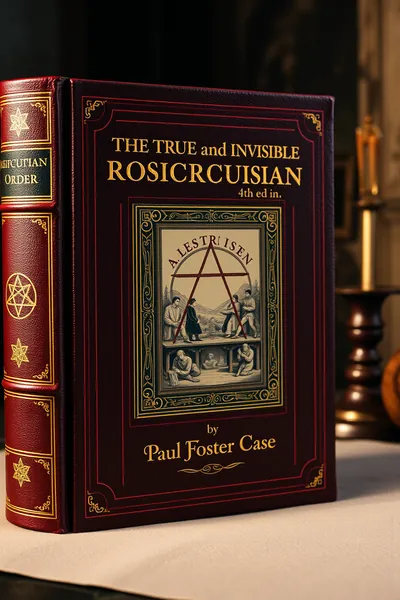
True and Invisible Rosicrucian Order

 71
71

True and Invisible Rosicrucian Order
Paul Foster Case's "True and Invisible Rosicrucian Order" offers a direct exposition of the Fraternitas Rosae Crucis' teachings, providing a valuable counterpoint to more mythologized accounts of Rosicrucianism. Case, a significant figure in 20th-century American occultism, presents the Order's structure and philosophy with a clarity that grounds esoteric concepts in practical application. The section detailing the initiatory degrees, for instance, moves beyond mere allegory to suggest tangible steps for inner development. However, the work sometimes feels overly didactic, occasionally lacking the evocative power found in earlier Rosicrucian literature. The specific emphasis on the Order's internal mechanics, while informative, can at times overshadow the broader philosophical currents that make Rosicrucian thought so enduring. Despite this, the book serves as an essential primary source for understanding a specific, organized expression of the Rosicrucian path in the modern era.
📝 Description
71
Paul Foster Case's 1985 book details the Fraternitas Rosae Crucis, an order with roots in early 17th-century Rosicrucian manifestos.
This volume presents the teachings of the Fraternitas Rosae Crucis, an order tracing its lineage to the early 17th-century Rosicrucian manifestos. Paul Foster Case outlines the order's internal structure, initiatory degrees, and philosophical foundations. The text functions as a practical guide for those interested in spiritual development through disciplined study and inner work.
Published in 1985 during a period of renewed interest in Western Esotericism, Case's work situates his Fraternitas Rosae Crucis within this broader historical context. It offers a specific interpretation of Rosicrucianism, emphasizing the practical application of Hermetic principles. The book is intended for serious students of Western Esotericism who seek structured paths of spiritual development and value historical continuity in occult science.
Paul Foster Case's book connects the Fraternitas Rosae Crucis to the historical Rosicrucian movement, itself a significant current within Western Esotericism. This tradition, emerging from the 17th-century manifestos, influenced subsequent esoteric groups through its symbolic language and philosophical ideas. Case's work places his order within this lineage, distinct from other Rosicrucian organizations, by focusing on the practical application of Hermetic and Kabbalistic principles for personal transformation.
💡 Why Read This Book?
• Gain practical insights into the structured initiatory system of the Fraternitas Rosae Crucis, understanding the specific steps and symbolism outlined in the text. • Explore the Rosicrucian interpretation of "The Great Work" as presented by Paul Foster Case, differentiating it from other esoteric traditions. • Learn about the historical lineage and organizational framework of this particular Rosicrucian Order, first published in 1985, and its place in modern esoteric history.
⭐ Reader Reviews
Honest opinions from readers who have explored this book.
❓ Frequently Asked Questions
What is the Fraternitas Rosae Crucis?
The Fraternitas Rosae Crucis is a Rosicrucian organization whose teachings are presented in this book by Paul Foster Case. It traces its origins to the Rosicrucian manifestos of the 17th century and focuses on a system of spiritual development through initiatory degrees.
When was "True and Invisible Rosicrucian Order" first published?
The book "True and Invisible Rosicrucian Order" by Paul Foster Case was first published in 1985, making it a significant text for understanding 20th-century Rosicrucian movements.
Does the book explain Rosicrucian initiation rituals?
While the book details the structure and purpose of the initiatory degrees within the Fraternitas Rosae Crucis, it focuses more on the philosophical and practical aspects rather than providing explicit ritualistic details.
Who was Paul Foster Case?
Paul Foster Case (1884-1954) was a prominent American occultist, author, and founder of the Builders of the Adytum (B.O.T.A.). He was instrumental in transmitting Rosicrucian and Hermetic teachings in the early 20th century.
What are the core symbols discussed in the book?
The book elaborates on the central Rosicrucian symbols of the Rose and the Cross, interpreting their significance within the Order's system of spiritual alchemy and self-transformation.
Is this book suitable for beginners in esoteric studies?
It is suitable for beginners who are serious and disciplined, as the book presents a structured system. However, its depth and specific terminology may be more immediately accessible to those with some prior exposure to Hermetic or Rosicrucian concepts.
🔮 Key Themes & Symbolism
The Rosicrucian Path
This work delineates a specific path of spiritual evolution as practiced by the Fraternitas Rosae Crucis. It emphasizes a disciplined approach to self-knowledge and union with the divine, framed by initiatory degrees. The text explores how the aspirant progresses through stages of inner transformation, aligning their personal consciousness with cosmic principles. It presents a structured method for attaining spiritual illumination, rooted in the historical Rosicrucian tradition and adapted for modern practitioners seeking tangible results in their Great Work.
Symbolism of Rose and Cross
Central to the teachings is the symbolic interplay of the Rose and the Cross. The Cross represents the material plane, the four elements, and the human body, while the Rose symbolizes the divine consciousness, spiritual unfolding, and the heart center. Their union signifies the alchemical marriage – the integration of spirit and matter, the divine spark within the human. This symbolism is not merely decorative but forms a core interpretive key to the entire system of spiritual development presented by the Order.
The Great Work and Inner Alchemy
The book frames the entire process of spiritual development as "The Great Work," an alchemical undertaking focused on the transmutation of the human personality. This involves purifying the lower nature and elevating consciousness through dedicated study, meditation, and practice. It is presented as an internal process, transforming the aspirant's psycho-spiritual makeup to achieve a higher state of being and understanding, mirroring the external processes of classical alchemy but applied to the soul.
Order Structure and Initiation
A significant portion of the text is dedicated to outlining the hierarchical structure and the progressive initiatory degrees of the Fraternitas Rosae Crucis. This provides a framework for understanding how knowledge and spiritual authority are transmitted within the Order. Each degree is presented as a step in the aspirant's journey, involving specific teachings, symbolic insights, and the development of inner faculties necessary for advancing toward spiritual realization.
💬 Memorable Quotes
Direct passages from the work, attributed to the author.
“The path of the Rosicrucian is one of inner illumination and service.”
— This statement expresses the dual focus of the Rosicrucian ideal: achieving personal spiritual enlightenment while also contributing positively to the world through one's awakened consciousness.
“The Cross represents the human form, the Rose the divine spark within.”
— This succinctly explains the core symbolism of the Rose and Cross, illustrating how the physical existence is seen as the vehicle for the divine consciousness that seeks expression and realization.
“True alchemy is the transformation of the personality.”
— This highlights the internal, psychological focus of the Rosicrucian Great Work, presenting spiritual development not as external magic, but as a fundamental alteration of one's character and consciousness.
“The degrees mark stages of spiritual realization and understanding.”
— This emphasizes the structured, progressive nature of the initiatory system described, indicating that advancement within the Order corresponds to tangible growth in spiritual awareness and wisdom.
“Knowledge of the hidden laws of Nature is essential for the aspirant.”
— This underscores the importance of esoteric study and understanding the underlying principles governing the cosmos and human existence as a prerequisite for effective spiritual work.
🌙 Esoteric Significance
Tradition
This work belongs firmly within the Western Esoteric Tradition, specifically the Rosicrucian current which draws heavily from Hermeticism, Kabbalah, and Christian mysticism. It represents a specific, organized expression of this lineage, aiming to provide a systematic path for spiritual development. Unlike more speculative or purely theoretical Rosicrucian texts, Case's contribution emphasizes the practical, initiatory structure intended to guide the aspirant through defined stages of self-realization.
Symbolism
The central symbols are the Rose and the Cross. The Cross represents the material plane, the four elements, and the human body, while the Rose symbolizes divine consciousness, spiritual awakening, and the heart. Their union signifies the alchemical marriage – the integration of the spiritual and material aspects of existence. Other motifs include light, the inner temple, and the concept of the "Great Work," all serving to illustrate the process of inner transformation and divine union.
Modern Relevance
Contemporary practitioners of Hermeticism and Kabbalah continue to draw from Case's systematic approach to spiritual development. His work provides a clear model for understanding organized esoteric paths, influencing modern study groups and individual practitioners seeking structured guidance. The emphasis on inner alchemy and the practical application of esoteric principles remains relevant for those exploring consciousness, self-mastery, and the integration of spiritual ideals into daily life.
👥 Who Should Read This Book
• Aspiring Rosicrucians seeking a structured initiatory path and detailed explanation of the Fraternitas Rosae Crucis teachings. • Students of Western Esotericism interested in understanding the historical development and practical applications of Rosicrucian philosophy beyond general overviews. • Practitioners of Hermeticism and Kabbalah looking for concrete methods and symbolic interpretations related to inner transformation and the Great Work.
📜 Historical Context
Paul Foster Case's "True and Invisible Rosicrucian Order," first published in 1985, arrived during a period of renewed Western esoteric interest, building upon foundations laid by earlier occultists. The late 19th and early 20th centuries saw the rise of prominent Rosicrucian organizations like the Hermetic Order of the Golden Dawn and the AMORC, establishing precedents for structured esoteric orders. Case's work for the Fraternitas Rosae Crucis offered a distinct interpretation, focusing on practical application and internal discipline. While figures like Aleister Crowley were also shaping esoteric discourse with thelema, Case's approach remained more aligned with traditional Hermeticism and Kabbalah, emphasizing inner transformation over ceremonial magic. The book emerged in a landscape where comparative mythology and religious studies were also gaining academic traction, providing context for the historical and philosophical claims made by esoteric groups.
📔 Journal Prompts
The Rosicrucian ideal of inner illumination and service: how can this be applied practically?
Reflect on the symbolic union of the Rose and the Cross in your personal spiritual journey.
Consider the concept of "The Great Work" as an internal alchemical process.
Analyze the role of structured initiatory degrees in spiritual development.
How does the knowledge of hidden natural laws inform your understanding of esoteric principles?
🗂️ Glossary
The Great Work
In Rosicrucianism and alchemy, this refers to the ultimate spiritual goal of transformation, often described as the union of the human soul with the divine, or the attainment of spiritual enlightenment and perfection.
Initiation
A ritual or process marking a transition to a new level of understanding, responsibility, or spiritual attainment within an esoteric order. It typically involves symbolic ceremonies and the transmission of specific teachings.
Inner Light
The divine spark or consciousness believed to reside within every individual, which the aspirant seeks to awaken, cultivate, and realize through spiritual practice.
Hermeticism
A spiritual, philosophical, and esoteric tradition based on the purported teachings of Hermes Trismegistus, emphasizing principles like "As above, so below" and the pursuit of wisdom through understanding the cosmos and human nature.
Kabbalah
A system of Jewish mysticism and esoteric interpretation of the Torah, often involving symbolic diagrams like the Tree of Life, used to understand the nature of God, the universe, and the human soul.
Alchemical Marriage
The symbolic union of opposites, often represented by the integration of spirit and matter, masculine and feminine principles, or the conscious and unconscious, leading to wholeness and spiritual realization.
Fraternitas Rosae Crucis
A specific Rosicrucian organization founded by Paschal Beverly Randolph, whose teachings are expounded in Paul Foster Case's work, focusing on a structured path of spiritual development.
🔮 Readers Also Liked
Browse all →








More by Paul Foster Case
All books →
More Free Occult Philosophy Books
View all →