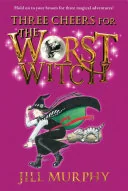
Three Cheers for the Worst Witch
 71
71

Three Cheers for the Worst Witch
Jill Murphy’s "Three Cheers for the Worst Witch" offers a familiar, if somewhat predictable, romp through Mildred Hubble’s persistently calamitous tenure at Miss Cackle’s. The strength of the book lies in Murphy's consistent portrayal of Mildred's well-meaning but disastrous nature. The scene involving the potion class and an unexpected explosion of glitter, for instance, perfectly encapsulates the series’ charm. However, the narrative structure, while comforting in its repetition of Mildred’s blunders, offers little in the way of surprise or thematic depth beyond the established formula. One wishes for a more developed exploration of the underlying magical principles or perhaps a deeper dive into the motivations of the more antagonistic characters like Ethel Hallow. Ultimately, it’s a reliable, if unadventurous, addition to a beloved series, delivering precisely what its established audience expects.
📝 Description
71
Jill Murphy's 2017 book, "Three Cheers for the Worst Witch," follows Mildred Hubble's disastrous first three terms at Miss Cackle's.
This story details Mildred Hubble's early years at Miss Cackle's Academy for Witches, a narrative focused on her escalating mishaps. Throughout her initial three terms, Mildred constantly finds herself in humorous predicaments as she struggles to learn witchcraft. Her efforts to master spells and navigate the social structure of the academy are often clumsy, leading to unintended consequences. The book captures a young witch's difficulties with following rules, her ambitions, and the often comical results of her actions within a structured magical school.
"Three Cheers for the Worst Witch" appeals to younger readers who enjoy tales of school life mixed with magic. It is a good fit for an audience that likes humor driven by characters and stories where a flawed protagonist remains likable. Those familiar with boarding school stories and magical settings will recognize common elements presented with a comedic touch. The writing is accessible, making it suitable for readers just starting out or anyone looking for lighthearted entertainment. The book also speaks to fans of children's fantasy literature.
Published in 2017, "Three Cheers for the Worst Witch" enters a literary tradition already rich with magical school narratives, a genre significantly shaped by J.K. Rowling's "Harry Potter" series. Jill Murphy's own "Worst Witch" series began in 1974, predating many contemporary fantasy works. This installment connects to established British children's literature and fantasy genres, offering a distinct voice that coexists with newer trends. The book continues to engage with themes of magical education and the 'outsider' protagonist, concepts that have long been present in fantasy fiction.
💡 Why Read This Book?
• Gain insight into the comedic potential of magical incompetence, as seen in Mildred Hubble's repeated mishaps with broomstick flying, a core element of witch training since the early "Worst Witch" books began. • Understand the symbolic significance of a structured magical academy like Miss Cackle's, which acts as a crucible for developing both inherent magical talent and adherence to esoteric tradition. • Experience the satisfaction of a protagonist whose earnest efforts, despite their chaotic outcomes, ultimately lead to growth, a narrative arc present since the series' inception in 1974.
⭐ Reader Reviews
Honest opinions from readers who have explored this book.
❓ Frequently Asked Questions
What is the central conflict in "Three Cheers for the Worst Witch"?
The central conflict revolves around Mildred Hubble's repeated failures and accidental disruptions at Miss Cackle's Academy for Witches during her first three terms, juxtaposed with her earnest desire to succeed and fit in.
Who are the main characters in "Three Cheers for the Worst Witch"?
The main characters include Mildred Hubble, the well-intentioned but accident-prone protagonist; her rival, Ethel Hallow; her best friend, Maud Spellbody; and the stern Headmistress, Miss Cackle.
What is the setting of the book?
The book is set at Miss Cackle's Academy for Witches, a traditional boarding school for young witches, first established in Jill Murphy's earlier works.
When was "Three Cheers for the Worst Witch" first published?
"Three Cheers for the Worst Witch" was first published in 2017, continuing the adventures of Mildred Hubble from the original series which began in 1974.
What is the overall tone of the book?
The tone is predominantly humorous and lighthearted, focusing on slapstick comedy and the relatable struggles of a young student trying to find her place.
Does this book require knowledge of previous "Worst Witch" stories?
While prior knowledge enhances the experience, "Three Cheers for the Worst Witch" functions as a self-contained narrative focusing on Mildred's early terms, making it accessible to new readers.
🔮 Key Themes & Symbolism
Incompetence and Charm
The narrative consistently explores the paradox of Mildred Hubble's character: her profound lack of skill in traditional witchcraft contrasts sharply with her endearing persistence and good intentions. This theme, evident since the series' 1974 debut, highlights how genuine effort can sometimes outweigh innate talent, even within a rigid esoteric system like Miss Cackle's Academy. The book suggests that charm and resilience are valuable magical attributes in themselves, often overlooked by more conventional practitioners focused solely on spellcasting accuracy.
Structured Esotericism vs. Chaos
Miss Cackle's Academy for Witches serves as a microcosm of structured esoteric training, emphasizing rules, hierarchy, and precise execution of magical arts. Mildred's presence acts as a disruptive force, embodying chaos within this ordered system. Her struggles with broomstick flying, potion-making, and even simple spell recitation highlight the tension between prescribed magical knowledge and intuitive, albeit uncontrolled, magical expression. This dynamic questions the efficacy of rigid systems in nurturing diverse forms of magical potential.
Social Dynamics and Belonging
Within the confines of the academy, social standing and peer acceptance are crucial. Mildred's recurring blunders often lead to ostracization and mockery, particularly from rivals like Ethel Hallow. The book examines the pressures of conformity within a specialized community and the challenges faced by those who deviate from the norm. Maud Spellbody's unwavering loyalty, however, underscores the importance of friendship and acceptance, suggesting that true belonging can be found even amidst perceived failure.
The Nature of Magic
"Three Cheers for the Worst Witch" implicitly probes the nature of magic itself. Is it purely a matter of learned technique and academic study, as Miss Cackle's curriculum suggests? Or does it involve an intrinsic, perhaps wilder, element that Mildred, despite her lack of formal skill, occasionally touches upon through sheer accident? The book plays with the idea that magic can be unpredictable and that even the most disciplined environments cannot fully contain its inherent mystery, a concept familiar in broader occult traditions.
💬 Memorable Quotes
Direct passages from the work, attributed to the author.
“How many disasters can Mildred Hubble cause in her first three terms at Miss Cackles's Academy for Witches?”
— This central question frames the entire narrative arc of Mildred's early experiences. It captures the book's premise: a focus on escalating mishaps and the comedic consequences of her well-intentioned but chaotic approach to magic.
“Mildred’s broomstick wobbled violently.”
— This simple description captures Mildred's fundamental struggle with basic magical skills. It serves as a recurring motif illustrating her lack of innate control and the physical manifestation of her magical ineptitude.
“She tried to make the potion bubble, but it just hissed.”
— This highlights the discrepancy between Mildred's intended magical outcome and the actual, often disappointing, result. It's a concrete example of her difficulties with the practical application of esoteric knowledge taught at the academy.
“Ethel Hallow sneered.”
— This represents the social antagonism Mildred faces. Ethel's consistent disdain exemplifies the hierarchical pressures within the academy and the judgment directed at those who fail to meet magical standards.
“Maud stood firmly by her friend.”
— This phrase signifies the importance of loyalty and camaraderie amidst social challenges. Maud's steadfast support for Mildred provides a counterpoint to the academy's often harsh social dynamics.
🌙 Esoteric Significance
Tradition
While not explicitly tied to a specific historical esoteric tradition like Hermeticism or Kabbalah, "The Worst Witch" series, including "Three Cheers," engages with a popular, modern interpretation of witchcraft as a practical, learnable art. It draws from a broader cultural archetype of the witch as an individual possessing innate magical abilities that require training and discipline, often within a formal educational setting. The academy functions as a symbolic locus for this training, echoing themes found in various folk traditions and later occult revivals that emphasized structured learning paths for magical practitioners.
Symbolism
Miss Cackle's Academy itself symbolizes a bastion of structured esoteric knowledge, representing the ordered, disciplined approach to magic. The broomstick, a quintessential symbol of witchcraft, represents freedom and mastery of the air element, but for Mildred, it becomes a symbol of her lack of control and grounding. Potions and spells are tangible manifestations of magical craft, where precise ingredients and incantations are meant to yield predictable results, serving as a symbolic representation of the alchemical or hermetic principle of 'as above, so below'—a principle Mildred consistently fails to manifest correctly.
Modern Relevance
Contemporary interest in witchcraft, both as a spiritual practice and a literary trope, finds echoes in Mildred's struggles. While "Three Cheers" is fiction, it taps into modern discussions about neurodiversity and learning differences, portraying a protagonist who excels not through conventional means but through sheer persistence. Furthermore, the enduring appeal of magical schools like Miss Cackle's reflects a continued societal fascination with structured paths to extraordinary abilities, a theme explored in various modern spiritual and self-help movements seeking personal transformation and empowerment through disciplined practice.
👥 Who Should Read This Book
• Young readers aged 7-12 encountering tales of magical education for the first time, who will appreciate Mildred Hubble's relatable struggles and humorous mishaps within the unique setting of Miss Cackle's Academy. • Fans of the original "Worst Witch" series looking for more adventures featuring Mildred, Maud, and Ethel, providing a nostalgic return to familiar characters and the established world first created in 1974. • Educators and parents seeking lighthearted fiction that subtly explores themes of perseverance, friendship, and overcoming challenges, using the fantastical backdrop of a witch academy to engage young minds.
📜 Historical Context
Jill Murphy's "Three Cheers for the Worst Witch," published in 2017, emerges within a rich lineage of British children's literature and the enduring popularity of magical school narratives. The "Worst Witch" series itself began in 1974, predating the global phenomenon of J.K. Rowling's "Harry Potter" series, which commenced its publication in 1997. Murphy's work thus represents an earlier, distinct strand within the genre, focusing on a more traditional, almost archetypal, portrayal of a struggling witch. Unlike the often darker, more complex world-building found in some contemporary fantasy, Murphy's approach remains rooted in a gentle, humorous exploration of school life. The book's reception occurs in an era where magical education has become a firmly established trope, allowing it to play with established expectations. Its consistent appeal across decades, despite the rise of numerous imitators and successors, points to a foundational strength in its characterization and premise, which has resonated with generations of readers.
📔 Journal Prompts
Mildred Hubble's repeated failures in broomstick flying.
The strict rules of Miss Cackle's Academy for Witches.
Ethel Hallow's consistent antagonism towards Mildred.
Maud Spellbody's unwavering loyalty.
The contrast between intended magical outcomes and accidental results.
🗂️ Glossary
Miss Cackle's Academy for Witches
The fictional boarding school setting where Mildred Hubble and other young witches are trained in the magical arts. It represents a structured environment for learning esoteric practices.
Broomstick Flying
A fundamental skill taught at Miss Cackle's, involving the controlled aerial navigation of a witch's broom. Mildred's persistent difficulty with this highlights her lack of natural aptitude.
Potions Class
A core subject at the academy where students learn to brew magical concoctions. Mildred's attempts often result in unexpected and chaotic outcomes, showcasing her struggles with precise magical execution.
Ethel Hallow
A rival student at Miss Cackle's Academy, known for her arrogance and disdain towards Mildred. She represents the social hierarchy and peer judgment within the school.
Maud Spellbody
Mildred's loyal best friend, who consistently supports her despite Mildred's many mishaps. Maud embodies steadfast friendship within the academy's social structure.
Headmistress
The leader of Miss Cackle's Academy, responsible for maintaining order and discipline. The Headmistress often deals with the fallout from Mildred's magical misadventures.
Accidental Magic
Refers to magical effects that occur unintentionally, often as a result of Mildred's clumsiness or misunderstood instructions. It highlights the unpredictable nature of magic.
This book appears in 1 collection
🔮 Readers Also Liked
Browse all →








From the “Incantations” Collection
View all →






More Free Occult Philosophy Books
View all →