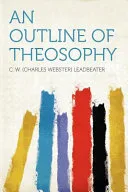
An Outline of Theosophy
 75
75

An Outline of Theosophy
Leadbeater’s An Outline of Theosophy functions precisely as its title suggests: a structured primer for a complex spiritual philosophy. The author’s prose, while dated, is remarkably direct, eschewing the florid language that often clouds esoteric texts. He systematically breaks down concepts like the septenary nature of man and the law of karma, making them accessible. A particular strength lies in his ability to connect these ideas to observable phenomena, albeit through a Theosophical lens. For instance, his discussion of the astral body and its interactions offers a concrete framework for understanding subjective experiences. However, the book’s limitation is its inherent bias. As a devoted proponent of Theosophy, Leadbeater presents its doctrines as established fact, without engaging critically with alternative viewpoints or acknowledging the speculative nature of some assertions. The section detailing the evolution of the Monad, while ambitious, requires a significant suspension of disbelief for the uninitiated. Ultimately, this outline is an effective, if uncritical, introduction to a specific spiritual system.
📝 Description
75
First published in 1911, C.W. Leadbeater's 'An Outline of Theosophy' explains core Theosophical doctrines.
C.W. Leadbeater's 'An Outline of Theosophy,' first released in 1911, offers a structured introduction to the principles of Theosophy. Leadbeater intended this work as a clear exposition for those new to the subject, aiming to simplify its complex doctrines and philosophical foundations. The book moves systematically through the essential ideas of the Theosophical movement, giving readers a coherent view of its esoteric worldview. It addresses concepts that might otherwise seem obscure, laying them out in a logical progression. This approach makes the material accessible to individuals who might be put off by lengthier or more specialized writings.
Readers interested in comparative religion, mysticism, or Western esoteric traditions will find this a useful starting point. Leadbeater addresses fundamental Theosophical ideas such as karma, reincarnation, the seven planes of existence, and the different bodies composing the human constitution. He also discusses the role of the Masters, the evolution of consciousness, and the underlying unity that Theosophy posits across all religions. Leadbeater's explanations are designed to demystify these esoteric concepts for a broader audience.
Published in 1911, 'An Outline of Theosophy' appeared during a time of heightened Western interest in spiritualism, occultism, and Eastern philosophies. The Theosophical Society, established by Helena Blavatsky in 1875, was instrumental in popularizing these ideas. Leadbeater, a prolific author within the society, shaped its literature and public understanding. This book reflects the society's objective to identify a universal wisdom present in various ancient traditions and to present it in a modern context.
💡 Why Read This Book?
• Gain a structured understanding of core Theosophical tenets, such as the seven planes of existence, presented clearly by C.W. Leadbeater, a pivotal figure in the movement. • Explore the concepts of karma and reincarnation as explained within the Theosophical framework, offering a specific lens on causality and spiritual evolution. • Familiarize yourself with the Theosophical Society's foundational ideas, including the notion of Masters and the evolutionary path of consciousness, as detailed in this early 20th-century text.
⭐ Reader Reviews
Honest opinions from readers who have explored this book.
❓ Frequently Asked Questions
What is the primary purpose of C.W. Leadbeater's An Outline of Theosophy?
The book's main goal is to provide a clear and systematic introduction to the fundamental principles and doctrines of Theosophy for those new to the subject.
When was An Outline of Theosophy first published?
The original publication date for An Outline of Theosophy by C.W. Leadbeater was 1911.
What are some key concepts discussed in the book?
Key concepts include karma, reincarnation, the seven planes of existence, the human constitution (multiple bodies), and the evolutionary journey of the soul.
Who founded the Theosophical Society mentioned in the book?
The Theosophical Society was founded in 1875 by Helena Blavatsky, along with Henry Steel Olcott and William Quan Judge.
Is this book suitable for academic study of esotericism?
Yes, it offers a primary source perspective on early 20th-century Theosophy, valuable for understanding the historical development of Western esoteric thought.
Does the book explain the concept of Masters?
Yes, An Outline of Theosophy discusses the role and nature of the 'Masters' or 'Mahatmas' within the Theosophical hierarchy.
🔮 Key Themes & Symbolism
The Seven Planes
Leadbeater meticulously details the Theosophical cosmology of seven planes of existence, extending beyond the physical to the astral, mental, and higher spiritual realms. This concept posits that consciousness operates on various levels, each with distinct laws and inhabitants. The book outlines the structure and purpose of these planes, illustrating how human evolution progresses through them. Understanding these planes is crucial for grasping the Theosophical view of reality and the nature of spiritual development, suggesting a multi-dimensional existence far richer than commonly perceived.
Karma and Reincarnation
Central to Theosophy, the law of karma and the process of reincarnation are explained as the fundamental mechanisms of spiritual evolution. Leadbeater presents karma not as fatalistic punishment but as a system of cause and effect, where actions in one life shape future experiences across multiple lifetimes. Reincarnation is depicted as the soul's journey through successive physical existences, providing opportunities for learning, growth, and the eventual purification of consciousness. This dual concept offers a framework for understanding life's apparent inequalities and challenges.
The Human Constitution
An Outline of Theosophy studies the intricate composition of the human being, positing a complex structure beyond the physical body. Leadbeater describes the subtle bodies—astral, mental, and causal—as integral parts of the self, each associated with different levels of consciousness and experience. This understanding is key to Theosophy's view of perception, emotion, and thought, explaining how individuals interact with the various planes of existence. The text clarifies how these bodies function and evolve throughout the process of reincarnation.
The Evolutionary Path
The book frames existence as a grand process of evolution guided by spiritual intelligence. It describes the journey of the Monad, or the divine spark within, through mineral, plant, animal, and human kingdoms, and onward towards eventual divinity. This evolutionary perspective, distinct from purely biological Darwinism, emphasizes the unfolding of consciousness and the attainment of higher spiritual awareness. Leadbeater highlights the role of Masters and the broader cosmic plan in guiding this slow, deliberate progression across vast epochs.
💬 Memorable Quotes
Direct passages from the work, attributed to the author.
“The word 'Theosophy' means Divine Wisdom.”
— This concise definition establishes the core identity of the subject matter, framing Theosophy as the pursuit and understanding of a fundamental, sacred knowledge.
“Karma is the law of cause and effect.”
— This highlights the Theosophical understanding of karma as a natural, impersonal principle governing actions and their consequences, rather than a divine judgment.
“Man is not only a physical body.”
— This points to the Theosophical doctrine of multiple subtle bodies (astral, mental, etc.) existing alongside the physical form, integral to consciousness and spiritual progression.
“Reincarnation is the vehicle of evolution.”
— This interpretation emphasizes the role of successive lives in the spiritual development and learning process of the soul, according to Theosophical teachings.
“The Masters guide the evolutionary scheme.”
— This suggests the existence of advanced spiritual beings who play a role in overseeing and facilitating the spiritual evolution of humanity and the planet.
🌙 Esoteric Significance
Tradition
This work is firmly rooted in the Theosophical tradition, established by Helena Blavatsky. It seeks to synthesize Eastern (primarily Hindu and Buddhist) concepts with Western esoteric ideas, presenting a universalist 'Ancient Wisdom.' Leadbeater's contribution lies in his attempt to codify and explain these complex doctrines, particularly concerning the nature of consciousness, karma, and reincarnation, for a Western audience, thereby shaping the popular understanding of Theosophy.
Symbolism
A key symbol is the 'Seven Planes,' representing the multi-layered nature of reality and consciousness, from the physical to the purely spiritual. The 'Monad' symbolizes the divine spark within each being, undergoing an evolutionary journey. The concept of 'Masters' or 'Mahatmas' represents highly evolved beings who guide humanity's spiritual progress, acting as intermediaries between the divine and the human.
Modern Relevance
Leadbeater's systematic explanations continue to influence modern esoteric practitioners and authors, particularly within New Age and contemporary Theosophical circles. Concepts like the subtle bodies and the detailed cosmology of planes inform various forms of energy healing, meditation practices, and spiritual psychology that explore consciousness beyond the physical.
👥 Who Should Read This Book
• Students of comparative religion seeking to understand the foundational texts and ideas of the Theosophical movement. • Individuals interested in early 20th-century esoteric thought and its influence on Western spiritual traditions. • Seekers exploring concepts of karma, reincarnation, and the nature of consciousness from a specific philosophical viewpoint.
📜 Historical Context
An Outline of Theosophy emerged in 1911, a period when the Theosophical Society, co-founded by Helena Blavatsky in 1875, was a significant influence on Western esotericism. The late Victorian and Edwardian eras saw a surge of interest in spiritualism, Eastern religions, and occult philosophies, partly as a reaction against rationalism and materialism. C.W. Leadbeater, alongside Annie Besant, was a leading figure, though often controversial, within the Society. His work aimed to systematize and popularize Blavatsky's complex teachings, particularly her main work, 'The Secret Doctrine.' During this time, Theosophy competed for attention with movements like Anthroposophy, which emerged from within the Theosophical Society itself when Rudolf Steiner broke away in 1913, emphasizing a more scientific and psychological approach to spiritual inquiry.
📔 Journal Prompts
The nature of the astral body and its interaction with the physical world.
The mechanics of karma as a law of cause and effect.
The concept of the Monad's evolutionary journey.
The purpose and structure of the seven planes of existence.
The role of Masters in guiding human spiritual development.
🗂️ Glossary
Theosophy
A system of esoteric philosophy originating in the 19th century, aiming to reveal the divine wisdom underlying all religions and sciences, often emphasizing concepts like karma and reincarnation.
Karma
The universal law of cause and effect, where actions in one life influence circumstances and experiences in subsequent lives; a principle of moral and spiritual accountability.
Reincarnation
The doctrine that the soul or spiritual principle passes from one physical body to another after death, continuing its evolutionary journey through successive lives.
Planes of Existence
The Theosophical concept of different levels or dimensions of reality, beyond the physical, such as the astral, mental, and spiritual planes, each with distinct characteristics.
Monad
The divine spark or eternal spiritual self within an individual, believed to undergo a long process of evolution through various forms and lifetimes.
Astral Body
A subtle body composed of finer matter than the physical body, associated with emotions, desires, and experiences occurring on the astral plane.
Masters
Highly evolved spiritual beings, often referred to as Mahatmas, believed to guide the spiritual evolution of humanity from higher planes of existence.