Theosophy Or Psychological Religion
 76
76

Theosophy Or Psychological Religion
F. Max Müller's "Theosophy or Psychological Religion" is an essential, if somewhat dry, defense of applying historical and philological rigor to religious studies. Müller's central thesis—that understanding religion requires examining its development through language and culture, rather than accepting dogma at face value—remains pertinent. He compellingly argues in lecture VI, "The Origin of the Lord's Prayer," for tracing the evolution of a concept through its textual history, a method crucial for dissecting later Theosophical interpretations. However, the dense academic prose, characteristic of late 19th-century scholarship, can be a barrier for contemporary readers not already steeped in classical philology. The work's strength lies in its intellectual architecture, but its limitation is its accessibility. It is a foundational text for the academic study of religion, demanding careful attention but rewarding the persistent reader.
📝 Description
76
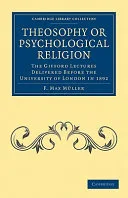
F. Max Müller's 1893 book, Theosophy Or Psychological Religion, argued for a scholarly approach to religious study.
Originally delivered as lectures in 1893, F. Max Müller's Theosophy Or Psychological Religion calls for applying historical and philological methods to religious inquiry. Müller argued that religious traditions should be viewed as evolving human phenomena, shaped by language, culture, and historical context, rather than as static doctrines. He advocated for rigorous scholarly examination over speculative or dogmatic interpretations.
This work is of interest to scholars of comparative religion, historians of ideas, and students of philosophy. It is particularly relevant for those examining the intellectual history of religious studies as an academic discipline and the origins of modern theological discourse and the academic study of mysticism. Müller's defense of the historical method provides a clear perspective on the development of the field.
Müller's book emerged in 1893 amidst significant academic interest in comparative mythology and the origins of religion. It countered prevailing views that often interpreted religious texts and practices through a lens of dogma or singular divine revelation. By emphasizing philology and historical analysis, Müller aligned himself with a movement to secularize and rationalize religious study, challenging traditional theological viewpoints.
While F. Max Müller was primarily a philologist and scholar of comparative religion, his 1893 work, Theosophy Or Psychological Religion, touches upon themes that resonate with esoteric traditions. The book's focus on 'psychological religion' suggests an interest in the internal, subjective experience of faith, a common thread in many esoteric paths. By advocating for the study of the mind's development in understanding religious experience, Müller indirectly engages with concepts of consciousness and inner transformation that are central to esoteric thought. His emphasis on tracing the evolution of religious ideas through language and culture also aligns with how esoteric traditions often view the transmission and interpretation of ancient wisdom.
💡 Why Read This Book?
• Learn how F. Max Müller, in 1893, advocated for the "historical method" to analyze religious phenomena, offering a critical lens distinct from later occult interpretations. • Understand Müller's concept of "psychological religion," which posits that core religious sentiments are rooted in human nature and discoverable through scholarly inquiry. • Grasp the significance of linguistic analysis in religious studies, as Müller uses etymology to explore the evolution of terms and concepts in lecture V, "The Essence of Religion."
⭐ Reader Reviews
Honest opinions from readers who have explored this book.
❓ Frequently Asked Questions
When was F. Max Müller's "Theosophy or Psychological Religion" first published?
F. Max Müller's "Theosophy or Psychological Religion" was first published in 1893, though this edition is a later reprint. The work originated from a series of lectures delivered by Müller.
What is the core argument of "Theosophy or Psychological Religion"?
The book argues that the study of religion must employ historical and philological methods to understand its development, rather than relying on speculative or dogmatic approaches.
What does Müller mean by "Psychological Religion"?
Müller uses "Psychological Religion" to describe religious experiences and sentiments as fundamentally human phenomena, accessible through understanding the mind and its development, rather than purely divine origins.
Who was F. Max Müller?
F. Max Müller (1823-1900) was a renowned German-British philologist and Orientalist, considered a leading authority on Indo-European languages and classical Sanskrit literature.
Is "Theosophy or Psychological Religion" related to Theosophy as a movement?
While the title includes "Theosophy," Müller uses the term to explore broader philosophical and psychological aspects of religion. His approach is scholarly and historical, distinct from the specific doctrines of the Theosophical Society founded by Helena Blavatsky.
What is the "historical method" Müller advocates for?
Müller's "historical method" involves tracing the evolution of religious ideas, texts, and practices through careful examination of their linguistic origins, cultural contexts, and historical development over time.
🔮 Key Themes & Symbolism
The Historical Method
Müller champions the "historical method" as indispensable for understanding religious phenomena. He argues that religious traditions must be studied through their development over time, tracing linguistic shifts and cultural influences. This approach contrasts with purely speculative or dogmatic interpretations, advocating for philological rigor and evidence-based analysis to uncover the genuine roots and evolution of spiritual ideas, as demonstrated in his lectures on comparative mythology.
Psychological Roots of Religion
The concept of "Psychological Religion" posits that religious sentiment and experience are inherent aspects of the human psyche. Müller suggests that by understanding the human mind, its needs, and its developmental stages, we can better comprehend the origins and forms of religion. This perspective seeks to ground religious inquiry in observable human psychology rather than solely in supernatural revelation or external authority.
Philology and Religious Language
Müller places significant emphasis on philology – the study of language in historical sources – as a critical tool for religious scholarship. He demonstrates how the etymology and evolution of religious terms reveal deeper meanings and historical shifts in belief. By analyzing the precise language used in sacred texts and traditions, scholars can gain insights into their original intent and subsequent interpretations.
Natural vs. Revealed Religion
The work explores the distinction between "natural religion," arising organically from human nature and reason, and "revealed religion," purportedly transmitted through divine intervention. Müller's historical approach often seeks to trace what appear as revealed doctrines back to more fundamental, natural human sentiments or linguistic developments, questioning the exclusivity of claims to divine revelation.
💬 Memorable Quotes
Direct passages from the work, attributed to the author.
“The historical method, when applied to religion, is the only one that can reveal to us the true genesis and growth of religious ideas.”
— This statement underscores Müller's core argument that understanding religion requires tracing its lineage and evolution through historical evidence, not accepting doctrines at face value.
“Religion, in its true sense, is nothing but the sum of the psychological phenomena of the human mind.”
— This interpretation highlights Müller's view of religion as an intrinsic part of human psychology, discoverable through introspection and scholarly analysis of the mind's workings.
“We must trace the history of words in order to understand the history of ideas.”
— This emphasizes the crucial role of philology in Müller's framework, suggesting that linguistic analysis is a direct pathway to comprehending the development and transformation of religious concepts.
“The study of the ancient languages of India has opened to us a new world of religious thought.”
— This reflects Müller's groundbreaking work in Sanskrit scholarship and its impact on comparative religion, revealing the depth and antiquity of non-Western religious traditions.
“True theology is the psychology of the human mind.”
— This concise statement reiterates Müller's central thesis, equating the rigorous study of the human psyche with the essence of theological understanding.
🌙 Esoteric Significance
Tradition
While the title engages with "Theosophy," Müller's work primarily belongs to the tradition of comparative religion and the academic study of mythology and language. He uses "Theosophy" in a broader, philosophical sense, exploring divine wisdom through human understanding. His rigorous historical and philological methodology departs from the initiatory or revelatory claims often found in specific esoteric lineages like Hermeticism or Kabbalah, instead seeking universal truths through rational inquiry into human culture.
Symbolism
Müller's focus is less on specific esoteric symbols and more on the conceptual evolution embedded within language. For instance, his analysis of the etymology of terms related to divinity or the soul, such as tracing the Indo-European roots of "Deus" (God), functions as a form of symbolic analysis. He examines how the meaning of these linguistic "symbols" has shifted historically, revealing underlying psychological and cultural frameworks that shaped religious thought.
Modern Relevance
Müller's insistence on the "historical method" and the "psychological" underpinnings of religion remains foundational for contemporary academic religious studies and cognitive science of religion. Scholars researching the origins of religious belief systems, the impact of language on cognition, and the evolution of mythic narratives continue to draw upon his methodological principles. His work provides a crucial counterpoint to purely faith-based interpretations, offering tools for critical analysis relevant to modern debates on secularism and spirituality.
👥 Who Should Read This Book
• Scholars of comparative religion and mythology seeking to understand the foundational arguments for the historical-critical method in religious studies. • Students of philosophy and linguistics interested in how language shapes belief systems and the evolution of theological concepts. • Researchers of intellectual history examining the academic secularization of religious discourse in the late 19th century.
📜 Historical Context
F. Max Müller's "Theosophy or Psychological Religion" emerged in 1893, a period marked by burgeoning academic interest in comparative religion and mythology. Scholars like Andrew Lang were exploring folklore and myth, while the burgeoning field of anthropology sought to understand human societies. Müller's work directly challenged more traditional, dogmatic approaches to theology, advocating for the "historical method" and philology, heavily influenced by his expertise in Sanskrit and Indo-European languages. This stance placed him within a broader intellectual current seeking to rationalize and secularize the study of religion, a movement that saw figures like William James also exploring the psychological dimensions of religious experience in his "The Varieties of Religious Experience" (published later, in 1902). Müller's emphasis on language and historical development was a departure from purely speculative or metaphysical systems.
📔 Journal Prompts
The historical genesis of religious ideas, as explored through philology.
Müller's concept of "Psychological Religion" and its implications for understanding personal faith.
The comparative analysis of religious terminology across cultures.
The application of the "historical method" to contemporary belief systems.
The relationship between language evolution and the development of spiritual concepts.
🗂️ Glossary
Philology
The study of language in oral and written historical sources; it is the intersection of textual criticism, literary criticism, history, and linguistics. Müller considered it essential for understanding religious texts.
Psychological Religion
Müller's term for understanding religion as rooted in the human mind and its inherent sentiments and experiences, rather than solely as external revelation.
Historical Method
A scholarly approach that emphasizes understanding phenomena by tracing their origins and development through historical evidence, linguistic analysis, and cultural context.
Natural Religion
The idea that religious sentiments and beliefs arise naturally from human reason and experience, as opposed to being divinely revealed.
Etymology
The study of the origin of words and the way in which their meanings have changed throughout history.
Theosophy
In Müller's context, the pursuit of divine wisdom through philosophical and intellectual inquiry into the nature of the divine and humanity's relationship to it.
Indo-European Languages
A large language family native to western and southern Eurasia, including Germanic, Indo-Iranian, and Hellenic languages, which Müller extensively studied.