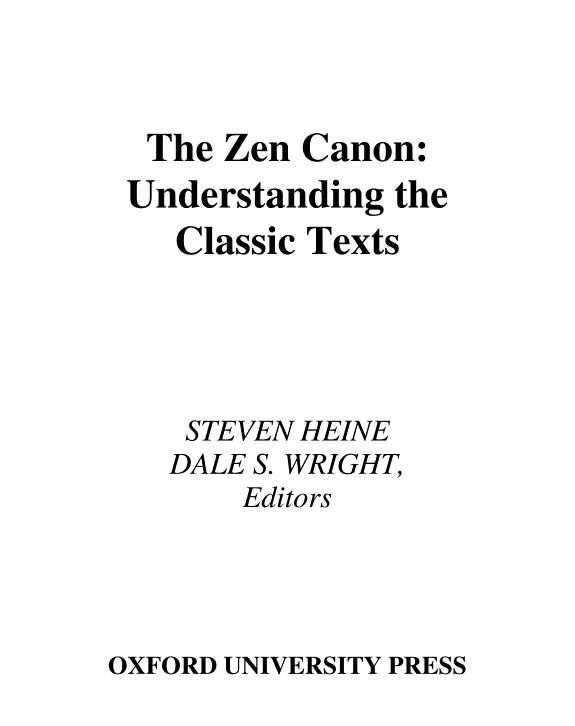
The Zen Canon
 84
84

The Zen Canon
Steven Heine and Dale S. Wright's "The Zen Canon" makes a compelling case for the literary richness of Zen Buddhism, a point often overlooked in favor of its experiential aspects. The collection skillfully presents Zen not as an anti-literary tradition, but one deeply invested in textual production. A particular strength lies in its detailed analysis of specific genres, such as the recorded sayings (goroku) and the enigmatic koan collections. For instance, the discussion around the Hakuin Ekaku's influence on koan literature provides concrete evidence of Zen's engagement with narrative and interpretive frameworks. However, the academic density of some essays might present a barrier for readers new to Buddhist studies. The work's primary limitation is its focus on scholarly analysis, which occasionally overshadows the devotional or experiential dimensions that are central to many Zen practitioners' understanding. Ultimately, "The Zen Canon" offers a valuable, albeit academic, re-evaluation of Zen's literary foundations.
📝 Description
84
Published in 2004, The Zen Canon argues for a rich literary heritage within Zen Buddhism.
This collection of essays, first released in 2004, examines the literary dimensions of Zen Buddhism. It challenges common perceptions, proposing that Zen possesses a deep and varied literary heritage. The volume shows how canonical texts function as more than just doctrine; they serve as channels for spiritual transmission and cultural identity.
The essays within The Zen Canon investigate diverse forms of Zen literature. These include hagiographies of masters, collections of recorded sayings known as goroku, koan literature, and monastic regulations called shingi. The authors present these forms not as fixed artifacts but as active elements in Zen practice and teaching. They illustrate the connection between text, interpretation, and lived experience.
This work emerged during the early 2000s, a period of growing academic attention to the creation and interpretation of Buddhist texts. It entered a scholarly conversation that questioned earlier, often simplified, views of Zen as exclusively experiential or opposed to written traditions. The book contributes to the understanding of how religious canons are formed and how literature helps establish and maintain monastic and sectarian identities.
The Zen Canon positions itself within a scholarly reevaluation of Zen Buddhism's textual foundations. It counters the notion of Zen as solely a practice of direct transmission, emphasizing the crucial role of written materials in its development and dissemination. The book highlights how texts like recorded sayings and monastic rules were integral to the formation of Zen lineages and the transmission of teachings across generations, moving beyond a purely experiential understanding.
💡 Why Read This Book?
• Gain a scholarly perspective on Zen's literary heritage, understanding how texts like the *goroku* (recorded sayings) shaped monastic education, as detailed in the collection's essays. • Explore the function of *koan* collections and their commentaries as specific literary devices used for spiritual training, moving beyond simplistic notions of Zen as purely experiential. • Appreciate the historical development of monastic rules (*shingi*) and hagiographic accounts as critical literary forms that solidified Zen Buddhist identity and practice from the early 2000s scholarly viewpoint.
⭐ Reader Reviews
Honest opinions from readers who have explored this book.
❓ Frequently Asked Questions
What is the primary argument of 'The Zen Canon' regarding Zen Buddhism?
The primary argument is that Zen Buddhism possesses a rich and varied literary heritage, challenging the perception of Zen as purely experiential or anti-textual. The collection highlights significant texts like recorded sayings and koan literature.
What types of Zen literature are discussed in 'The Zen Canon'?
The book discusses various literary forms including hagiographic accounts of masters, recorded sayings (goroku), koan collections and their commentaries, and rules for monastic life (shingi).
Who are the editors of 'The Zen Canon'?
The editors are Steven Heine and Dale S. Wright. The book was first published in 2004.
What is the significance of koan collections according to the book?
Koan collections are presented as significant literary and pedagogical tools within Zen, used for spiritual training and the transmission of understanding beyond intellectual comprehension.
Is 'The Zen Canon' suitable for beginners in Zen studies?
While valuable, the book is written from an academic perspective and may be more suitable for students and scholars of religion and literature who have some prior familiarity with Buddhist studies.
When was 'The Zen Canon' first published?
'The Zen Canon' was first published in 2004, reflecting scholarly trends of the early 21st century concerning religious textual traditions.
🔮 Key Themes & Symbolism
Literary Transmission
This theme explores how Zen Buddhism, often perceived as purely experiential, actively utilizes and generates literature for spiritual transmission. Essays examine the function of recorded sayings (*goroku*) and master biographies as vehicles for conveying teachings and lineage. The collection argues that these literary forms are not secondary to practice but integral to it, shaping understanding and monastic life. The initial publication in 2004 situates this discussion within contemporary academic discourse on religious texts.
Koan Pedagogy
The book critically analyzes the role of koan collections and their accompanying commentaries. These are presented as sophisticated literary devices designed to circumvent purely rational thought and induce direct insight. The work discusses how specific koans and their interpretations, developed over centuries, function as a unique form of Zen literature that challenges and trains the practitioner's mind, moving beyond simple riddles to complex pedagogical tools.
Monastic Codification
Another key theme is the literary codification of monastic life within Zen. This includes the study of monastic rules (*shingi*) and administrative documents. These texts reveal the structured social and disciplinary frameworks necessary for maintaining the sangha. The collection highlights how these regulations, alongside hagiographic accounts, contribute to the identity and continuity of Zen lineages, demonstrating the practical application of literary forms in institutional settings.
Challenging Perceptions
The overarching theme is a re-evaluation of Zen Buddhism's relationship with text and literature. By presenting a diverse array of literary genres, the essays challenge the popular notion of Zen as solely an 'enlightenment-in-a-flash' or anti-intellectual tradition. The work positions Zen literature as central to its historical development and ongoing practice, supported by scholarly analysis from the early 2000s.
💬 Memorable Quotes
Direct passages from the work, attributed to the author.
“Zen Buddhism actually has a rich and varied literary heritage.”
— This core assertion frames the entire collection, directly confronting the common misconception that Zen is primarily an oral or experiential tradition devoid of substantial textual output.
“Among the significant texts are hagiographic accounts and recorded sayings of individual Zen masters, koan collections and commentaries and rules for monastic life.”
— This outlines the specific literary genres the book examines, detailing the concrete forms through which Zen's literary heritage is expressed and transmitted across generations.
“The work explores the function of koan collections.”
— This points to the analytical approach taken, focusing not just on the existence of koans but on their specific role and purpose within Zen practice and pedagogy.
“The Zen Canon argues for a deep and varied literary heritage.”
— This interpretation emphasizes the scholarly depth and breadth of the collection's findings, underscoring the complexity of Zen's textual traditions.
“Essays examine the codification of monastic life through texts.”
— This highlights the practical and institutional dimension of Zen literature, showing how written rules and accounts shaped the lived experience of monks and nuns.
🌙 Esoteric Significance
Tradition
While Zen Buddhism itself is a distinct Mahayana tradition, its literary output, as explored in this collection, intersects with broader esoteric concerns regarding direct transmission of knowledge and the nature of consciousness. The emphasis on koans and master-disciple dialogues aligns with esoteric methods of bypassing discursive thought to achieve direct realization, a common thread in various mystical traditions.
Symbolism
Key symbols include the koan itself, representing paradox and the limits of intellect; the figure of the enlightened master, embodying wisdom and transmission; and monastic rules (*shingi*), symbolizing the structured path and discipline required for spiritual cultivation. These elements function symbolically to guide practitioners toward deeper understanding and ethical conduct.
Modern Relevance
Contemporary mindfulness movements and integrated Buddhist studies programs often draw upon the understanding of Zen's textual foundations presented here. Thinkers exploring contemplative practices and the intersection of psychology and spirituality find value in analyzing the literary structures that facilitated insight in historical Zen lineages.
👥 Who Should Read This Book
• Students of comparative religion and East Asian studies seeking to understand the textual underpinnings of a major Buddhist school. • Scholars of literature interested in the diverse forms and functions of religious narratives, including hagiographies and paradoxical dialogues. • Practitioners of Zen or other contemplative traditions who wish to deepen their appreciation for the historical and literary context of their practice.
📜 Historical Context
Published in 2004, "The Zen Canon" emerged during a period of robust academic engagement with Buddhist textual traditions. This era saw scholars increasingly scrutinizing the historical development and literary production of various Buddhist schools, moving beyond earlier, often romanticized, interpretations. The work countered prevalent Western perceptions of Zen as an exclusively experiential or anti-literary path. Contemporaries like Bernard Faure were also exploring the complex relationship between Buddhism, art, and textual practices. While not facing overt censorship, the book contributed to a scholarly re-evaluation that challenged existing paradigms within Buddhist studies, particularly regarding the role of literature in establishing and maintaining Zen’s identity and monastic structures.
📔 Journal Prompts
The function of koan collections in spiritual training.
Hagiographic accounts of Zen masters as literary constructs.
The role of monastic rules (shingi) in establishing Zen identity.
Zen's literary heritage versus its experiential reputation.
Recorded sayings (goroku) as primary sources for understanding Zen transmission.
🗂️ Glossary
Goroku
Literally 'recorded sayings.' These are collections of sermons, dialogues, and pronouncements by Zen masters, forming a significant body of Zen literature.
Koan
A paradoxical anecdote or riddle used in Zen Buddhism to provoke doubt and test a student's progress in Zen practice. It aims to break down conceptual thinking.
Hagiography
The writing of the lives of saints or revered religious figures. In Zen, these accounts detail the spiritual journeys and enlightenment experiences of masters.
Shingi
Literally 'rules and regulations.' These are monastic codes and administrative texts that govern the daily life, conduct, and organization of Zen monasteries.
Zen Buddhism
A school of Mahayana Buddhism that originated in China, emphasizing meditation and intuitive understanding over scripture. Known for its unique literary and pedagogical methods.
Literary Heritage
The body of written works produced by a culture or tradition, viewed as an inheritance. In this context, it refers to the diverse texts generated by Zen Buddhism.
Esoteric
Intended for or likely to be understood by only a small number of people with a specialized knowledge or interest. Often related to mystical or hidden teachings.
This book appears in 1 collection
🔮 Readers Also Liked
Browse all →









From the “Zen Buddhism” Collection
View all →




More Free Occult Philosophy Books
View all →