The Vortex
 83
83

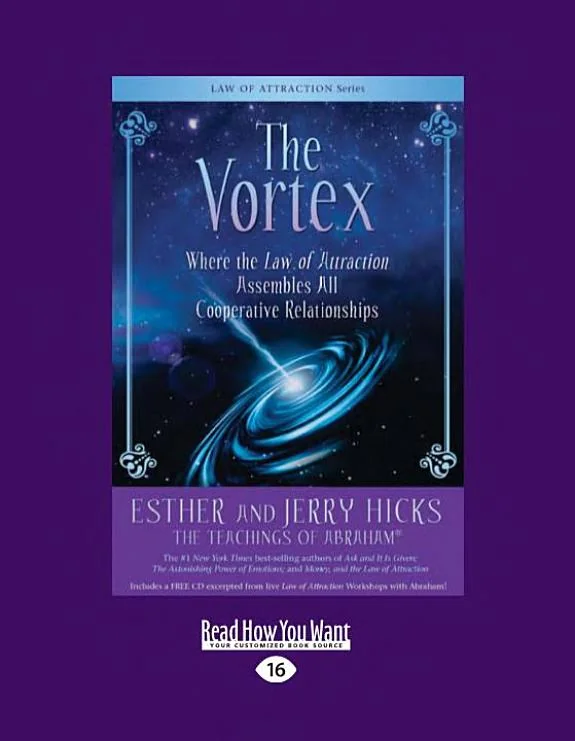
The Vortex
Esther Hicks' The Vortex offers a consistent distillation of the Abraham teachings, primarily concerning relational dynamics. The strength lies in its unwavering focus on the vibrational nature of all interactions, providing a clear, albeit repetitive, method for self-assessment. The limitation, however, is the inherent repetition within the Abraham material, which can make sections feel less like new revelations and more like rephrased familiar concepts. A particularly striking passage discusses how a negative relationship serves as a beacon, highlighting precisely what beliefs need energetic adjustment. While accessible, the book's reliance on Abraham's specific metaphysical framework may not satisfy those seeking empirical psychological analysis. It remains a focused guide for adherents of the Law of Attraction seeking relational improvement.
📝 Description
83
In 2010, Esther Hicks published The Vortex, a book detailing teachings from Abraham on energetic principles in relationships.
The Vortex, channeled by Esther Hicks from Abraham, was published in March 2010. It proposes that all human relationships, whether past or present, serve as mirrors reflecting our internal vibrational state and our beliefs about ourselves and others. The book offers a framework for understanding and improving these dynamics through energetic principles. Readers seeking to analyze their interpersonal dynamics will find this work applicable, especially those familiar with Abraham Hicks' previous books like Ask and It Is Given. It is suited for individuals interested in how the Law of Attraction applies to social interactions and who believe that energetic alignment can resolve relational difficulties. The core idea is the 'Vortex,' a vibrational space where desires are held and manifested. Challenging relationships are presented as opportunities to identify beliefs that hinder the attraction of desired experiences. The book stresses taking emotional responsibility and focusing on positive aspects to alter one's vibrational output and, consequently, one's reality.
Published in 2010, The Vortex emerged during a period of significant interest in New Thought and self-help movements that often incorporated concepts from quantum physics. The teachings attributed to Abraham, channeled by Esther and Jerry Hicks since the 1980s, gained considerable momentum in the early 21st century. This placed them within a lineage of authors exploring consciousness and personal empowerment, appearing alongside figures who also discussed inner awareness and manifestation.
💡 Why Read This Book?
• Understand how your beliefs about relationships, as explored in the context of the Abraham teachings, directly shape your interactions and attract specific individuals. • Learn to identify and release limiting beliefs that create relational discord, a core principle of the "Vortex" concept presented by Abraham. • Gain practical techniques for shifting your emotional state, a key element discussed in relation to attracting healthier connections, directly from the 2010 publication.
⭐ Reader Reviews
Honest opinions from readers who have explored this book.
❓ Frequently Asked Questions
What is the core concept of 'The Vortex' in Esther Hicks' book?
The Vortex, as presented by Abraham through Esther Hicks, is a vibrational space where desires are held and manifested. The book explains that relationships serve as indicators of whether you are allowing positive experiences into your vibrational reality or are blocked by limiting beliefs.
How does The Vortex explain relationship problems?
According to the teachings, relationship problems arise from vibrational misalignment. The book suggests that a challenging relationship is a signal that your beliefs about yourself or the other person are not in harmony with your desires, thus creating a 'vortex' of discord.
What is the role of 'Abraham' in this book?
Abraham is described as an entity of pure, unconditional love, speaking through Esther Hicks. The teachings channeled by Abraham form the basis of the book's content, offering a spiritual and energetic perspective on human relationships.
When was 'The Vortex' by Esther Hicks first published?
The Vortex by Esther Hicks was first published in March 2010, continuing the dissemination of the Abraham-Hicks teachings on the Law of Attraction and vibrational reality.
Does this book offer advice for improving specific types of relationships?
Yes, the book frames all relationships—romantic, familial, professional, and even self-relationship—as opportunities to practice energetic alignment. It provides a universal approach to understanding and improving any connection through inner work.
What is the primary goal for readers of 'The Vortex'?
The primary goal is to help readers understand that they are the creator of their reality, including their relationships. By shifting their vibrational focus, readers can learn to attract more harmonious and fulfilling connections as outlined in the book's teachings.
🔮 Key Themes & Symbolism
Vibrational Alignment
The core of The Vortex posits that everything, including relationships, operates on a vibrational frequency. The book teaches readers to assess their own vibrational output and align it with their desires for harmonious connections. It suggests that discord in relationships is a clear indicator of a mismatch between one's energetic state and what one truly wants to experience, emphasizing the need to consciously manage one's thoughts and emotions to attract positive relational experiences.
Creation and Relationships
This work frames individuals as deliberate creators of their reality, with relationships serving as a primary arena for this creation. The book explains that the 'Vortex' is the energetic space where one's desires are held and where new realities, including improved relationships, are formed. It guides readers to understand that by focusing on what they appreciate about themselves and others, they actively contribute to the creation of more positive interactions and connections.
Emotional Guidance System
The teachings presented in The Vortex emphasize the importance of one's emotional state as a reliable 'guidance system.' Positive emotions signal alignment with one's desires and the 'Vortex,' while negative emotions indicate misalignment and the presence of limiting beliefs. The book provides methods for interpreting these emotions and consciously shifting them to achieve a state conducive to attracting and sustaining healthy, fulfilling relationships.
Belief Identification
A significant focus is placed on identifying the underlying beliefs that shape relational experiences. The Vortex teaches that many negative relational patterns stem from unconscious or ingrained beliefs about oneself, others, or the nature of relationships. By bringing these beliefs into conscious awareness, readers are empowered to challenge and transform them, thereby altering the energetic blueprint that governs their interactions.
💬 Memorable Quotes
Direct passages from the work, attributed to the author.
“This book helps you understand every relationship you are currently involved in as well as every relationship you have ever experienced.”
— This statement directly addresses the book's central aim: providing a comprehensive framework for relational analysis. It suggests that the teachings within offer a universal key to unlocking understanding across all past, present, and potentially future interpersonal dynamics.
“It is not your job to fix the other person.”
— This highlights a key tenet of shifting focus inward. Instead of trying to change others, the teachings advocate for self-awareness and personal energetic adjustment as the most effective means to improve relationships.
“The Vortex is where you let the Creation happen.”
— This refers to the energetic space where desires are held and manifested. The interpretation is that once one has clarity on what they want in a relationship, they must allow the universe (or the Vortex) to bring it forth without interference.
“Your relationship with yourself is the most important relationship you will ever have.”
— This foundational concept underscores that external relationships are reflections of one's internal state. Improving self-perception and self-love is presented as the prerequisite for attracting and maintaining healthy connections with others.
💡 Key Ideas
Editorial paraphrase of the work's core concepts — not direct quotes.
All relationships are your creation.
This quote expresses the Abraham-Hicks principle of personal creation. It asserts that individuals are not passive recipients of relational experiences but are active architects, shaping their connections through their thoughts, beliefs, and energetic output.
🌙 Esoteric Significance
Tradition
The teachings of Abraham, as presented in The Vortex, align with the broader Neoplatonic and Hermetic traditions that view the universe as a unified energetic field. It echoes Gnostic ideas of divine sparks within individuals seeking alignment with the source. While not strictly Kabbalistic, it shares the concept of manifestation through focused intent. The Hicks depart from traditional esotericism by emphasizing direct, personal creation via emotional vibration rather than complex ritual or symbolic systems.
Symbolism
The primary symbol is the 'Vortex' itself, representing the energetic crucible where intentions solidify into reality, akin to the alchemical vessel or the cosmic womb. The concept of 'Source Energy' or 'Pure Energy' functions as the divine animating principle, echoing the concept of the One or Ain Soph. Relationships are viewed symbolically as energetic conduits or mirrors, reflecting the individual's internal energetic state back to them.
Modern Relevance
The Vortex's emphasis on vibrational alignment and the Law of Attraction continues to influence contemporary self-help and New Age spirituality. Thinkers and practitioners in fields like consciousness studies, energy healing, and manifestation coaching frequently reference or build upon these concepts. The book's accessible language makes its core ideas readily applicable to modern digital-age audiences seeking personal growth and improved well-being.
👥 Who Should Read This Book
• Individuals familiar with Esther and Jerry Hicks' previous works seeking deeper insight into relational dynamics through the Abraham-Hicks teachings. • Seekers of spiritual or metaphysical explanations for interpersonal challenges who believe in the power of focused intention and vibrational alignment. • Personal development enthusiasts looking for a framework to understand how their inner beliefs directly influence their external relationships, as presented in the 2010 publication.
📜 Historical Context
The Vortex emerged in 2010, a period marked by widespread popular engagement with the Law of Attraction and New Thought principles, heavily influenced by works like The Secret (2006). Esther and Jerry Hicks, with their Abraham teachings dating back to the late 1980s, were already established figures in this milieu. Their work offered a specific metaphysical framework, contrasting with more empirically-oriented psychological approaches to relationships prevalent in academic circles. While figures like Tony Robbins focused on motivational psychology and authors like Marianne Williamson explored spiritual growth, the Hicks offered a direct channelled perspective emphasizing vibrational physics as the engine of reality. The reception was largely within their existing follower base, reinforcing their position as key proponents of channeled spiritual guidance in the self-help genre.
📔 Journal Prompts
The concept of the 'Vortex' in your relationships.
Identifying beliefs that shape your relationship with yourself.
Your emotional guidance system regarding a specific connection.
The energetic mirror of your current relationships.
Allowing Source Energy to improve a challenging interaction.
🗂️ Glossary
Vortex
An energetic space where desires are held and vibrational alignment with the Universe occurs, facilitating manifestation. In relationships, it's the state where harmony is attracted.
Source Energy
The pure, original, unconditional energy of the Universe, often equated with God or the Divine. Abraham teaches that all beings are extensions of Source Energy.
Vibrational Frequency
The specific energetic rate at which everything in the Universe exists. According to Abraham, thoughts and emotions have frequencies that attract similar frequencies.
Law of Attraction
The principle that 'that which is like unto itself is drawn.' It states that positive or negative thoughts bring corresponding experiences into a person's life.
Limiting Beliefs
Thoughts or assumptions held consciously or unconsciously that restrict one's potential or ability to achieve desired outcomes, particularly in relationships.
Emotional Guidance System
The body's natural way of indicating whether one's thoughts are in alignment with one's desires. Positive emotions signal alignment; negative emotions signal misalignment.
Deliberate Creator
An individual who consciously directs their thoughts and focus to create their desired reality, rather than passively experiencing circumstances.
This book appears in 1 collection
🔮 Readers Also Liked
Browse all →









From the “Law of Attraction” Collection
View all →




More Free Occult Philosophy Books
View all →