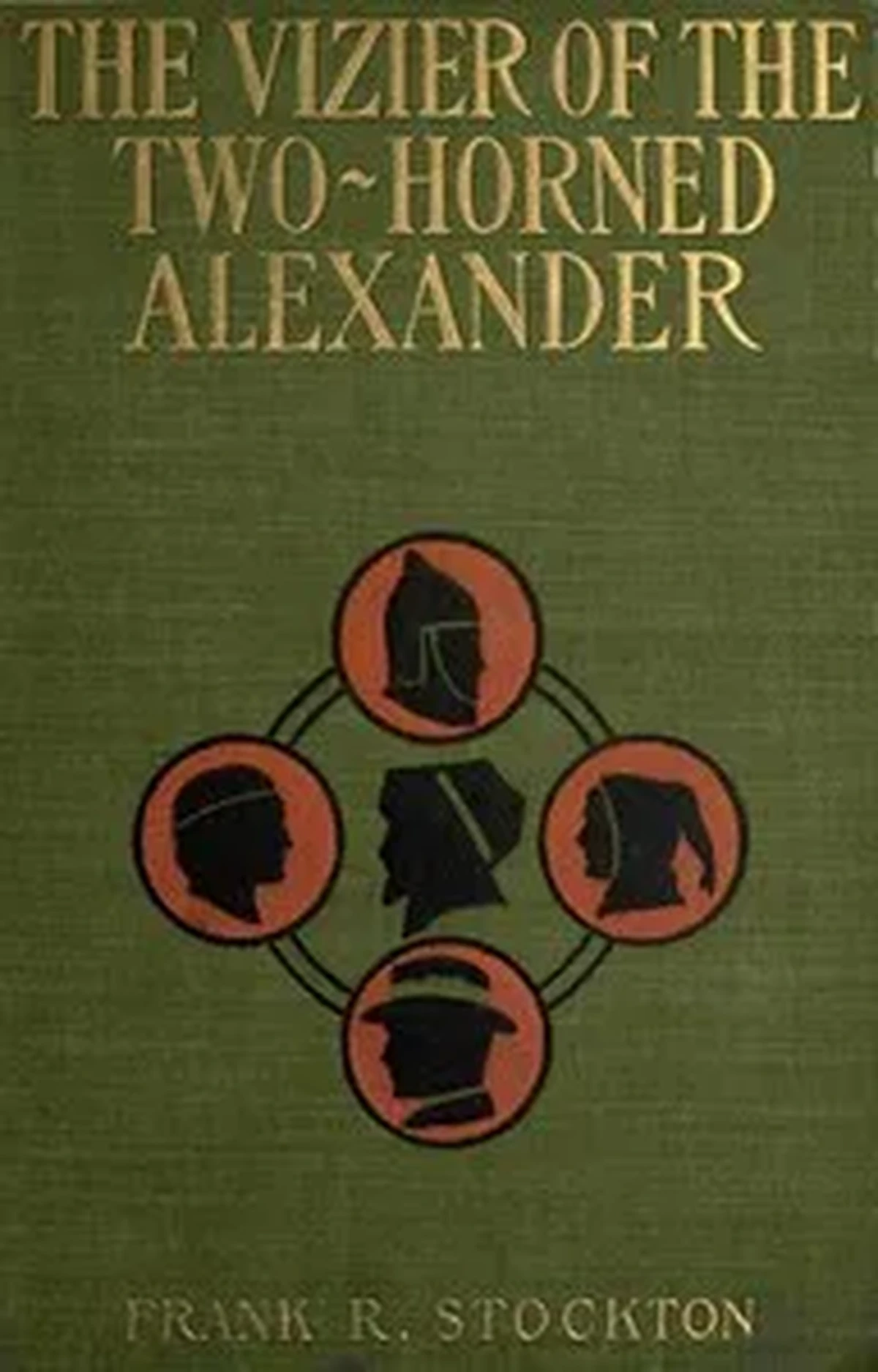
The vizier of the two-horned Alexander
 75
75

The vizier of the two-horned Alexander
Frank R. Stockton’s "The Vizier of the Two-Horned Alexander" offers a peculiar, almost melancholic reflection on existence, presented through the voice of a man who claims to have witnessed Alexander the Great’s campaigns firsthand and lived far beyond. The strength of the novella lies in its conversational structure, allowing Stockton to explore philosophical quandaries with a disarming lightness. The vizier’s casual recounting of millennia of experience, a concept that could easily become bombastic, is instead rendered with a quiet weariness that feels surprisingly authentic. However, the work’s deliberate pacing, while contributing to its contemplative mood, might test the patience of readers accustomed to more dynamic narratives. The vizier’s purported encounter with the mythical figure of Alexander, who is presented not just as a conqueror but as a figure grappling with his own legacy, serves as a compelling anchor. Stockton’s prose, characteristic of the late Victorian era, is precise yet evocative, but it occasionally borders on the archaic, requiring a focused reader. The novella ultimately succeeds as a character study on the burden of immense time and the stories we choose to tell about ourselves. It is a subtle exploration of immortality's ennui.
📝 Description
75
Frank R. Stockton's 1899 novella features a vizier who claims to have lived for centuries.
Published in 1899, "The Vizier of the Two-Horned Alexander" presents a unique narrative structure. The story unfolds through reported conversations with a vizier who claims an impossibly long lifespan. This ancient figure recounts experiences spanning various historical periods and encountering legendary individuals. Through his testimony, Stockton examines the nature of truth, the construction of identity, and the subjective experience of time and memory. The narrative invites readers to consider how personal and collective histories are formed and how unreliable memory can be. It is a story that favors contemplation over rapid plot development, focusing on character dialogue and philosophical inquiry.
This work appeals to readers who enjoy speculative fiction that engages with deeper questions. Those interested in narratives that challenge linear perceptions of time, explore the fallibility of memory, and deconstruct mythmaking will find it particularly rewarding. The book's measured pace and emphasis on conceptual exploration offer a different kind of reading experience, distinct from modern, action-oriented fiction. It also holds interest for students of late 19th-century literature, particularly those studying early forms of historical fantasy and proto-science fiction.
Emerging in the late 19th century, a period marked by widespread fascination with spiritualism and ancient civilizations, Stockton's tale taps into the era's intellectual currents. Concepts of reincarnation and hidden histories, popularized by figures like Helena Blavatsky, created a receptive audience for narratives of extended life and secret knowledge. While not overtly occult, the vizier's vast lifespan allows for a commentary that transcends conventional historical understanding, resonating with the period's interest in esoteric traditions and alternative perspectives on human history.
💡 Why Read This Book?
• Gain a unique perspective on historical memory by engaging with the vizier's claims of witnessing events from Alexander the Great's era, challenging conventional timelines. • Experience a narrative that scrutinizes the nature of truth and legend through the voice of an exceptionally long-lived character, prompting reflection on how stories are formed. • Appreciate a literary style from the 1899 publication that offers a contemplative, character-driven approach, distinct from modern narrative velocity, focusing on the psychological weight of vast time.
⭐ Reader Reviews
Honest opinions from readers who have explored this book.
❓ Frequently Asked Questions
What historical figure is the "Two-Horned Alexander" referring to?
The title refers to Alexander the Great, a figure often depicted with ram's horns in later iconography, particularly in Persian and Hellenistic art, symbolizing his supposed divine or god-like lineage.
What is the main premise of 'The Vizier of the Two-Horned Alexander'?
The book's premise centers on a vizier who claims to have lived for thousands of years, recounting his extraordinary experiences and interactions with historical figures, including Alexander the Great himself.
When was 'The Vizier of the Two-Horned Alexander' first published?
Frank R. Stockton's novella was first published in 1899, placing it at the cusp of the 20th century during a period of significant literary and philosophical shifts.
Does the book involve actual magic or supernatural elements?
While the vizier's longevity is extraordinary, the book focuses more on philosophical speculation and the nature of storytelling rather than overt magical systems. The narrative's 'magic' lies in its premise and the vizier's recounted experiences.
What kind of historical periods does the vizier claim to have experienced?
The vizier claims to have lived through numerous historical periods, beginning with the era of Alexander the Great (4th century BCE) and extending through centuries of subsequent human history.
Is this book part of a larger series by Frank R. Stockton?
No, 'The Vizier of the Two-Horned Alexander' is a standalone novella. While Stockton wrote many popular stories, this particular work is not part of a connected series.
🔮 Key Themes & Symbolism
The Burden of Immortality
The vizier's extraordinary lifespan, beginning in the time of Alexander the Great, is presented not as a gift but as a profound weight. He recounts millennia of human history, experiencing the rise and fall of empires, the repetition of follies, and the loss of countless loved ones. This theme explores the psychological toll of outliving one's era, the detachment that can arise from immense temporal perspective, and the existential ennui that accompanies near-eternal existence. His narrative invites contemplation on whether such an existence is truly desirable or a form of perpetual sorrow.
History as Narrative
Stockton uses the vizier's perspective to question the very nature of history. By presenting events through the lens of a single, incredibly long-lived witness, the work suggests that historical accounts are always mediated, subjective, and prone to transformation over time. The vizier's ability to recount events from the era of the Two-Horned Alexander (4th century BCE) highlights how legends form and how personal memory can diverge from or shape 'official' history. The narrative itself becomes an artifact, demonstrating how stories are constructed and preserved across generations.
Identity Across Time
The vizier's extended existence raises questions about the continuity of self. How does one maintain a coherent identity when experiencing thousands of years of change, witnessing the evolution of cultures, languages, and societies? The narrative implies that identity is fluid, shaped by experience and memory, but also potentially fragmented by the sheer scale of time. The vizier's persistent voice, despite his claims of vast age, suggests a core self that endures, yet the story probes the challenges and transformations inherent in such an enduring existence.
The Allure of the Past
Published in 1899, a period fascinated by ancient civilizations and romanticized notions of antiquity, the novella taps into a cultural longing for connection with distant eras. The vizier serves as a conduit to these lost worlds, offering a direct, albeit subjective, link to figures like Alexander the Great. This theme reflects the late Victorian interest in historical romance and the enduring human fascination with origins, legendary figures, and the possibility of uncovering hidden truths about past civilizations.
💬 Memorable Quotes
Direct passages from the work, attributed to the author.
“I have lived ever since the days of Alexander the Great.”
— This statement, central to the vizier's narrative, immediately establishes the fantastical premise of the story and its focus on extreme longevity. It frames the entire work as a reflection on history and time from an impossibly extended perspective.
“He spoke of his long life as if it were a simple fact, like the weather.”
— This interpretation highlights the vizier's extraordinary ability to normalize his millennia-spanning existence. His casual recounting of vast temporal experience underscores the narrative's unique approach to philosophical themes, presenting the incredible as mundane.
“The vizier's stories were a curious mix of historical detail and personal reflection.”
— This interpretation captures the essence of the narrative's content. It suggests that the vizier's accounts blend factual or popularly understood historical elements with his own subjective experiences and interpretations, blurring the line between history and personal testimony.
“He seemed weary, as if the weight of centuries pressed upon him.”
— This interpretation describes the emotional state of the vizier, suggesting that his immense age has brought not only knowledge but also profound fatigue. It speaks to the theme of immortality's burden, portraying it as a source of sorrow rather than power.
💡 Key Ideas
Editorial paraphrase of the work's core concepts — not direct quotes.
The great conqueror himself seemed to ponder his own legacy.
This paraphrase points to the characterization of Alexander the Great within the story. It suggests that beyond his military might, the figure of Alexander is explored for his own contemplations on fame and historical impact, adding a layer of depth to the legendary figure.
🌙 Esoteric Significance
Tradition
While not overtly aligned with a single esoteric tradition like Hermeticism or Kabbalah, "The Vizier of the Two-Horned Alexander" appeals to Gnostic and Neoplatonic themes concerning time, knowledge, and the soul's journey. The vizier’s claim of ancient lineage and his unique perspective echo the Gnostic concept of aeons and the transmission of hidden knowledge from remote antiquity. His extended existence can be seen as a metaphor for the soul's potentially vast journey through multiple incarnations or states of being, accumulating wisdom (or weariness) across epochs.
Symbolism
The 'Two-Horned Alexander' is a potent symbol, referencing depictions of Alexander the Great with ram's horns, often associated with divinity or the god Ammon-Ra in ancient Near Eastern iconography. This duality represents the fusion of earthly power (conquest) and perceived divine authority or destiny. The vizier himself, as the narrator of such a figure's era, symbolizes the enduring nature of memory and the human drive to record and interpret history, even across vast stretches of time.
Modern Relevance
Contemporary interest in transhumanism and extended lifespans finds a historical echo in the vizier's predicament. Thinkers and writers exploring the psychological and societal implications of radical life extension or immortality can draw parallels to Stockton's early fictionalized exploration of such a concept. Furthermore, narrative theorists and scholars of historiography can examine the vizier’s subjective account as a case study in the construction of historical myth and the unreliability of long-term memory.
👥 Who Should Read This Book
• Students of late 19th-century literature examining the evolution of speculative fiction and historical romance, to understand early explorations of time and memory. • Readers interested in philosophical fiction, particularly those drawn to narratives that ponder the nature of existence, history, and the human condition through unique premises. • Enthusiasts of ancient history and mythology, who will appreciate the literary engagement with figures like Alexander the Great and the symbolic representation of ancient iconography.
📜 Historical Context
Published in 1899, Frank R. Stockton’s "The Vizier of the Two-Horned Alexander" arrived during a fin-de-siècle period captivated by ancient mysteries and the burgeoning field of comparative mythology. This era saw the rise of movements like Theosophy, championed by Helena Blavatsky, which promoted esoteric interpretations of ancient texts and the concept of cyclical time, creating an audience receptive to tales of prolonged existence and hidden histories. Stockton’s work, while ostensibly fiction, taps into this cultural fascination with antiquity and the possibility of enduring wisdom. It emerged in a literary landscape populated by authors exploring historical romance and speculative fiction; contemporaries like H.G. Wells were beginning to popularize scientific romances, though Stockton’s approach remained more allegorical and less technologically focused. The reception of such works often reflected a society grappling with modernity while holding onto romanticized views of the past.
📔 Journal Prompts
The vizier's claim of witnessing Alexander the Great's era — how does this perspective alter your understanding of historical records?
Reflect on the vizier's reported weariness; what might be the true cost of immense temporal knowledge?
Consider the 'Two-Horned Alexander' symbolism; what does this fusion of human and divine represent in your own worldview?
Analyze the vizier's narrative as a form of personal mythology; what elements make his story compelling?
How does the vizier's recounting of events challenge the idea of a singular, objective historical truth?
🗂️ Glossary
Vizier
A high-ranking political advisor or minister in historical Islamic governments. In "The Vizier of the Two-Horned Alexander," the title character serves as the primary narrator and embodies ancient wisdom.
Alexander the Great
A king of the ancient Greek kingdom of Macedon, renowned for his military campaigns and conquests across Persia, Egypt, and into India. He lived from 356 to 323 BCE.
Two-Horned Alexander
A symbolic epithet for Alexander the Great, referencing iconography where he is depicted with the horns of a ram, often associated with the Egyptian deity Ammon-Ra, signifying divine authority.
Fin-de-siècle
French for 'end of the century,' referring to the period of cultural change and artistic innovation in the late 19th century, particularly in Europe, often associated with decadence and new artistic movements.
Theosophy
A philosophical and spiritual movement founded in the late 19th century by Helena Blavatsky, seeking to understand the underlying principles of all religions and philosophies, often incorporating elements of ancient wisdom and occultism.
Iconography
The visual images and symbols used in the study or representation of subjects, particularly in art. In this context, it refers to the visual depictions of Alexander the Great with horns.
Ennui
A feeling of listlessness and dissatisfaction arising from a lack of occupation or excitement; a profound sense of weariness or boredom, often associated with prolonged existence.
🔮 Readers Also Liked
Browse all →









More by Frank R. Stockton
All books →
More Free Occult Philosophy Books
View all →