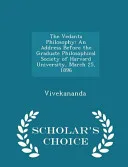
The Vedanta Philosophy
 79
79

The Vedanta Philosophy
Vivekananda's exposition of Vedanta Philosophy in this work offers a clear, systematic presentation of Advaita Vedanta for a Western audience, a formidable task undertaken with remarkable clarity. His ability to distill complex metaphysical concepts into accessible language is a significant strength. The section on Maya, for instance, effectively frames the illusion of separateness as a cognitive construct rather than a denial of empirical reality. However, the book’s focus on academic lecture format means it sometimes lacks the direct, devotional fervor found in other Vedanta texts. The emphasis on Jnana Yoga, while intellectually rigorous, might feel abstract to those seeking a more experiential spiritual path. A particular strength lies in his dissection of the 'four Vedas' and their philosophical import, moving beyond mere ritual. The work provides a solid intellectual foundation but may require supplementary material for a complete devotional or practical understanding. It is a foundational text for understanding Indian philosophical influence on Western thought.
📝 Description
79
Swami Vivekananda's 1893 Chicago address introduced Advaita Vedanta to a Western audience.
This book collects Swami Vivekananda's lectures from the late 19th century, primarily aimed at introducing the philosophy of Advaita Vedanta to the West. Vivekananda sought to explain the ultimate reality, Brahman, and the self, Atman, to a global audience. The text details the path to moksha, liberation from the cycle of rebirth, which is achieved by recognizing the fundamental unity of Atman and Brahman.
It is written for those interested in spiritual knowledge and Eastern philosophies, especially individuals contemplating the nature of reality, consciousness, and the self. Students of metaphysics and theology will find its philosophical arguments valuable, as will those studying the historical dissemination of Indian thought. The work also appeals to anyone curious about the spread of Indian philosophy to the Western world during a period of growing interest in Eastern spirituality.
Vivekananda's lectures represent a significant moment in the transmission of Hindu philosophy to the West. Delivered in the late 1890s, they engaged with a Western intellectual climate shaped by rationalism and materialism. Unlike some contemporary syncretic or esoteric interpretations of Eastern thought, Vivekananda's approach was direct and philosophical. His work offered a sophisticated spiritual perspective, distinct from prevailing materialist views, contributing to a broader interest in Eastern spirituality that emerged in the late 19th century.
💡 Why Read This Book?
• Gain a structured understanding of Advaita Vedanta's core tenets, including Brahman and Maya, directly from a pivotal figure who introduced these concepts to the West in the 1890s. • Explore the concept of the self (Atman) and its identity with ultimate reality (Brahman), as articulated in Vivekananda's lectures, offering a philosophical counterpoint to materialist worldviews. • Learn about the different paths to liberation (Moksha), such as Karma Yoga and Jnana Yoga, presented through Vivekananda's systematic framework, providing a roadmap for spiritual inquiry.
⭐ Reader Reviews
Honest opinions from readers who have explored this book.
❓ Frequently Asked Questions
What is the primary philosophical school of thought presented in The Vedanta Philosophy by Swami Vivekananda?
The book primarily presents the Advaita Vedanta school of Hindu philosophy. This non-dualistic tradition posits that the ultimate reality (Brahman) is singular and unchanging, and the individual self (Atman) is identical to it.
When did Swami Vivekananda first introduce these Vedanta concepts to the Western world?
Swami Vivekananda began introducing Vedanta concepts to the Western world in the 1890s, notably following his impactful speech at the Parliament of Religions in Chicago in 1893.
What does 'Maya' refer to in the context of The Vedanta Philosophy?
In this work, Maya refers to the concept of illusion or cosmic ignorance that causes us to perceive multiplicity and separateness in the world, obscuring the underlying oneness of Brahman.
Are the concepts of Karma Yoga and Jnana Yoga explained in this book?
Yes, The Vedanta Philosophy explains various paths to spiritual realization, including Karma Yoga (the path of action) and Jnana Yoga (the path of knowledge), as key methods for achieving liberation.
Is this book suitable for someone new to Eastern philosophy?
Yes, while complex, Vivekananda's lectures are structured to introduce the foundational concepts of Vedanta to a Western audience unfamiliar with the philosophy, making it accessible for beginners.
What is the ultimate goal of Vedanta philosophy as described by Vivekananda?
The ultimate goal, known as Moksha, is liberation from Samsara (the cycle of birth and death). This is achieved through the realization of the non-dual nature of reality and the unity of the individual soul with Brahman.
🔮 Key Themes & Symbolism
The Nature of Reality (Brahman)
This work meticulously unpacks the Vedantic concept of Brahman as the singular, ultimate reality that underlies all existence. It argues that all phenomena, from the material universe to individual consciousness, are manifestations of this one, undifferentiated Absolute. Vivekananda uses analogies to explain how this singular reality appears as manifold due to Maya, the power of cosmic illusion, challenging the perception of inherent separateness and duality.
The Self (Atman) and its Unity
Central to the philosophy is the concept of Atman, the true self, which is presented not as a separate entity but as identical with Brahman. The book guides the reader toward recognizing that the perceived individual ego is a temporary construct, and the eternal essence of the self is divine and unbounded. This realization is the key to overcoming suffering and achieving spiritual freedom, moving beyond the limitations of personal identity.
Paths to Liberation (Moksha)
Vivekananda outlines four principal Yogas as pathways to realizing the truth of oneness and achieving Moksha: Karma Yoga (selfless action), Bhakti Yoga (devotion), Raja Yoga (meditation and control of the mind), and Jnana Yoga (the path of knowledge and discrimination). Each path is presented as a valid means to dismantle ignorance and attain the state of liberation from the cycle of birth and death.
The Role of Maya
Maya is explained as the principle that creates the appearance of diversity and duality in the universe. It is not an absolute reality but a veil that conceals the underlying unity of Brahman. Understanding Maya is crucial for the spiritual aspirant, as it allows for the deconstruction of perceived limitations and the recognition of the illusory nature of the material world and individual ego.
💬 Memorable Quotes
Direct passages from the work, attributed to the author.
“The goal is to know that we are Brahman.”
— This concise statement captures the core aim of Advaita Vedanta. It suggests that true spiritual attainment lies not in becoming something other than what one is, but in realizing one's inherent divine nature, which is already identical with the ultimate reality.
💡 Key Ideas
Editorial paraphrase of the work's core concepts — not direct quotes.
All that we see is Maya.
This paraphrased concept highlights the Vedantic understanding of the phenomenal world. It asserts that the perceived reality of individual objects and separate selves is an illusion, a temporary appearance that masks the singular, unchanging nature of Brahman.
We are not the body or the mind.
This common Vedantic assertion, likely paraphrased from Vivekananda's teachings, points to the distinction between the true self (Atman) and the empirical self. It encourages practitioners to look beyond physical and mental identifications to discover their eternal essence.
Jnana Yoga is the path of discrimination.
This statement likely summarizes Vivekananda's description of the path of knowledge. It emphasizes the intellectual and analytical process of distinguishing between the real (Brahman) and the unreal (the phenomenal world and the ego).
Action done for its own sake purifies the mind.
This paraphrased idea reflects the principle of Karma Yoga. It suggests that performing one's duties without attachment to the results purifies the mind, making it receptive to higher spiritual understanding and realization.
🌙 Esoteric Significance
Tradition
Vivekananda's Vedanta belongs to the broad lineage of Indian philosophical and spiritual traditions, specifically the orthodox school of Advaita Vedanta, one of the six classical Darshanas of Hinduism. While often presented in academic and philosophical terms, its core teachings on the oneness of existence, the illusory nature of the perceived world, and the direct realization of the divine Self align with the ultimate goals of many esoteric paths worldwide, including mystical branches of Western religions.
Symbolism
Within Vedanta, the concept of Brahman is often symbolized by 'Om' (Aum), the primordial sound representing the totality of existence. The idea of Maya can be visualized as a veil or a cosmic play (Lila). The journey of the Atman is often depicted as a return to its source, akin to a drop rejoining the ocean, emphasizing unity over individuality and dissolution of ego.
Modern Relevance
Vivekananda's articulation of Vedanta has profoundly influenced contemporary spiritual thinkers, New Age movements, and various forms of meditation and mindfulness practices. Modern proponents of yoga, transpersonal psychology, and consciousness studies frequently draw upon his accessible explanations of non-duality, the nature of the mind, and the potential for human spiritual evolution. His work remains a reference for those exploring Eastern philosophies in a modern context.
👥 Who Should Read This Book
• Students of comparative religion and philosophy seeking to understand a major Eastern spiritual tradition from a foundational Western interpreter. • Individuals interested in metaphysics and ontology who want to explore concepts like ultimate reality, illusion, and the nature of consciousness. • Seekers of spiritual knowledge exploring paths to self-realization and liberation from existential suffering, looking for a systematic philosophical framework.
📜 Historical Context
Swami Vivekananda's lectures on Vedanta Philosophy in the late 1890s occurred during a period of significant intellectual and spiritual exchange between India and the West. Following his seminal address at the 1893 Parliament of Religions in Chicago, Vivekananda became a prominent figure, introducing the sophisticated philosophy of Advaita Vedanta to a Western audience largely unfamiliar with its nuances. This era saw a growing interest in Eastern thought, partly stimulated by the Theosophical Society, but Vivekananda's approach was distinctly philosophical and less syncretic than some contemporaries. He engaged with Western intellectual currents, including the rise of scientific rationalism and materialism, offering Vedanta as a robust spiritual and metaphysical framework. His work contrasted with the prevalent Western philosophical discourse, providing a profound alternative that resonated with many seeking spiritual depth beyond conventional religious structures.
📔 Journal Prompts
The concept of Brahman as the singular, underlying reality: how does this challenge your perception of the material world?
The distinction between Atman and the ego: explore the implications of your true self being eternal and unbounded.
Reflect on Maya: identify instances where the appearance of separateness might be an illusion in your daily life.
Consider the Four Yogas: which path (Karma, Bhakti, Raja, Jnana) most aligns with your current life stage and disposition?
The goal of Moksha: what does liberation from the cycle of birth and death mean to you conceptually?
🗂️ Glossary
Brahman
The ultimate, unchanging, singular reality or Absolute in Hindu philosophy, the source and sustainer of all existence.
Atman
The individual self or soul, which in Advaita Vedanta is identical with Brahman.
Advaita Vedanta
A school of Hindu philosophy emphasizing non-duality, teaching that the individual soul and the ultimate reality are one.
Maya
Cosmic illusion or ignorance, the power that conceals the true nature of reality and makes the world of multiplicity appear real.
Moksha
Liberation from Samsara, the cycle of birth, death, and rebirth; spiritual freedom.
Yoga
A discipline or path aimed at spiritual realization, often referring to specific practices like Karma, Bhakti, Raja, or Jnana Yoga.
Samsara
The continuous cycle of birth, death, and reincarnation, driven by karma.