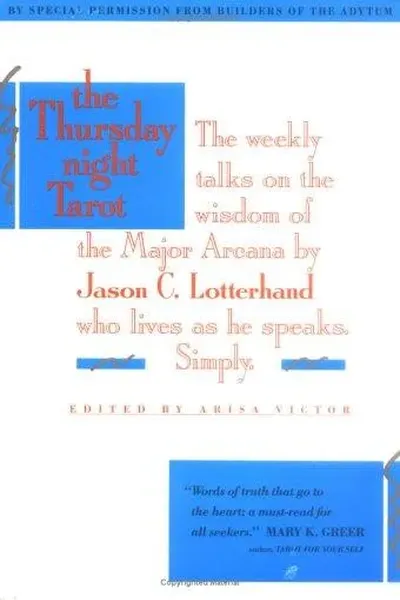
The Thursday night tarot

 71
71

The Thursday night tarot
Jason C. Lotterhand's 'The Thursday Night Tarot' provides a refreshingly grounded perspective on a system often shrouded in mysticism. Rather than relying on esoteric jargon or predictions, Lotterhand focuses on the Tarot as a practical tool for psychological introspection, a stance that feels particularly relevant given its 1989 publication date. The strength of the book lies in its methodical approach to the card meanings, presenting them as components of a coherent symbolic language. One passage that stands out is the detailed breakdown of how the Pip cards, beyond their suit and number, carry distinct narrative potential. A limitation, however, is that the book's methodical nature might feel less accessible to those seeking purely intuitive or divinatory guidance. Ultimately, 'The Thursday Night Tarot' serves as a valuable manual for serious students of the cards who prioritize understanding over simple prognostication.
📝 Description
71
Published in 1989, Jason C. Lotterhand's 'The Thursday Night Tarot' reoriented Tarot study towards psychological depth.
'The Thursday Night Tarot,' by Jason C. Lotterhand, first published in 1989, advances a unique perspective on Tarot. Lotterhand presents the cards not simply as instruments for fortune telling, but as a complete framework for introspection and personal evolution. His approach highlights the archetypal stories within each card, urging readers to see them as reflections of their inner lives and outer experiences.
This book is for those who want a more analytical and inward-looking method for using the Tarot. It addresses practitioners who find basic interpretations lacking and seek to grasp the deeper structures and meanings of the Major and Minor Arcana. Tarot readers who have moved beyond introductory stages and wish to enrich their practice with a system that merges psychological insight and symbolic meaning will find this work especially useful. It also suits students of esoteric traditions interested in how symbolic systems can aid personal growth.
Released in 1989, 'The Thursday Night Tarot' arrived during a resurgence of interest in Western esotericism. This period saw many authors, influenced by figures like Carl Jung, focus on psychological interpretations of the Tarot. Lotterhand's work offered a structured method for engaging the cards, aligning with contemporary explorations of Tarot as a psychological tool and symbolic language, distinct from older divinatory or ceremonial magic traditions.
💡 Why Read This Book?
• Gain a structured method for Tarot interpretation that emphasizes symbolic coherence, moving beyond rote memorization of card meanings, as demonstrated in the detailed analysis of the Minor Arcana. • Develop a deeper understanding of the Tarot as a psychological mirror, learning how to apply its archetypal narratives to personal growth and self-awareness, drawing from the book's exploration of the Fool's Journey. • Engage with the Tarot as a language of the soul, fostering a more introspective and analytical relationship with the cards, informed by Lotterhand’s systematic approach first published in 1989.
⭐ Reader Reviews
Honest opinions from readers who have explored this book.
❓ Frequently Asked Questions
What is the primary focus of 'The Thursday Night Tarot'?
'The Thursday Night Tarot' by Jason C. Lotterhand focuses on the Tarot as a symbolic system for psychological introspection and self-discovery, rather than solely for divination. It explores the archetypal narratives within the cards.
When was 'The Thursday Night Tarot' first published?
The book was first published in 1989, placing it within a period of significant engagement with psychological and esoteric interpretations of the Tarot.
Who would benefit most from reading this book?
Individuals seeking a deeper, more analytical understanding of the Tarot, practitioners looking to move beyond basic readings, and students of esoteric symbolism interested in psychological applications will find this book beneficial.
Does the book offer traditional fortune-telling methods?
While the Tarot can be used for divination, Lotterhand's approach emphasizes its role as a symbolic language for psychological insight and personal growth, suggesting a focus beyond simple prediction.
What is the 'Fool's Journey' concept as presented in the book?
The Fool's Journey, a central concept in many Tarot systems, likely refers to the progression through the Major Arcana as a metaphor for spiritual development and individuation, a theme explored in the book.
Is this book suitable for absolute beginners to the Tarot?
While accessible, the book's analytical and psychological depth might be best appreciated by those who have some foundational familiarity with Tarot cards or symbolism.
🔮 Key Themes & Symbolism
Tarot as Symbolic Language
Lotterhand presents the Tarot not as a mere tool for predicting the future, but as a rich, symbolic language capable of articulating complex psychological states and spiritual trajectories. This perspective frames the 78 cards as a coherent system of archetypal imagery, where each symbol and sequence offers insights into the human condition. The work likely details how the suits, numbers, and figures within the deck form a grammar for understanding inner landscapes, moving beyond superficial divinatory meanings to engage with the profound symbolic resonance of the cards.
Psychological Introspection
A core theme is the Tarot's utility in facilitating self-awareness and psychological growth. The book encourages readers to view the cards as mirrors reflecting their internal world, offering guidance for personal development. By engaging with the archetypes and narratives embodied in the Tarot, individuals can gain clarity on their motivations, challenges, and potential pathways. This approach aligns with psychological interpretations prevalent since the mid-20th century, using the Tarot as a framework for exploring the subconscious and conscious mind.
The Archetypal Journey
The concept of the Fool's Journey, tracing the progression through the Major Arcana, is likely central to Lotterhand's exploration. This narrative arc symbolizes the individual's path of initiation, transformation, and self-realization. The book probably illustrates how each Major Arcana card represents a stage or a challenge in this universal journey. Understanding this archetypal progression provides a map for navigating life's transitions and developing a deeper connection to one's own life story and spiritual unfolding.
Systematic Interpretation
Rather than relying solely on intuition, 'The Thursday Night Tarot' advocates for a systematic and methodical approach to card interpretation. This involves understanding the inherent logic and structure of the Tarot deck, including the relationships between the Major and Minor Arcana. The book likely provides frameworks for analyzing card spreads and individual card meanings within their broader context, fostering a disciplined and analytical engagement with the Tarot that can be applied consistently.
💬 Memorable Quotes
Direct passages from the work, attributed to the author.
“The Tarot provides a vocabulary for the soul's own language.”
— This interpretation suggests that the Tarot cards are not arbitrary symbols but form a structured system that can articulate the deepest aspects of our inner lives, allowing us to understand and express what might otherwise remain ineffable.
“Each card is a mirror, reflecting not just external events but internal states.”
— This highlights the book's focus on the Tarot as a tool for self-reflection. It implies that by examining the imagery and symbolism of a card, one can gain insight into their own feelings, thoughts, and psychological patterns.
“The Minor Arcana detail the everyday unfolding of archetypal energies.”
— This suggests that the numbered cards are not merely sequential but represent the practical manifestation and daily experience of the larger archetypal forces found in the Major Arcana.
“Understanding the Fool's Journey maps the path of personal evolution.”
— This interpretation points to the book's use of the Major Arcana progression as a metaphor for spiritual development and the stages of psychological maturation an individual undergoes throughout life.
“A systematic approach unlocks the Tarot's inherent logic.”
— This emphasizes Lotterhand's method, suggesting that a structured and analytical engagement with the cards reveals a coherent underlying system, enabling more consistent and insightful readings.
🌙 Esoteric Significance
Tradition
This work aligns with the modern esoteric revival of the late 20th century, which often synthesized Hermetic principles with Jungian psychology. It fits within the broader Western esoteric tradition by treating the Tarot as a symbolic map for spiritual and psychological development, akin to how the Kabbalah or Gnostic texts were explored. Lotterhand's approach emphasizes the inherent wisdom within the archetypal imagery, suggesting a structured path to gnosis or self-knowledge through systematic engagement with the cards.
Symbolism
Key symbols likely explored include the Fool, representing the beginning of a spiritual or psychological journey, and the archetypal figures of the Major Arcana, embodying universal human experiences and developmental stages. The Minor Arcana, particularly the four suits (Wands, Cups, Swords, Pentacles), would be analyzed for their elemental correspondences and their representation of different aspects of life—creativity, emotion, intellect, and the material world, respectively.
Modern Relevance
Contemporary practitioners of modern witchcraft, depth psychology, and symbolic studies continue to draw from Lotterhand's systematic approach. His emphasis on the Tarot as a psychological tool appeals to current therapeutic practices that utilize archetypal imagery and narrative. Thinkers and practitioners exploring Jungian Tarot, archetypal psychology, and symbolic literacy often find value in such structured methodologies for understanding the Tarot's enduring relevance.
👥 Who Should Read This Book
['• Tarot students seeking a structured, analytical framework beyond basic meanings to deepen their interpretive skills.', '• Individuals interested in the psychological and archetypal dimensions of symbolism, particularly as applied to personal growth.', '• Esoteric practitioners looking to integrate the Tarot into a broader system of self-inquiry and spiritual development.']
📜 Historical Context
Published in 1989, 'The Thursday Night Tarot' emerged during a vibrant period for esoteric studies, particularly within Western esotericism. The late 20th century saw a significant surge in the popularization and academic interest in occult traditions, with figures like Carl Jung's interpretations of archetypes profoundly influencing the psychological approach to Tarot. This era was characterized by a move away from purely divinatory or spiritualist interpretations toward a more psychological and symbolic understanding of the cards. Lotterhand’s work contributed to this trend, offering a structured, analytical method at a time when many authors were exploring Tarot's connection to psychology and personal growth. Contemporary authors like Rachel Pollack were also active, further expanding the discourse on Tarot's deeper meanings and applications. The book's emphasis on systematic interpretation offered a counterpoint to more purely intuitive approaches.
📔 Journal Prompts
The Fool's Journey as a map of my current life path.
How the suit of Swords reflects my intellectual challenges.
Connecting the archetypal energies of the Major Arcana to my inner world.
Identifying the 'language of the soul' in a specific card reading.
Applying the systematic approach to a recent personal event.
🗂️ Glossary
Major Arcana
The 22 trump cards in a Tarot deck, typically representing significant life lessons, spiritual stages, and archetypal forces. They are often seen as charting a journey of spiritual development.
Minor Arcana
The 56 cards in a Tarot deck, divided into four suits (Wands, Cups, Swords, Pentacles). They represent more mundane events, daily circumstances, and practical challenges and experiences.
Archetype
A universal, archaic pattern of behavior or image that recurs in the literature, art, and mythology of cultures throughout the world, often representing fundamental human experiences or figures.
Symbolic Language
A system of communication where images, signs, or objects represent abstract ideas, concepts, or deeper meanings, often conveying complex information intuitively.
Pip Cards
The numbered cards within the Minor Arcana (Ace through 10), distinct from the court cards (Page, Knight, Queen, King).
Divination
The practice of seeking knowledge of the future or the unknown by supernatural means, often involving the interpretation of omens or signs, such as those found in Tarot readings.
Fool's Journey
A common allegorical interpretation of the Major Arcana, depicting the journey of the Fool (card 0) through the stages of life, growth, and spiritual realization represented by the other Major Arcana cards.
🔮 Readers Also Liked
Browse all →






More by Jason C. Lotterhand
All books →
More Free Occult Philosophy Books
View all →