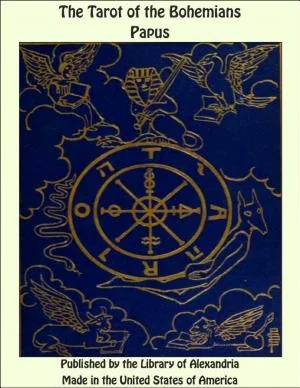
The tarot of the Bohemians
 82
82

The tarot of the Bohemians
Papus's "The Tarot of the Bohemians" presents a dense, almost encyclopedic, approach to the Tarot, aiming to codify its esoteric meanings with remarkable ambition. Its primary strength lies in its comprehensive attempt to synthesize Kabbalah, astrology, and symbolism into a cohesive Tarot system, a project that profoundly influenced subsequent occult literature. The detailed correspondences offered, particularly regarding the Major Arcana's connection to Hebrew letters and astrological signs, are meticulously laid out. However, the work can be overwhelming for newcomers due to its academic and somewhat dry prose, often assuming a pre-existing familiarity with esoteric concepts. A notable passage is the detailed breakdown of the Hierophant (Pope) card, where Papus connects it to divine wisdom and spiritual authority, illustrating his method of symbolic exegesis. The limitation is its historical specificity; while invaluable for understanding late 19th-century occultism, some of its interpretations may feel dated or overly rigid to contemporary practitioners. It is an essential, if challenging, historical document for the serious Tarot scholar.
📝 Description
82
Papus's "The Tarot of the Bohemians" was first published in 1896.
Published in 1896, Gérard Encausse, writing as Papus, structured "The Tarot of the Bohemians" as a symbolic language, not just a divinatory tool. He connected the Tarot's Major and Minor Arcana to Kabbalah, astrology, and numerology. Papus intended the work to show the Tarot as a universal cipher for understanding the cosmos and human consciousness.
This book is for serious students of esoteric traditions, especially those interested in the historical development of Tarot symbolism and its place in Western occultism. Readers who want a rigorous, academic approach to the Tarot, going beyond simple fortune-telling, will find it useful. Historians of magic, occultism, and late 19th-century French intellectual life can also use it as a resource. It shows the foundational texts that influenced modern esoteric movements.
Papus presented the Tarot as a "Book of Thoth," containing secrets of creation. He detailed the "Great Arcanum" and "Lesser Arcanum," explaining how the 22 Major Arcana represent fundamental cosmic principles. The work also examined the Minor Arcana's connection to everyday life and human experience.
Emerging during a late 19th-century European occult revival, "The Tarot of the Bohemians" appeared alongside growing interest in spiritualism and Theosophy. Papus, a key figure in French occultism and co-founder of the Martinist Order, sought to legitimize occult studies by linking them to Hermeticism, Kabbalah, and Egyptian mysteries. His work was part of a broader effort to synthesize various esoteric traditions, building on ideas from contemporaries like Eliphas Lévi.
💡 Why Read This Book?
• Understand the Tarot as a symbolic language beyond divination, as Papus meticulously links the 22 Major Arcana to Kabbalistic concepts and astrological correspondences, first outlined in his 1896 work. • Gain insight into the late 19th-century occult revival by examining Papus's synthesis of Hermeticism and Tarot, a period marked by figures like Eliphas Lévi. • Explore the esoteric interpretation of the "Book of Thoth" concept, as presented in "The Tarot of the Bohemians," revealing the cards as keys to cosmic principles and spiritual initiation.
⭐ Reader Reviews
Honest opinions from readers who have explored this book.
❓ Frequently Asked Questions
What is the historical significance of Papus's "The Tarot of the Bohemians"?
Published in 1896, it was a pivotal work in the late 19th-century occult revival, attempting to systematize Tarot symbolism with Kabbalah and astrology, influencing generations of esotericists and historians of magic.
Does "The Tarot of the Bohemians" focus on fortune-telling?
While it touches on divinatory aspects, the book's primary focus is on the Tarot as a philosophical and spiritual system, a symbolic language for understanding the universe and the human condition.
What esoteric traditions are explored in "The Tarot of the Bohemians"?
Papus heavily integrates Kabbalah, Hermeticism, astrology, and numerology, presenting the Tarot as a key that unlocks these ancient wisdom systems.
Who was Papus and why is he important?
Papus, born Gérard Encausse, was a leading French occultist and physician in the late 1800s, co-founder of the Martinist Order, and a prolific author whose works shaped modern Western esotericism.
Is "The Tarot of the Bohemians" suitable for beginners?
It is quite dense and assumes some familiarity with esoteric concepts. Beginners might find it challenging, but it's invaluable for those serious about historical Tarot scholarship.
What are the "Great Arcanum" and "Lesser Arcanum" according to Papus?
Papus uses these terms to distinguish the 22 Major Arcana (representing fundamental principles or the Great Arcanum) from the 56 Minor Arcana (representing their manifestations or the Lesser Arcanum).
🔮 Key Themes & Symbolism
Tarot as Symbolic Language
Papus presents the Tarot not as mere playing cards or a tool for prediction, but as a profound symbolic language, a 'Book of Thoth,' encoding universal truths. He meticulously maps the 22 Major Arcana to concepts within Kabbalah and astrology, viewing each card as a hieroglyph representing cosmic forces and stages of spiritual evolution. This interpretation positions the Tarot as a cipher for understanding the fundamental principles of existence and the journey of the soul.
Kabbalistic and Astrological Correspondences
A central tenet of the work is the detailed correlation between the Tarot trumps and the Hebrew alphabet, as well as planetary and zodiacal influences. Papus argues that this systematic alignment reveals the Tarot's ancient origins and its role as a key to unlocking the secrets of the Kabbalistic Tree of Life. This approach seeks to demonstrate the inherent esoteric structure of the cards, grounding them in established mystical traditions.
Spiritual Initiation and the Great Arcanum
The book frames the Tarot as a guide for spiritual initiation, particularly through the "Great Arcanum," often associated with the Major Arcana. Papus interprets the cards as representing archetypal forces and stages in the development of consciousness, charting a path from primal creation to divine realization. The Minor Arcana are seen as the practical manifestations and daily applications of these grander principles, offering a complete symbolic map for the adept.
The 'Bohemian' Connection
The title itself hints at a lineage Papus associates with ancient Egypt and the mythical origins of the Tarot, often linked to the Romani people ('Bohemians') as custodians of this ancient wisdom. While this connection is more symbolic than historical in a modern sense, Papus uses it to evoke a sense of primal, universal knowledge passed down through ages. The work explores the idea that this esoteric knowledge is accessible through the symbolic grammar of the Tarot.
💬 Memorable Quotes
Direct passages from the work, attributed to the author.
“The Tarot is the book of destinies, the hieroglyphic book of the human race.”
— This statement expresses Papus's view of the Tarot as a divinely inspired text that holds the blueprint for both individual lives and the collective journey of humanity, encoded in symbolic form.
“The 22 letters of the Hebrew alphabet correspond to the 22 Major Arcana.”
— This highlights a core principle of Papus's system: the direct correlation between the Tarot trumps and the Hebrew alphabet, a foundational element in Kabbalistic studies and a key to unlocking esoteric meaning.
“The Tarot is the key to all sciences, all religions, and all philosophies.”
— Papus elevates the Tarot beyond a simple divination tool, positioning it as a universal language and a master key capable of deciphering the underlying principles of all knowledge systems.
“The Great Arcanum represents the divine essence and the principles of creation.”
— This interpretation emphasizes the cosmic and spiritual significance attributed to the Major Arcana, viewing them as embodiments of fundamental forces and the very mechanics of existence as understood in esoteric thought.
“The Lesser Arcanum manifests the principles of the Great Arcanum in the world.”
— This clarifies the relationship between the Major and Minor Arcana in Papus's system, suggesting that the numbered cards depict how divine principles are expressed and experienced within the phenomenal world.
🌙 Esoteric Significance
Tradition
This work is firmly rooted in the Western Esoteric Tradition, specifically drawing heavily from Hermeticism and Kabbalah. Papus positions the Tarot as a divinely revealed text, akin to the Sepher Yetzirah, intended to unlock the secrets of creation. It represents a key moment in the formalization of Tarot as a central pillar of occult pedagogy, seeking to bridge Neoplatonism, Gnosticism, and alchemical symbolism into a unified esoteric worldview, distinct from purely magical or divinatory applications.
Symbolism
Two prominent symbols are the Tree of Life and the Hebrew alphabet. Papus meticulously aligns the 22 Major Arcana with the 22 paths of the Kabbalistic Tree of Life and the 22 Hebrew letters. This linkage transforms the Tarot cards into visual representations of divine emanations and cosmic principles, offering a framework for understanding spiritual ascent and the structure of reality according to Kabbalistic cosmology.
Modern Relevance
Papus's systematization of Tarot correspondences continues to influence modern esoteric practitioners and scholars. Contemporary Kabbalistic Tarot readers, occultists studying Western Hermeticism, and students of esoteric history often reference "The Tarot of the Bohemians" as a foundational text. Its rigorous approach to symbolic interpretation provides a framework that, while debated, remains a significant reference point for those seeking to understand the deeper, philosophical dimensions of the Tarot beyond simple fortune-telling.
👥 Who Should Read This Book
• Students of Western Esotericism: Those interested in the historical development of occultism, particularly the late 19th-century revival and figures like Papus and the Martinist Order. • Serious Tarot Scholars: Individuals seeking to understand the Tarot as a complex symbolic system and philosophical text, moving beyond basic divinatory meanings and exploring its historical esoteric interpretations. • Comparative Mysticism Enthusiasts: Readers interested in how different mystical traditions, such as Kabbalah and Hermeticism, have been synthesized and applied to symbolic systems like the Tarot.
📜 Historical Context
Published in 1896, "The Tarot of the Bohemians" emerged during a fervent period of occult revival in late 19th-century France. This era saw a proliferation of esoteric societies and publications, fueled by a reaction against materialism and a renewed interest in mysticism, spiritualism, and ancient wisdom traditions. Papus (Gérard Encausse) was a central figure, co-founding the Martinist Order and actively engaging with contemporaries like Stanislas de Guaita and Eliphas Lévi, whose earlier works on Tarot and magic had already established a framework. Papus’s book sought to synthesize these influences, particularly Kabbalah and Hermeticism, into a coherent system, presenting the Tarot as a key to understanding these complex doctrines. Unlike purely academic or purely divinatory approaches, Papus’s work aimed to establish the Tarot as a profound philosophical and spiritual text, contributing significantly to its mystique and scholarly study within esoteric circles.
📔 Journal Prompts
The concept of the Great Arcanum as presented by Papus.
The specific Kabbalistic correspondences assigned to the Major Arcana.
How the "Book of Thoth" metaphor informs the interpretation of Tarot symbolism.
The role of the "Bohemian" lineage in Papus's esoteric framework.
The relationship between the Major Arcana and the Hebrew alphabet in this text.
🗂️ Glossary
Great Arcanum
In Papus's system, this primarily refers to the 22 Major Arcana of the Tarot, which he believed represented the fundamental divine principles and cosmic forces governing existence.
Lesser Arcanum
The 56 Minor Arcana (Wands, Cups, Swords, Pentacles) are referred to as the Lesser Arcanum, representing the manifestations, applications, and practical workings of the divine principles found in the Great Arcanum.
Kabbalah
A body of Jewish mystical teachings and esoteric traditions that seeks to understand the nature of God and the universe, often visualized through the Tree of Life and gematria.
Hermeticism
A philosophical and religious tradition based on the purported teachings of Hermes Trismegistus, emphasizing divine wisdom, the interconnectedness of all things, and the pursuit of spiritual enlightenment.
Book of Thoth
An ancient Egyptian legendary text attributed to the god Thoth, often associated with magic, wisdom, and the secrets of the universe. Papus links the Tarot to this legendary book.
Martinism
An esoteric order founded in the late 18th century, which Papus helped to revive and expand in the late 19th century, focusing on Christian mysticism and the teachings of Louis Claude de Saint-Martin.
Hieroglyphic Book
Papus's description of the Tarot, viewing its cards not as mere images but as symbolic glyphs or hieroglyphs that convey profound esoteric meanings and universal truths.
🔮 Readers Also Liked
Browse all →







More by Papus
All books →





More Free Divination & Tarot Books
View all →