The Tarot
 61
61

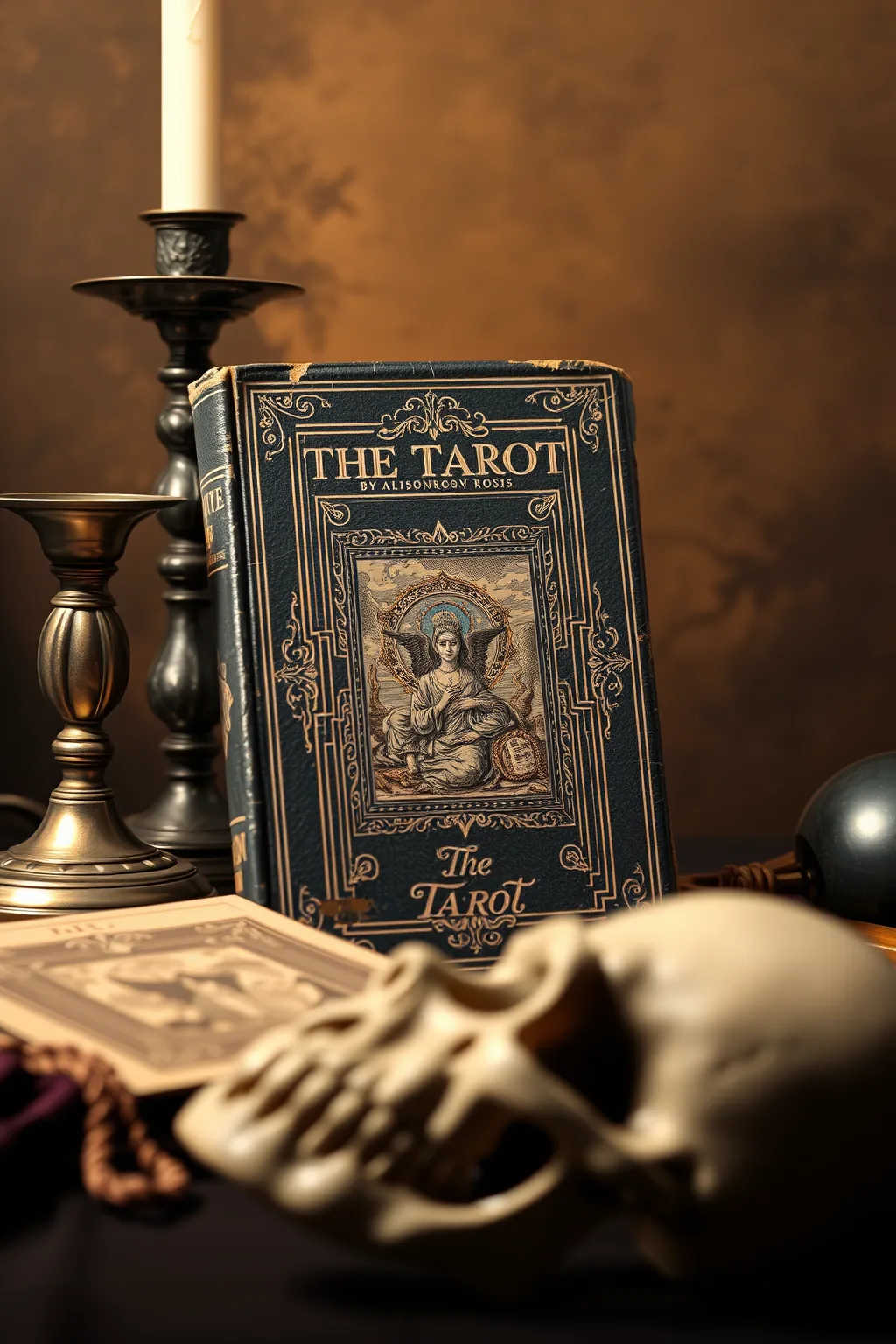
The Tarot



Alison Ross's 'The Tarot' is a luminous beacon in the often-murky waters of divinatory literature. With an alchemist's touch, Ross transmutes the familiar into the profound, illuminating the deep esoteric currents that pulse beneath the surface of each card. This is not a superficial guide; it's an invitation to gnosis, a scholarly yet accessible exploration of the Tarot as a spiritual technology. The author masterfully dissects the symbolic language, revealing its echoes in ancient wisdom traditions. 'The Tarot' is essential reading for practitioners seeking to deepen their understanding and for those on the path of self-discovery who wish to engage with a truly potent divinatory system.
📝 Description
61
Alison Ross's 'The Tarot' examines the cards not just as divination tools but as mirrors of consciousness.
Alison Ross's 'The Tarot' moves beyond simple fortune-telling to consider the cards as a complex system for understanding inner states. The book details the symbolism within both the Major and Minor Arcana, suggesting connections to broader philosophical ideas. Ross interprets each card as a distinct symbol, speaking to processes of personal change and spiritual growth.
The work aims to illuminate the Tarot's role in esoteric traditions and its potential for self-discovery. It is written for those who approach the Tarot with a serious interest in its deeper meanings, beyond everyday prediction. The author's intent is to sharpen the reader's awareness through a close study of the cards' symbolic language.
This book situates the Tarot within a lineage of esoteric thought, linking its symbolic system to currents within Hermeticism and Western esotericism. It treats the cards as more than mere instruments for divination, but as a method for engaging with archetypal patterns that inform human consciousness and spiritual development. The work suggests a correspondence between the Tarot's imagery and concepts of initiation and transformation found in various mystical traditions.
💡 Why Read This Book?
Uncover the profound symbolic language of the Tarot, moving beyond simple fortune-telling to grasp its power as a tool for self-realization and spiritual growth. 'The Tarot' by Alison Ross offers a deep dive into esoteric philosophy and archetypal wisdom, making it an ideal read for serious practitioners, spiritual seekers, and academic scholars interested in the metaphysical dimensions of divination.
⭐ Reader Reviews
Honest opinions from readers who have explored this book.
❓ Frequently Asked Questions
What makes this book different from other Tarot guides?
Alison Ross's 'The Tarot' distinguishes itself by delving into the esoteric and philosophical underpinnings of the cards, connecting them to ancient wisdom traditions and offering a framework for spiritual growth, rather than just predictive meanings.
Is this book suitable for beginners?
Yes, while it offers profound depth for advanced practitioners, 'The Tarot' also provides a clear and accessible introduction to the symbolic language and esoteric significance of the cards for those new to the subject.
What esoteric traditions are explored in the book?
The book draws extensively from Hermeticism, Kabbalah, and Neoplatonic philosophy, weaving these rich esoteric threads into the interpretation of the Tarot's symbolism.
Can the Tarot be used for more than just prediction?
Absolutely. Ross emphasizes the Tarot as a powerful system for self-reflection, psychological insight, spiritual development, and understanding the archetypal forces at play in life.
Where can I find additional resources mentioned by the author?
Esoteric Library often provides supplementary materials and links to related texts within its digital archives, which may include further resources connected to Alison Ross's research.
🔮 Key Themes & Symbolism
The Archetypal Language of the Cosmos
This volume elucidates the Tarot not merely as a deck of cards, but as a living language of archetypes that mirrors the fundamental structures of the universe and the human psyche. Ross guides readers to perceive the deep symbolic resonance within each card, revealing how these universal patterns manifest in our lives. The exploration examines the Jungian concept of archetypes, presenting them as primordial images and universal patterns that shape our collective unconscious and individual experiences. Understanding this language allows for a profound connection to the subtle energies that govern existence, offering insights into destiny, purpose, and the soul's journey.
The Alchemical Journey of Transformation
'The Tarot' unveils the cards as a map of the alchemical process, charting the soul's journey from the prima materia of the Fool to the perfected state of the World. Alison Ross illuminates how each card represents a stage of inner transformation, a crucible of experience designed to purify, refine, and elevate consciousness. This section explores the symbolic representations of dissolution, conjunction, distillation, and coagulation as they appear within the Arcana, offering a profound framework for personal evolution and spiritual enlightenment. The book encourages readers to view their own life challenges as alchemical reactions, leading to profound self-discovery and rebirth.
Hermetic Principles and Divinatory Art
Fundamentally, , 'The Tarot' is a evidence of the enduring power of Hermetic philosophy and its application to the art of divination. Ross intricately ties the Seven Principles of Hermeticism—Mentalism, Correspondence, Vibration, Polarity, Rhythm, Cause and Effect, and Gender—into the interpretation of the Tarot's symbolism. This allows for a more profound and multi-layered understanding of the cards, revealing their function not just as predictive tools, but as mirrors reflecting the interconnectedness of all things. The book empowers readers to engage with the Tarot as a profound system for self-inquiry and cosmic understanding, aligning their inner world with universal laws.
💬 Memorable Quotes
Direct passages from the work, attributed to the author.
“Within each image lies a universe of hidden meaning.”
— This highlights the profound depth and complexity of Tarot imagery, encouraging a contemplative approach to uncovering its complex wisdom.
“The Tarot whispers the secrets of the soul's unfolding.”
— This evokes the Tarot's role as a guide on the spiritual path, revealing the inner journey and the process of personal growth and revelation.
“Seek not answers, but the wisdom to ask the right questions.”
— This emphasizes a philosophical approach to divination, valuing self-inquiry and the development of intuition over passive reception of predictions.
“The Great Work begins within the silent chambers of the heart.”
— This profound statement connects the esoteric practice of the 'Great Work' (spiritual transformation) to inner reflection and the cultivation of inner awareness.
💡 Key Ideas
Editorial paraphrase of the work's core concepts — not direct quotes.
The cards are not merely signs, but gateways.
This quote suggests that the Tarot transcends simple symbolic representation, acting as portals to deeper levels of consciousness and understanding.
🌙 Esoteric Significance
Tradition
Alison Ross's 'The Tarot' is deeply rooted in the Western Esoteric Tradition, particularly drawing from Hermeticism, Kabbalah, and Rosicrucianism. It presents the Tarot as a microcosm of the universe and a map of the soul's journey, aligning with the Hermetic principle of 'As Above, So Below.' The book explores the Tarot's connection to the Tree of Life and the stages of spiritual initiation, offering a framework for understanding cosmic order and personal evolution within these ancient mystical systems.
Symbolism
The book meticulously deciphers the wide range of symbols embedded within the Tarot deck. From the Fool's journey representing the path of creation and consciousness to the intricate numerological and astrological correspondences of each card, Ross reveals the profound depth of this visual language. Key symbols like the Ouroboros, the Caduceus, and the elements are explored in their complex meanings, demonstrating how they function as conduits for channeling divine energies and informative the hidden workings of reality. The interpretation extends beyond simple iconography to their energetic and vibrational significance.
Modern Relevance
'The Tarot' by Alison Ross offers a timeless guide to working through the complexities of modern existence through the lens of ancient wisdom. In an age of rapid change and information overload, the Tarot provides a grounding force, a tool for introspection, and a means to connect with deeper truths. Ross highlights its relevance as a pathway to enhanced intuition, psychological insight, and spiritual resilience, empowering individuals to face challenges with greater clarity and purpose. The book ensures the Tarot remains a vibrant and essential practice for contemporary seekers of wisdom and self-mastery.
👥 Who Should Read This Book
This profound exploration of 'The Tarot' is ideally suited for a diverse audience. For the **beginner**, it offers a clear yet comprehensive introduction to the symbolic language and esoteric significance of the cards, laying a solid foundation. **Practitioners** will find a wealth of new perspectives and deeper interpretations to enrich their existing knowledge and practice. **Spiritual seekers** will discover the Tarot as a powerful tool for self-discovery, personal growth, and understanding the deeper currents of life. **Scholars of mysticism and occultism** will appreciate the rigorous academic yet accessible approach to the Tarot's historical and philosophical context, making it a valuable addition to their libraries.
📜 Historical Context
Emerging from the wide range of Renaissance esotericism, the Tarot emerged as a complex symbolic system, drawing upon a confluence of Kabbalistic thought, Hermetic philosophy, and ancient mythologies. While its precise origins remain debated, by the 18th century, figures like Antoine Court de Gébelin began to explicitly link the Tarot to Egyptian mysteries and occult traditions, solidifying its reputation as a divinatory tool and a key to hidden knowledge. The Tarot's journey through history has been one of constant reinterpretation, evolving from a game of cards to a profound vehicle for spiritual exploration, influencing mystics, artists, and philosophers alike. Alison Ross's work stands as a modern evidence of this enduring legacy, situating the Tarot firmly within the lineage of Western esoteric thought.
📔 Journal Prompts
Reflect on the Fool's journey in your own life. What 'leap of faith' are you currently contemplating?
Choose a card that appeals to a current challenge. How can its symbolism offer guidance or a new perspective?
Explore the concept of 'As Above, So Below' in relation to a Major Arcana card. How does its celestial correspondence inform its earthly meaning?
Consider the Minor Arcana as stages of manifestation. Which suit best represents your current endeavors and why?
How can the 'Great Work' described in the book be applied to your daily life and personal growth?
🗂️ Glossary
Arcana
In Tarot, 'Arcana' refers to the divisions within the deck. The Major Arcana represent significant life events and spiritual lessons, while the Minor Arcana detail the more mundane aspects of life and their energetic manifestations.
Hermeticism
An ancient philosophical and religious tradition based on the teachings attributed to Hermes Trismegistus. It emphasizes the interconnectedness of the cosmos, the pursuit of wisdom, and the divine nature of reality.
Kabbalah
A system of Jewish mysticism that explores the divine nature of God and the universe through esoteric interpretations of scripture. Its most famous representation is the Tree of Life.
Archetype
In Jungian psychology and esoteric thought, an archetype is a universal, archaic pattern of thought or image derived from the collective unconscious and capable of appearing universally in literature, art, and myth.
Prima Materia
In alchemy, the 'first matter' or primal substance from which all things are created. In Tarot, it is often associated with the Fool, representing potential and the unmanifested state.
This book appears in 3 collections
🔮 Readers Also Liked
Browse all →
From the “Tarot” Collection
View all →
More Free Divination & Tarot Books
View all →