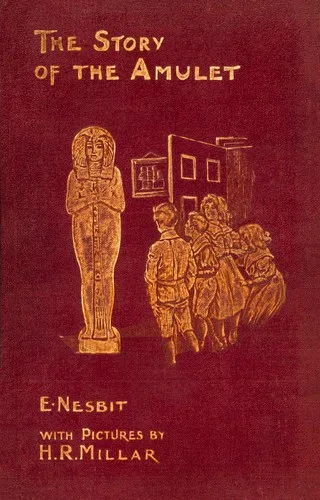
The Story of the Amulet
 76
76

The Story of the Amulet
Edith Nesbit’s *The Story of the Amulet* presents a curious case of posthumous publication, arriving in 1949 with a narrative that feels both familiar and distinctly Nesbit. The core strength lies in her unparalleled ability to ground fantastical elements in the everyday lives and reactions of children. The sibling dynamics are rendered with a sharp, observant wit that few authors achieve. However, the amulet itself, while a compelling plot device, occasionally feels less like a fully realized magical entity and more a convenient mechanism for advancing the plot. The sequence where the amulet transports the children to ancient Egypt, while visually rich, strains credulity even within the fantasy framework, demanding a significant suspension of disbelief regarding the temporal mechanics. Despite this, the novel’s enduring appeal rests on its honest portrayal of childhood agency and the often-humorous consequences of unchecked desire. It remains a solid, if not quite top-tier, Nesbit offering.
📝 Description
76
Edith Nesbit's 1949 novel, The Story of the Amulet, uses a magical artifact to explore how wishes shape consequence.
The Story of the Amulet follows four siblings who find an ancient Egyptian amulet that grants wishes. This relic, however, does not simply fulfill desires; it brings about complex and often unexpected results. The children’s adventures take them through various historical settings as they grapple with the moral questions raised by the amulet’s power.
Nesbit’s narrative balances a children's adventure with deeper considerations of cause and effect. The magic serves as a vehicle to examine the responsibilities that come with power, even when that power is seemingly benevolent. The story is accessible for young readers but also offers layers for adult readers interested in Nesbit's unique approach to fantasy.
The book’s plot is well-structured, guiding the protagonists through fantastical events while maintaining a clear ethical framework. It appeals to those who enjoy classic children's literature where imagination is grounded in relatable human experiences and moral lessons.
While not overtly occult, The Story of the Amulet touches on esoteric themes through its central artifact. The amulet, originating from ancient Egypt, functions as a magical object that manipulates causality, a common trope in occult traditions. The narrative illustrates how such powerful items, when wielded without full understanding, can disrupt natural order and lead to unforeseen outcomes, mirroring cautionary tales found in various magical systems about the dangers of uncontrolled forces.
💡 Why Read This Book?
• You will learn how the unintended consequences of seemingly simple wishes can create complex narrative challenges, as seen when the siblings wish for specific outcomes with the amulet. • You will gain an appreciation for Nesbit's distinct approach to magical realism, exemplified by her 1949 publication which grounds fantastic events in realistic childhood reactions. • You will feel the weight of responsibility that accompanies power, particularly through the children's struggles with the ancient Egyptian amulet and its unpredictable effects.
⭐ Reader Reviews
Honest opinions from readers who have explored this book.
❓ Frequently Asked Questions
What is the primary magical object in Edith Nesbit's The Story of the Amulet?
The primary magical object is an amulet from ancient Egypt. This artifact possesses the power to grant wishes, but these wishes often have unforeseen and complex consequences for the children who discover it.
When was The Story of the Amulet first published?
The Story of the Amulet was first published in 1949, after the author Edith Nesbit's passing.
What are the main themes explored in the book?
The book explores themes of consequence, responsibility, the nature of wishes, and the interplay between fate and free will through the children's interactions with the magical amulet.
Who are the main characters?
The main characters are four siblings: Leo, Jane, Martin, and Lucy. Their differing personalities and reactions to the amulet drive the narrative forward.
Does the amulet grant wishes instantly?
The amulet grants wishes, but not always in the straightforward manner the children expect. The narrative emphasizes the often ironic or complicated results of their desires, suggesting that wishes carry inherent risks.
Is the book suitable for young children?
While a children's fantasy novel, its exploration of consequences and nuanced plot may be best suited for older children who can grasp the underlying themes, or for shared reading experiences.
🔮 Key Themes & Symbolism
The Nature of Wishes
The amulet serves as a focal point for exploring the profound and often ironic nature of wishes. Unlike simple wish-fulfillment fantasies, Nesbit's narrative emphasizes that desires, when granted, carry inherent complexities and unexpected outcomes. The children's innocent requests often manifest in ways that create new problems, forcing them to confront the reality that getting what one wants is not always straightforward. This theme critiques a superficial understanding of desire, suggesting that true satisfaction comes from understanding and navigating consequences rather than simply obtaining an object or state.
Responsibility and Agency
A central tenet of the book is the development of responsibility among the young protagonists. Faced with the potent magic of the ancient Egyptian amulet, they are compelled to make difficult choices and learn from their mistakes. Their agency is highlighted not just in using the amulet, but in how they react to the situations it creates. This exploration of agency suggests that true power lies in character development and ethical decision-making, rather than in external magical artifacts. The narrative champions the idea that understanding and accepting responsibility are crucial for growth.
Fate vs. Free Will
The Story of the Amulet subtly engages with the philosophical tension between preordained destiny and individual choice. The amulet, as an artifact from a distant past, seems to embody a form of fate, guiding events and presenting challenges. However, the children's active engagement—their wishes, their attempts to control outcomes, and their moral deliberations—demonstrates the power of free will. The story suggests that while external forces or circumstances (like the amulet's magic) may influence life, it is ultimately the choices made by individuals that shape their path and their character.
The Elements of Antiquity
The presence of an ancient Egyptian amulet grounds the fantasy in a tangible historical and cultural context. This introduces the idea that objects carry histories and energies, and that the past can directly impact the present. The children's encounters with the amulet’s origins and its inherent power underscore a connection to ancient civilizations and their beliefs. It prompts reflection on how long-held artifacts and their associated lore can resurface, influencing contemporary lives and offering lessons from bygone eras.
💬 Memorable Quotes
Direct passages from the work, attributed to the author.
“The amulet was a thing of great antiquity, and it held a potent magic.”
— This statement captures the essence of the central magical artifact. It highlights its age and power, setting the stage for the narrative's exploration of how ancient magic interacts with modern children.
“They found themselves transported to lands and times far removed from their own.”
— This describes the fantastical element of the amulet's power, where it enables the children to experience different historical periods and imaginative locales, a key feature of their adventures.
“The children learned that magic, while powerful, demanded careful consideration.”
— This interpretation emphasizes the moral and practical lessons the protagonists gain. They discover that wielding or benefiting from magical power requires wisdom and foresight, not just desire.
“An object from ancient Egypt held the key to their present predicaments.”
— This highlights the connection between the past and present within the story. The ancient amulet is not merely a relic but an active force influencing the children's current challenges and adventures.
💡 Key Ideas
Editorial paraphrase of the work's core concepts — not direct quotes.
Every wish granted brought with it a new set of problems.
This paraphrased concept reflects a recurring motif in the book: the complex and often ironic consequences of the wishes made by the siblings. It underscores the narrative's exploration of responsibility and the double-edged nature of desire.
🌙 Esoteric Significance
Tradition
While not explicitly aligned with a single esoteric tradition, *The Story of the Amulet* draws upon a general Western fascination with ancient artifacts and their latent powers, particularly those originating from Egypt. This echoes themes found in Theosophy and early 20th-century occultism, which often incorporated Egyptian mythology and symbolism. The amulet itself functions as a focal point for exploring concepts of hidden knowledge and the influence of ancient forces on the present, a common thread in many esoteric schools seeking to bridge the past and present through mystical understanding.
Symbolism
The amulet, as the central symbol, represents latent power, hidden knowledge, and the capacity for transformation—or disruption. Its ancient Egyptian origin imbues it with associations of mystery, forgotten wisdom, and potent magical traditions. The narrative also features symbolic elements tied to the consequences of wishes, where the realization of desires often manifests in ironic or challenging ways, symbolizing the adage 'be careful what you wish for' and the inherent complexities of altering one's perceived destiny.
Modern Relevance
Contemporary interest in ancient Egyptian spirituality, artifact-based magic, and the psychology of desire finds echoes in Nesbit's work. Modern practitioners of esoteric studies, particularly those interested in comparative mythology or the symbolic power of objects, can find fertile ground for contemplation. The book's exploration of how external magical forces interact with human psychology and ethical choice remains relevant for discussions on manifestation, intention, and the responsible use of personal power in various contemporary spiritual and self-help contexts.
👥 Who Should Read This Book
• Young readers aged 9-12 who enjoy classic adventure stories with magical elements and a clear moral compass. • Parents and educators seeking children's literature that encourages discussions about consequences, responsibility, and the nature of desire. • Adult readers interested in Edith Nesbit's oeuvre or in children's fantasy that subtly explores philosophical themes beyond simple entertainment.
📜 Historical Context
Edith Nesbit's *The Story of the Amulet*, first published in 1949, emerged in a post-World War II landscape that saw significant shifts in children's literature. While Nesbit herself was a prominent figure in the earlier Edwardian era, known for works like *The Railway Children* (1906), this particular story gained traction later. The period saw authors like C.S. Lewis publishing *The Lion, the Witch and the Wardrobe* in 1950, signaling a trend toward more overt fantasy and allegorical narratives in children's books. Nesbit's style, however, often retained a grounded realism in character and setting, even when employing magical elements, distinguishing her from some contemporaries. Her work frequently explored themes of childhood agency and social dynamics within a fantastical framework, a characteristic that continued to resonate. The reception of her books generally praised their imaginative qualities and relatable child protagonists, cementing her legacy as a foundational figure in modern children's fantasy.
📔 Journal Prompts
The ancient Egyptian amulet's power and its impact on the siblings' choices.
Reflect on a time a wish granted led to unexpected difficulties.
The contrasting personalities of Leo, Jane, Martin, and Lucy when faced with magical opportunities.
Consider the balance between fate and the choices the children make.
Analyze the symbolic meaning of the amulet as an object of power.
🗂️ Glossary
Amulet
A magical charm or charm worn to provide protection or magical power. In the book, it's an ancient Egyptian artifact that grants wishes.
Ancient Egypt
A civilization that flourished in Northeast Africa from prehistory until its conquest by Rome. Known for its advanced culture, monumental architecture, and complex religious beliefs.
Consequence
A result or effect of an action or condition. The book heavily emphasizes the often unforeseen consequences of the wishes granted by the amulet.
Wish
A desire or hope for something to happen. The narrative explores the nature and implications of granted wishes, particularly their literal and complex manifestations.
Agency
The capacity of individuals to act independently and make their own free choices. The children's agency is tested as they grapple with the amulet's power.
Fate
The development of events beyond a person's control, regarded as determined by a supernatural power. The book explores how the amulet's magic interacts with the characters' sense of fate.
Time Travel
The concept of movement to different points in time, either past or future. The amulet facilitates this for the characters, though often with unpredictable results.
🔮 Readers Also Liked
Browse all →







More by Edith Nesbit
All books →





More Free Occult Philosophy Books
View all →