The sixth dimension
 64
64

The sixth dimension



By Lorelei Sage (Contemplative Literature Editor) — Swami Prakashanand Saraswati's 'The Sixth Dimension' is a monumental work for the serious student of consciousness and esoteric philosophy. It elegantly bridges the gap between the intellectual pursuit of Hindu metaphysics and the experiential realization of higher states of being. The author's profound insights into the nature of mind and its capacity to transcend material limitations are both breathtaking and practical. This book is a rare gem, offering not just theoretical understanding but a potential pathway to direct experience. It is an essential read for practitioners seeking to deepen their contemplative practices and scholars interested in the nuanced depths of Indian spiritual thought. Its strength lies in its clarity and the gentle yet firm guidance it offers towards self-discovery.
📝 Description
64
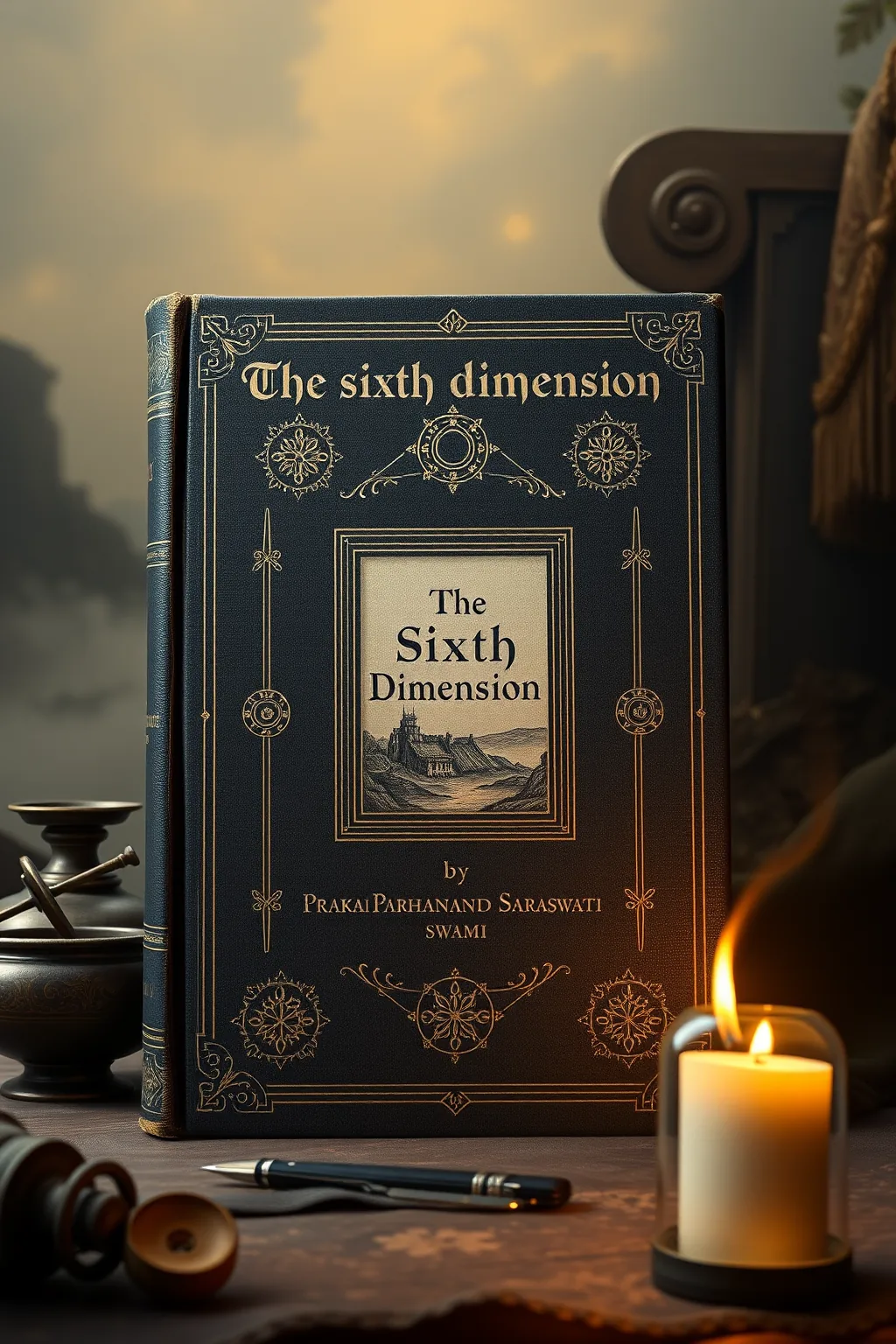
Swami Prakashanand Saraswati's 'The Sixth Dimension' explains consciousness beyond physical reality.
Published in 1977, 'The Sixth Dimension' by Swami Prakashanand Saraswati addresses consciousness as it extends beyond the physical world. The book discusses subtle energies and the nature of consciousness, drawing from Hindu philosophical concepts. It aims to guide readers to perceive realities beyond the common three dimensions. The text uses symbolism and philosophical ideas to show how the mind, body, and spirit are connected.
This work is presented as a guide for individuals seeking a deeper understanding of consciousness. It suggests that by understanding these subtler aspects, one can unlock inner potential. The book encourages readers to expand their perception of reality and sharpen their spiritual awareness. It is intended for those interested in the more profound aspects of the mind and its capabilities.
This book is situated within the esoteric traditions of Hindu philosophy, particularly Vedanta and related schools of thought that explore consciousness. It follows a lineage of yogic and spiritual texts that posit realities beyond empirical observation. The concept of dimensions beyond the physical is a recurring theme in various Indian mystical traditions, often linked to states of meditation and yogic attainment. Swami Prakashanand Saraswati's approach connects these ideas to practical understanding for the spiritual seeker.
💡 Why Read This Book?
Unlock the secrets of consciousness and the hidden dimensions of reality. 'The Sixth Dimension' offers a unique perspective on mind-body interconnectedness rooted in ancient Hindu wisdom. Ideal for spiritual seekers, practitioners of meditation, and students of comparative philosophy eager to explore the esoteric architecture of existence and expand their inner awareness.
⭐ Reader Reviews
Honest opinions from readers who have explored this book.
❓ Frequently Asked Questions
What is the 'Sixth Dimension' in the context of this book?
The 'Sixth Dimension' refers to planes of consciousness and subtle energies that exist beyond our ordinary three-dimensional perception, representing a deeper level of awareness and reality accessible through spiritual practice.
Is this book suitable for beginners in spirituality?
While it delves into profound concepts, Swami Prakashanand Saraswati's writing is accessible. Beginners will find it an inspiring introduction to advanced spiritual philosophy, though dedicated contemplation will enhance understanding.
How does this book relate to Hindu philosophy?
The book draws deeply from the rich tapestry of Hindu philosophical traditions, particularly Vedanta and yogic philosophy, reinterpreting ancient concepts through the lens of consciousness and subtle dimensions.
What kind of practices might this book inspire?
It encourages introspection, meditation, and the cultivation of heightened awareness. Readers may be inspired to explore practices that enhance their understanding of the mind-body connection and subtle energy systems.
Is 'The Sixth Dimension' a work of divination?
While it explores consciousness and perception which are foundational to divination, its primary focus is on understanding the nature of reality and consciousness itself, rather than specific predictive techniques.
🔮 Key Themes & Symbolism
Consciousness as the Fabric of Reality
This theme posits that consciousness is not merely a product of the physical brain but the fundamental substratum of all existence. The book explores how the perceived 'dimensions' are, in fact, different vibratory states or manifestations of this singular, all-pervading consciousness. It challenges the materialistic view, suggesting that by understanding and expanding our own consciousness, we can access and comprehend these higher realities, moving beyond the limitations of our physical senses to perceive a more unified and profound truth about the universe.
The Interplay of Mind and Body
The work meticulously dissects the intricate relationship between the physical body and the non-physical mind, asserting their inseparable nature. It proposes that the body is a vehicle through which consciousness experiences the material world, and that the mind's states—thoughts, emotions, and intentions—directly influence physical well-being. Conversely, the condition of the body can profoundly impact mental clarity and spiritual receptivity. This section offers insights into how harmonizing these two aspects can lead to holistic health and spiritual advancement.
Esoteric Symbolism and Ancient Wisdom
Swami Prakashanand Saraswati masterfully deciphers the strong symbolism embedded within ancient Hindu scriptures and traditions, revealing their profound relevance to the exploration of higher consciousness. These symbols are not mere decorative elements but keys that unlock deeper metaphysical understandings. The book guides the reader to interpret these archetypal images and narratives as maps for spiritual evolution, illustrating how age-old wisdom provides practical pathways for reading through the subtle realms and achieving self-realization, demonstrating the enduring power of tradition.
💬 Memorable Quotes
Direct passages from the work, attributed to the author.
“The body is a temple, the mind its priest.”
— This highlights the sacred connection between the physical form and the inner mental and spiritual faculties, emphasizing the importance of maintaining both for spiritual growth.
“Dimensions are but veils of perception.”
— This implies that the boundaries we perceive as dimensions are not inherent limitations of existence but rather constructs of our limited awareness, which can be transcended.
“Silence is the language of the soul.”
— This points to the profound wisdom and direct communication that can be accessed through inner stillness, suggesting that the soul communicates through subtle, non-verbal means.
“To know oneself is to know the cosmos.”
— This classic esoteric tenet suggests that through deep self-understanding and inner exploration, one can grasp the fundamental principles and interconnectedness of the entire universe.
💡 Key Ideas
Editorial paraphrase of the work's core concepts — not direct quotes.
Reality is but a whisper of consciousness.
This quote suggests that our perceived physical world is a limited manifestation of a vaster, fundamental consciousness, implying that true reality lies within this deeper awareness.
🌙 Esoteric Significance
Tradition
This work is deeply embedded within the Advaita Vedanta tradition of Hindu philosophy, emphasizing the non-dual nature of reality and the inherent divinity within each individual. It also draws heavily from Tantric and Yogic traditions, which explore the energetic and conscious dimensions of existence. The book offers a contemporary interpretation of these ancient lineages, making their clear insights accessible to a modern audience seeking experiential understanding of consciousness and its subtle manifestations.
Symbolism
The book utilizes potent esoteric symbols inherent in Hindu cosmology and yogic lore. Concepts like the chakras, nadis, and the subtle body are explored not as mere anatomical maps but as symbolic representations of consciousness's journey and energetic pathways. The 'sixth dimension' itself functions as a powerful metaphor for transcending ordinary perception, symbolizing a state of expanded awareness, intuitive knowledge, and direct communion with the divine. These symbols act as archetypal keys, guiding the reader towards inner realization.
Modern Relevance
In an era increasingly dominated by materialism and digital distraction, 'The Sixth Dimension' offers a vital counterpoint, guiding readers back to the profound power of inner awareness and consciousness. Its exploration of the mind-body connection is highly relevant to contemporary discussions on holistic health and well-being. Furthermore, its philosophical underpinnings resonate with emerging scientific theories about consciousness and the interconnectedness of the universe, providing a spiritual framework for understanding these complex ideas and encouraging a more integrated and meaningful approach to life.
👥 Who Should Read This Book
This profound text is a treasure for the dedicated spiritual seeker yearning for a deeper understanding of consciousness and reality. Scholars of comparative religion and philosophy will find its nuanced exploration of Hindu metaphysics invaluable. Practitioners of meditation and yoga will discover new dimensions to their practice, gaining insights that can accelerate their inner journey. Beginners curious about the esoteric and the nature of existence will find an accessible yet deeply clear guide, while advanced practitioners will appreciate its sophisticated articulation of timeless truths.
📜 Historical Context
Published within the rich intellectual milieu of modern Indian spirituality, 'The Sixth Dimension' emerges from a tradition deeply rooted in ancient Vedic and Upanishadic thought, which has continuously evolved through centuries of philosophical discourse and yogic practice. The late 20th and early 21st centuries have seen a significant global interest in Eastern mysticism and consciousness studies, a period where scholars and spiritual seekers alike have actively engaged with texts that bridge Eastern metaphysics and Western scientific inquiry into the mind. Swami Prakashanand Saraswati's work contributes to this ongoing dialogue, offering a refined perspective on consciousness that speaks to contemporary explorations of quantum physics and the nature of reality, while firmly anchoring its wisdom in timeless spiritual principles.
📔 Journal Prompts
Reflect on a moment when you felt a profound sense of interconnectedness with the universe. What did this experience reveal about the nature of reality?
How does your current understanding of 'mind' and 'body' align with or diverge from the concepts presented in the book?
Identify a symbol from Hindu mythology or your own spiritual practice. How might this symbol represent a 'dimension' beyond ordinary perception?
Consider your daily experiences. Where do you perceive the subtle energies or subtle bodies of yourself or others interacting?
If consciousness is the fundamental fabric of reality, what implications does this have for how you approach your daily life and interactions?
🗂️ Glossary
Consciousness
The state or quality of awareness, or of being aware of an external object or something within oneself. In this context, it is considered the fundamental substratum of all existence, not merely a byproduct of the brain.
Subtle Body
A non-physical, energetic counterpart to the physical body, composed of nadis (energy channels) and chakras (energy centers). It is considered the vehicle for consciousness and emotions.
Vedanta
A school of Hindu philosophy that synthesizes the teachings of the Upanishads, emphasizing the oneness of the individual soul (Atman) and the universal spirit (Brahman).
Nadis
In yogic and Ayurvedic traditions, these are the channels or pathways through which vital energy (prana) flows within the subtle body. There are believed to be thousands of nadis.
Chakras
Energy centers located along the spine in the subtle body, believed to regulate the flow of prana and influence physical, emotional, and spiritual well-being. Each chakra is associated with specific qualities and functions.
This book appears in 3 collections
🔮 Readers Also Liked
Browse all →









More by Prakashanand Saraswati (swami)
All books →
From the “Tarot” Collection
View all →








More Free Divination & Tarot Books
View all →