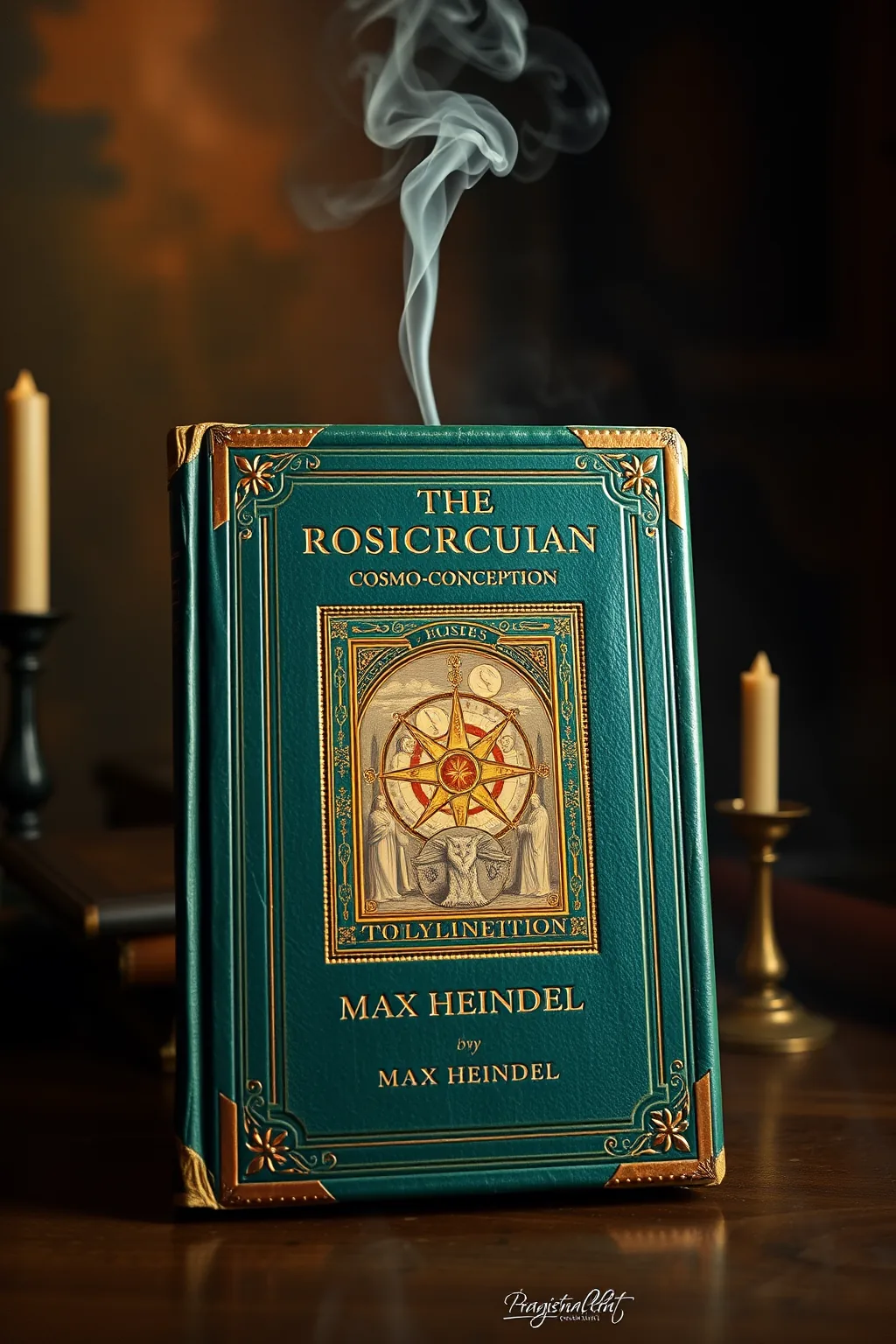
The Rosicrucian Cosmo Conception
 78
78

The Rosicrucian Cosmo Conception
Max Heindel’s *The Rosicrucian Cosmo Conception* is a dense, systematic exposition of a particular esoteric philosophy, aiming to reconcile scientific materialism with spiritual realities. Heindel’s strength lies in his ambitious attempt to construct a coherent, detailed cosmology that addresses the "why" behind existence, positing a structured evolutionary path for humanity across vast cosmic epochs. The work is particularly notable for its detailed descriptions of the post-death states and the nature of the "spiritual body." However, the sheer density of its conceptual framework, filled with specialized terminology and allegorical interpretations, can present a significant barrier to entry for newcomers. While Heindel’s explanation of the "Seven World Periods" offers a sweeping perspective on cosmic evolution, the unwavering confidence in his specific Rosicrucian interpretation, presented as universal truth, may feel dogmatic to readers familiar with other esoteric systems. It is a work that demands sustained focus and a willingness to accept its premises wholesale, rewarding the diligent student with a singular, albeit idiosyncratic, vision of the universe.
📝 Description
78
Max Heindel published The Rosicrucian Cosmo Conception in 1909, detailing a Rosicrucian spiritual worldview.
This 1909 book lays out a systematic esoteric cosmology and anthropology from a Rosicrucian viewpoint. Max Heindel sought to explain the universe and human life, from the smallest atom to the largest galaxy, through a spiritual lens that harmonized with scientific observation. The text describes the origin, evolution, and eventual destiny of humanity and the cosmos, outlining a path for spiritual development.
It is written for students of Western esoteric thought interested in Rosicrucianism. The book offers an allegorical and symbolic interpretation of life, death, and rebirth, aiming to complement scientific understanding. Readers who appreciate a structured spiritual philosophy and a narrative of cosmic and human development will find detailed metaphysical concepts within its pages. The work is designed to reveal the hidden laws that govern existence and spiritual progress.
Published in 1909, The Rosicrucian Cosmo Conception emerged during a vibrant period for Western esoteric thought, influenced by movements like Theosophy. Max Heindel, a student of Theosophy, developed distinct teachings emphasizing Christian mysticism and a structured evolutionary path. The era saw broad interest in spiritualism and occultism, with Heindel's work offering a coherent spiritual framework that synthesized these interests.
💡 Why Read This Book?
• Gain an understanding of the Rosicrucian perspective on cosmic and human evolution, particularly its detailed explanation of the "Seven World Periods" and the structure of the human being across physical, vital, and spiritual bodies. • Explore Heindel's unique synthesis of Christian mysticism and occult science, offering a structured path for spiritual development and the "Great Work" beyond conventional religious frameworks. • Grasp the symbolic meanings behind concepts such as the "Life Waves" and the roles of various "Hierarchies" in creation, providing a framework for interpreting existence from a spiritual, evolutionary standpoint.
⭐ Reader Reviews
Honest opinions from readers who have explored this book.
❓ Frequently Asked Questions
What is the core teaching of The Rosicrucian Cosmo Conception?
The core teaching is a detailed esoteric cosmology explaining the origin, evolution, and destiny of the cosmos and humanity, presented through a Rosicrucian lens. It aims to reconcile science and religion by outlining a spiritual evolutionary path.
When was The Rosicrucian Cosmo Conception first published?
The book was first published in 1909, positioning it within the early 20th-century surge of interest in esoteric and spiritual movements.
Who was Max Heindel?
Max Heindel (1865-1919) was a Danish-American mystic and author, founder of the Rosicrucian Fellowship. He developed his teachings after extensive study and alleged spiritual experiences.
How does this book relate to Theosophy?
Heindel was influenced by Theosophy, but The Rosicrucian Cosmo Conception presents distinct teachings, particularly its emphasis on Christian esoteric traditions and a more defined evolutionary plan, diverging from some Blavatskyan doctrines.
What is the concept of the 'Great Work' in this book?
The 'Great Work' refers to the process of spiritual evolution and self-perfection that humanity undertakes across lifetimes and cosmic cycles, aiming for liberation and union with the Divine.
Is The Rosicrucian Cosmo Conception available online for free?
Yes, due to its age and Heindel's intent, The Rosicrucian Cosmo Conception is in the public domain and widely available in full text for free online.
🔮 Key Themes & Symbolism
Cosmic and Human Evolution
The work meticulously details a grand evolutionary scheme that spans multiple "World Periods" and "Life Waves." It posits that both the cosmos and individual souls progress through distinct stages of development, moving from denser forms to more refined spiritual states. This process involves the evolution of consciousness and the formation of various bodies – physical, vital, desire, and spirit – each playing a role in the unfolding journey toward self-realization and liberation from material existence.
The Seven-Fold Constitution of Man
Heindel presents humanity as possessing a seven-fold constitution: Physical Body, Vital Body, Desire Body, and the three Spirit Bodies (Spirit, Life Spirit, and Divine Spirit). This intricate structure is central to understanding the processes of life, death, and rebirth. Each body is described in terms of its origin, function, and evolutionary trajectory, forming the basis for a comprehensive esoteric psychology and biology.
The Path of the Great Work
The ultimate aim for humanity, as outlined in the Cosmo Conception, is the completion of the "Great Work." This refers to the process of spiritual alchemy and self-mastery, where individuals consciously participate in their own evolution. It involves purifying the lower vehicles (physical, vital, desire bodies) and developing the higher Spirit bodies, ultimately leading to a state of spiritual enlightenment and freedom from the cycle of reincarnation.
Divine Hierarchies and Spiritual Realms
The book elaborates on a celestial hierarchy of beings, or "Elohim," who are responsible for guiding the evolutionary processes of the universe. These divine intelligences manifest in different "World Periods" and "Life Waves," shaping the unfolding of creation. Understanding these spiritual forces and realms is presented as crucial for comprehending the intricate workings of the cosmos and humanity's place within it.
💬 Memorable Quotes
Direct passages from the work, attributed to the author.
“The Universe and everything in it is a manifestation of God.”
— This statement captures the pantheistic or panentheistic undercurrent in Heindel's work, asserting that all existence is a divine emanation, providing a spiritual foundation for the entire cosmological system.
“When we have finished our work in the physical world, we leave the physical body and continue our evolution in the invisible worlds.”
— This highlights the Rosicrucian belief in post-mortem consciousness and the continuation of spiritual development beyond physical death, emphasizing that life is an ongoing process of evolution through different planes of existence.
“The Word 'Evolution' means unfolding.”
— This simple definition underscores the central theme of the book: that existence is not static but a continuous process of revelation and development, from the simplest forms to the most complex spiritual states.
“We are given a physical body, a vital body, and a desire body, and later we are to build the spirit body.”
— This directly references the seven-fold constitution of man, outlining the composite nature of the human being and the developmental stages involved in acquiring higher spiritual faculties.
“The aim of the Great Architect is to make of His children spiritual intelligences.”
— This conveys the ultimate purpose of existence from the Rosicrucian viewpoint: the transformation of humanity into fully realized spiritual beings, guided by a Divine plan and intelligence.
🌙 Esoteric Significance
Tradition
This work is firmly rooted in the Western Esoteric Tradition, specifically drawing from Rosicrucianism and Christian mysticism, while also incorporating elements influenced by Theosophy and Hermeticism. It presents a comprehensive cosmological system that maps out spiritual evolution through distinct evolutionary cycles and the development of human vehicles, fitting within the broader Hermetic quest for understanding divine principles and their manifestation in the material world.
Symbolism
Key symbols include the "Tree of Life," representing the stages of cosmic and human evolution, and the "Seven World Periods," symbolizing the grand cycles of creation and dissolution. The "Rose Cross" itself is a potent symbol, uniting the spiritual (rose) with the material (cross), indicative of the Rosicrucian goal of spiritualizing matter and achieving balance within the human being.
Modern Relevance
Heindel's detailed cosmology continues to inform contemporary Rosicrucian organizations and students of Western esotericism. His systematic approach to spiritual evolution and the nature of consciousness influences modern occultists and those exploring the intersection of spirituality and quantum physics, as well as individuals seeking structured paths for personal spiritual growth and self-mastery.
👥 Who Should Read This Book
• Aspiring students of esoteric philosophy seeking a comprehensive, systematic overview of cosmic and human evolution from a Rosicrucian perspective. • Researchers interested in the history of Western Esotericism and the development of spiritual movements in the early 20th century, particularly those influenced by Theosophy. • Individuals seeking a detailed, allegorical framework for understanding life, death, and the afterlife, particularly those drawn to Christian mystical traditions interpreted through an occult lens.
📜 Historical Context
The Rosicrucian Cosmo Conception, first published in 1909, arrived during a period of intense spiritual and intellectual ferment in the Western world. The late 19th and early 20th centuries witnessed a widespread questioning of traditional religious dogma and the rise of numerous esoteric movements. Helena Blavatsky's Theosophical Society, founded in 1875, had already popularized concepts of Eastern mysticism, reincarnation, and cosmic evolution. Max Heindel, initially a student of Theosophy, developed his own distinct system, emphasizing Christian esoteric traditions and a more structured, allegorical interpretation of spiritual evolution. His work offered a detailed cosmology that sought to bridge the perceived gap between science and spirituality, a common concern of the era. Contemporary figures like Annie Besant continued to expound Theosophical teachings, while others explored spiritualism and various forms of occultism, creating a rich and sometimes contentious field of spiritual inquiry.
📔 Journal Prompts
The concept of "Life Waves" and their progression through different kingdoms.
The seven-fold constitution of man and its implications for personal experience.
The "Great Work" as a process of spiritual development and self-mastery.
The role of "Hierarchies" in cosmic creation and guidance.
Interpreting the symbolic meaning of the "Rose Cross" in relation to personal spiritual goals.
🗂️ Glossary
Vital Body
The life-giving principle or etheric body, responsible for vitality and the processes of growth, assimilation, and reproduction. It is considered a finer vehicle than the physical body.
Desire Body
The emotional or astral body, which is the seat of feelings, desires, and impulses. It is the vehicle through which we experience pleasure and pain.
Spirit Body
The highest aspect of the human being, representing the divine spark or individualized consciousness that is the true Self. It is the ultimate goal of evolution to fully embody this spirit.
Seven World Periods
A cosmic framework describing vast epochs of creation and evolution through which the universe and its inhabitants pass, each period having distinct characteristics and evolutionary tasks.
Life Waves
The distinct streams of consciousness or "souls" that pass through the various kingdoms of nature (Mineral, Plant, Animal, Human) and evolutionary stages, carrying the evolutionary impulse.
Hierarchies
Divine beings or spiritual intelligences that preside over and guide the evolutionary processes of the cosmos, from the lowest elemental spirits to the highest Archangels.
The Great Work
The process of spiritual evolution, self-purification, and transformation undertaken by humanity to achieve liberation, enlightenment, and union with the Divine.
🔮 Readers Also Liked
Browse all →








More by Max Heindel
All books →





More Free Occult Philosophy Books
View all →