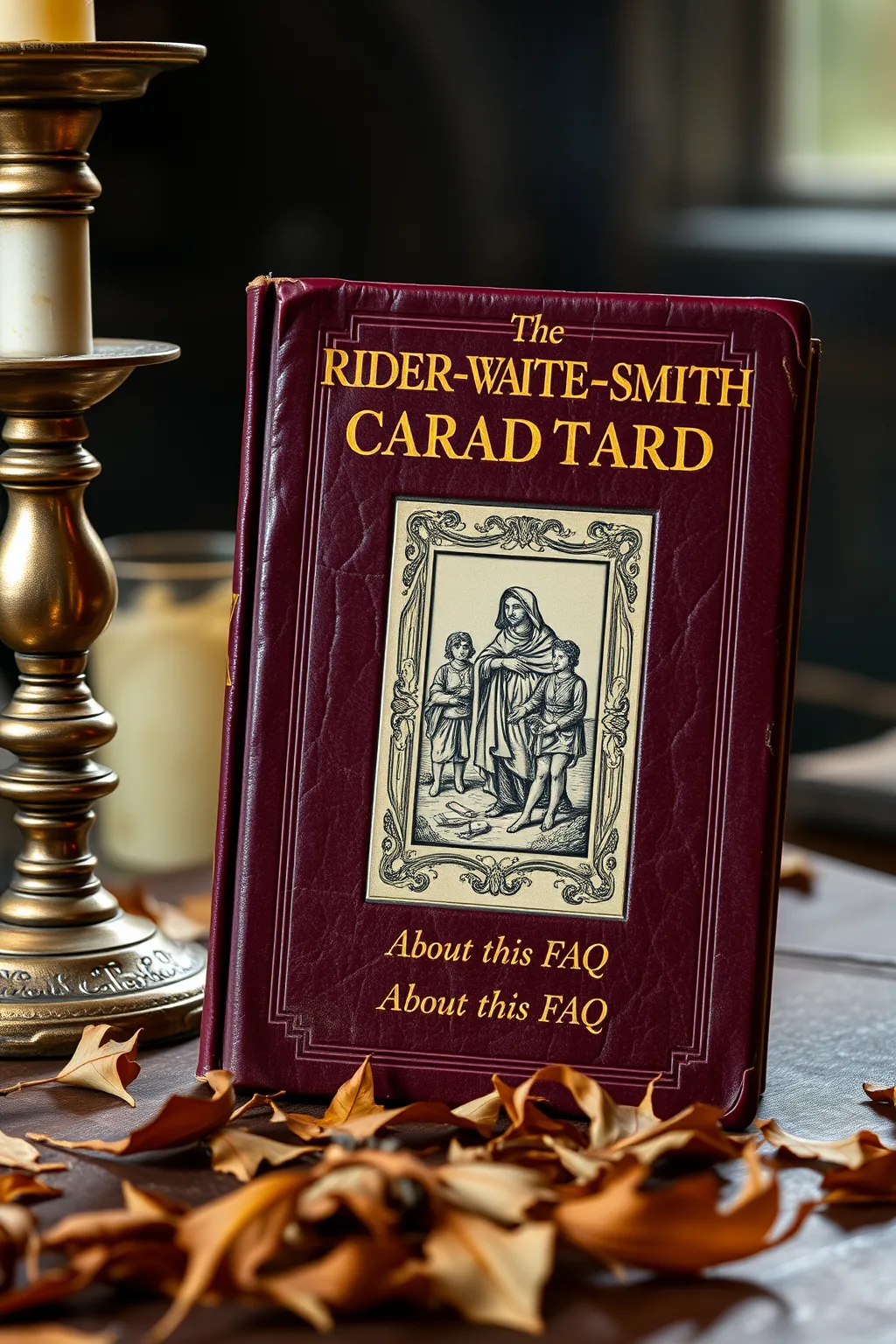
The Rider-Waite-Smith Tarot Card Copyright FAQ
 82
82

The Rider-Waite-Smith Tarot Card Copyright FAQ



By Isolde Whitaker (Sacred Texts Editor) — This essential FAQ clarifies the complex copyright landscape surrounding the seminal Rider-Waite-Smith Tarot. It meticulously navigates the history and preservation of Arthur Edward Waite and Pamela Colman Smith's groundbreaking creation, offering invaluable insights for practitioners and scholars alike. The guide’s strength lies in its accessible yet thorough approach to intellectual property, ensuring respect for the deck's legacy. It empowers readers to engage with the Tarot not only as a tool for divination but as a significant artistic and historical artifact. A must-read for anyone seeking to understand the foundational deck that underpins much of modern Tarot practice.
📝 Description
82
This FAQ addresses the copyright history of the Rider-Waite-Smith Tarot, first published in 1909.
This document clarifies the copyright questions surrounding the Rider-Waite-Smith Tarot deck. It details the origins of the deck's imagery, tracing its lineage from early 20th-century art to its widespread use today. The FAQ explains the intellectual property considerations that have protected these specific card designs over time. It aims to help users understand the legal and historical context of the deck's visual elements, which are central to its interpretation. The text covers key cards and their associated symbolism as depicted in this particular deck. It intends to foster a more informed approach to using the Tarot by providing background on its creation and protection.
The FAQ covers the specific visual language of the Rider-Waite-Smith deck, distinguishing it from other Tarot systems. It explains how copyright has influenced the dissemination and adaptation of these iconic images. Readers will find information on the artistic choices made by Pamela Colman Smith and others involved in the deck's creation. The goal is to equip students of the Tarot with a clearer understanding of the deck's unique status and the protections afforded to its artwork.
The Rider-Waite-Smith deck is a cornerstone of modern Western esoteric practice, particularly within Tarot divination. Its creation in the early 20th century, following the Hermetic Order of the Golden Dawn's teachings, marked a shift towards more pictorial and psychologically resonant card imagery. This FAQ situates the deck's visual legacy within the broader context of esoteric symbolism and its transmission through copyrighted artistic works. Understanding the copyright history helps to appreciate how this specific iteration of Tarot imagery became so dominant, influencing countless subsequent decks and practices in occult traditions.
💡 Why Read This Book?
Unlock the mysteries of Tarot copyright, ensuring respectful engagement with the Rider-Waite-Smith deck. This FAQ is essential for practitioners, scholars, and collectors seeking to understand the lineage and intellectual property of this iconic divinatory tool. Gain clarity on the historical context and preservation efforts, fostering a deeper appreciation for its enduring esoteric power and ethical use.
⭐ Reader Reviews
Honest opinions from readers who have explored this book.
❓ Frequently Asked Questions
Who holds the primary copyright for the Rider-Waite-Smith Tarot imagery?
The copyright for the original Rider-Waite-Smith Tarot deck artwork, created by Pamela Colman Smith under Arthur Edward Waite's direction, is complex. While the original works entered the public domain in many jurisdictions, subsequent editions and specific derivative works may have their own copyrights held by publishers like U.S. Games Systems, Inc.
When did the original Rider-Waite-Smith Tarot artwork become public domain?
The exact date varies by country due to differing copyright laws. In the United States, works published before 1929 are generally in the public domain. Therefore, the original artwork by Smith, published in 1909, is widely considered to be in the public domain in the US.
What are the implications of the public domain status for modern Tarot decks?
Public domain status allows for the creation of new decks that reproduce or are inspired by the original Rider-Waite-Smith imagery. However, it does not grant permission to use specific publisher's editions or proprietary artwork, which may still be protected.
How can I legally use or reproduce Rider-Waite-Smith imagery?
For the original artwork, you can generally use it freely in many regions. However, if you are referencing a specific published edition (like those by U.S. Games Systems), it's crucial to check their licensing agreements to avoid infringement on their specific edition's rights.
Does this FAQ cover copyright for other Tarot decks?
This FAQ specifically focuses on the copyright history and current status of the Rider-Waite-Smith Tarot deck, its original creators, and its primary publishers. Information on other decks would require separate research into their respective creators and publication histories.
🔮 Key Themes & Symbolism
The Genesis of Archetypal Imagery
This theme explores the profound historical and artistic confluence that birthed the Rider-Waite-Smith Tarot. It explores the collaborative vision of Arthur Edward Waite and the visionary artistry of Pamela Colman Smith, examining how their unique perspectives fused to create a deck that transcended mere illustration, embedding deep esoteric symbolism and archetypal resonance. We uncover the influences from Hermeticism, Rosicrucianism, and other occult traditions that shaped the deck's visual language, making each card a portal to hidden knowledge and spiritual inquiry. The focus is on the original intent and the powerful archetypes that continue to speak to the soul.
Reading through the Labyrinth of Copyright
This section untangles the complex legal and ethical considerations surrounding the copyright of the Rider-Waite-Smith Tarot. It illuminates the journey of this iconic deck's imagery from its creation through its publication, public domain status, and subsequent licensing. Understanding these nuances is crucial for respecting the intellectual property of the original artists and publishers, while also embracing the freedom that public domain offers for creative reinterpretation. The aim is to foster responsible engagement with the deck, ensuring its legacy is honored while allowing for its continued accessibility and evolution within the esoteric community.
The Enduring Power of Visual Symbolism
Here, we celebrate the outstanding visual language of the Rider-Waite-Smith Tarot, a system of symbolism that has captivated and guided seekers for over a century. This theme examines how Pamela Colman Smith’s intuitive illustrations, imbued with occult significance, translate abstract concepts into tangible archetypes. From the celestial alignments to the earthly elements, each card's imagery is a carefully crafted cipher of universal truths. We explore how these symbols act as keys to unlocking subconscious wisdom, facilitating personal growth, and providing useful insights into the human condition and the cosmic dance.
💬 Memorable Quotes
Direct passages from the work, attributed to the author.
“Wisdom lies not in the knowing, but in the seeing.”
— This highlights the importance of intuitive perception and direct experience in acquiring true wisdom. It suggests that genuine insight comes from engaging with the symbolic language of the Tarot and allowing its visual truths to reveal themselves, rather than merely accumulating factual knowledge.
“The range of fate is woven with threads of intent.”
— This profound statement connects the concept of destiny or fate with individual agency and conscious choice. It implies that while there may be a grand design, our actions and intentions are integral in shaping the unfolding patterns of our lives.
“Each symbol whispers a forgotten tongue.”
— This evocative phrase speaks to the ancient and often overlooked meanings embedded within Tarot symbols. It suggests that these visual elements carry elements of primordial wisdom and hidden knowledge, waiting to be deciphered by those who listen closely.
“The Fool's journey begins where the map ends.”
— This captures the essence of venturing into the unknown, embracing uncertainty, and trusting intuition. It signifies that true growth and discovery often occur when one steps beyond the boundaries of the familiar and expected, embracing the spirit of exploration.
💡 Key Ideas
Editorial paraphrase of the work's core concepts — not direct quotes.
The cards are not merely pictures; they are keys.
This quote emphasizes the active, unlocking potential of Tarot imagery. It suggests that each card's visual narrative serves as a guide, a tool to open doors to deeper understanding, intuition, and self-discovery, rather than passive visual representations.
🌙 Esoteric Significance
Tradition
The Rider-Waite-Smith Tarot is deeply rooted in the Western Esoteric Tradition, drawing heavily from Hermeticism, Kabbalah, Rosicrucianism, and the teachings of occult orders like the Hermetic Order of the Golden Dawn. It serves as a visual lexicon for these complex philosophical and magical systems, translating abstract spiritual principles into accessible archetypal imagery that can be used for introspection, divination, and spiritual development.
Symbolism
The deck's power lies in its intricate and layered symbolism. Each card is a microcosm of universal truths, incorporating astrological, alchemical, and numerological correspondences. From the Fool's leap of faith to the World's completion, the symbols depict the archetypal journey of the soul, the interplay of elemental forces, and the unfolding of consciousness. The imagery serves as a conduit for accessing subconscious wisdom and understanding the hidden connections within the cosmos.
Modern Relevance
Despite its historical origins, the Rider-Waite-Smith Tarot remains profoundly relevant today. Its archetypal imagery speaks to timeless human experiences, offering guidance and insight in a rapidly changing world. As a tool for self-reflection, psychological exploration, and spiritual guidance, it empowers individuals to navigate life's challenges, understand their inner landscapes, and connect with a deeper sense of purpose. Its enduring popularity underscores its capacity to resonate with contemporary seekers of wisdom and meaning.
👥 Who Should Read This Book
This comprehensive FAQ is an indispensable resource for a wide spectrum of individuals. For the **beginner Tarot enthusiast**, it explains the historical and legal background of the foundational Rider-Waite-Smith deck, fostering a more informed and respectful practice. **Scholars of occult history and divination** will find valuable clarity on copyright nuances and the deck's intellectual lineage. **Dedicated Tarot practitioners** seeking to deepen their understanding of the deck's creation and preservation will gain critical insights. **Collectors and artists** interested in the provenance and artistic integrity of this iconic artwork will find it particularly useful, ensuring they engage with its legacy ethically and knowledgeably.
📜 Historical Context
The Rider-Waite-Smith Tarot deck emerged from a wide range of late Victorian and Edwardian occult revivalism, a period marked by a fervent interest in mysticism, spiritualism, and esoteric philosophies. Published in 1909, it was a radical departure from earlier, more static Tarot designs. Arthur Edward Waite, a prominent member of the Hermetic Order of the Golden Dawn, sought to create a deck that was not only a tool for divination but a profound symbolic system reflecting complex occult teachings. Pamela Colman Smith, an artist with a unique spiritual sensibility, brought Waite's vision to life with her vibrant and evocative illustrations, infusing the cards with an unprecedented level of psychological depth and narrative power. This era's intellectual ferment, blending ancient wisdom with burgeoning psychological insights, provided the fertile ground for such an enduringly influential creation.
📔 Journal Prompts
How does the concept of copyright influence your personal relationship with the Rider-Waite-Smith Tarot imagery?
Reflect on a specific symbol within the Rider-Waite-Smith deck that speaks to you and its potential connection to esoteric traditions.
Consider the collaboration between Waite and Smith; how might the interplay of vision and execution impact the esoteric meaning of the cards?
In what ways does the public domain status of the original artwork empower or challenge the 'sacredness' of the Tarot for you?
How can understanding the historical context of the Rider-Waite-Smith Tarot deepen your practice or interpretation of its divinatory messages?
🗂️ Glossary
Archetype
A universal, archaic pattern of the unconscious mind, perceived as a typical image or symbol that is part of the collective unconscious. In Tarot, these are fundamental human experiences and themes represented by the cards.
Divination
The practice of seeking knowledge of the future or the unknown by supernatural means. Tarot is a primary tool used in this practice, interpreting symbolic imagery to gain insight.
Esoteric
Intended for or likely to be understood by only a small number of people with a specialized knowledge or interest. In the context of Tarot, it refers to hidden spiritual meanings and occult teachings.
Hermeticism
A religious, philosophical, and esoteric tradition based on the purported teachings of Hermes Trismegistus. It emphasizes mystical knowledge, alchemy, and astrology, influencing much of Western occultism.
Public Domain
Works whose intellectual property rights have expired, have been forfeited, or are inapplicable. Such works can be freely used, modified, and distributed by anyone.
This book appears in 3 collections
🔮 Readers Also Liked
Browse all →








From the “Tarot” Collection
View all →







More Free Divination & Tarot Books
View all →