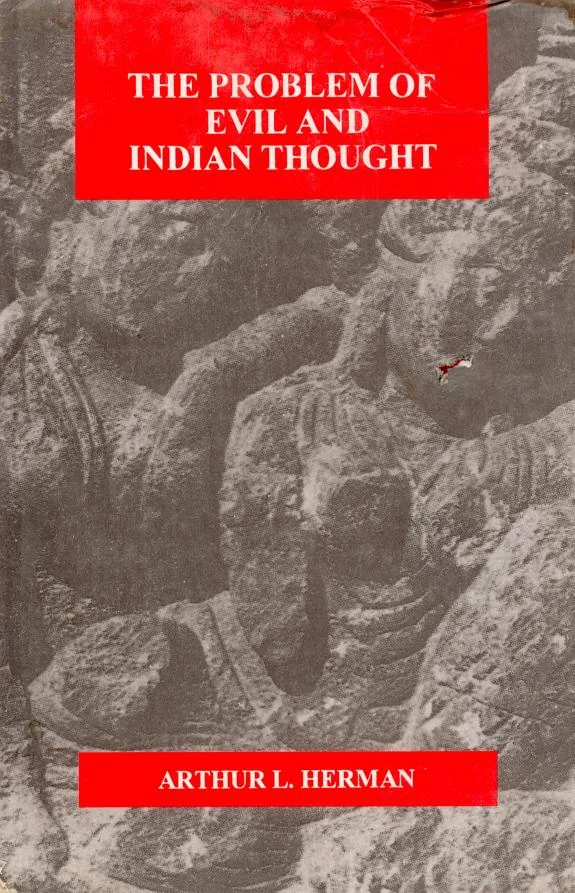
The Problem of Evil and Indian Thought
 79
79

The Problem of Evil and Indian Thought
Arthur L. Herman’s "The Problem of Evil and Indian Thought" offers a scholarly, if dry, dissection of a question that has haunted human consciousness. The book’s strength lies in its meticulous cataloging of Western philosophical responses, reducing a sprawling history of thought into a manageable eight categories. Herman’s subsequent application of this framework to Indian thought is commendable for its ambition, though the execution occasionally feels more like an academic exercise than a living exploration. The initial chapters, tracing solutions from Augustine to Leibniz, are particularly illuminating. However, the transition to Indian thought, while comprehensive, can feel dense, and the integration of the two parts, while intended, doesn't always achieve the seamless synthesis one might hope for. The work is a valuable reference for specialists but may prove challenging for the casual seeker of spiritual answers.
📝 Description
79
Arthur L. Herman's 1993 book examines Indian philosophical responses to the problem of evil.
First published in 1993, Arthur L. Herman's "The Problem of Evil and Indian Thought" undertakes a detailed philosophical examination of how various Indian traditions grapple with the existence of suffering and malevolence. The work begins by dissecting Western philosophical approaches, identifying and categorizing historical attempts to reconcile divine goodness with the presence of evil into eight distinct types. This initial analysis provides a framework for a comparative study.
Herman then applies this analytical structure to major Indian philosophical schools, including Vedanta, Buddhism, and Jainism. The book aims to illuminate the unique perspectives found within these traditions and to uncover unexpected parallels with Western philosophical discourse. The central contribution of the text is its systematic classification of solutions to the problem of evil and its subsequent application to the rich theological and philosophical traditions of India, establishing a crucial link between these disparate intellectual landscapes.
While often approached through Western philosophical lenses, the problem of evil is a central concern in many esoteric traditions that seek to understand the nature of reality and the divine. Indian thought, with its diverse schools like Vedanta, Buddhism, and Jainism, offers intricate cosmologies and soteriological paths that inherently address the presence of suffering and imperfection. Herman's work provides a structured way to understand how these non-dualistic and karma-centric systems conceptualize and resolve what appears as malevolence or deficiency in the created order, often through concepts like illusion (maya), karma, or the limitations of conditioned existence.
💡 Why Read This Book?
• Gain a structured understanding of Western philosophical solutions to the problem of evil, as presented in Herman's systematic categorization of historical responses. • Explore how Indian philosophical traditions, such as Vedanta and Buddhism, grapple with the existence of suffering, offering unique perspectives beyond Western frameworks. • Appreciate the comparative method applied to profound theological questions, learning how Herman's analysis, first developed for Western thought, illuminates Eastern doctrines.
⭐ Reader Reviews
Honest opinions from readers who have explored this book.
❓ Frequently Asked Questions
When was Arthur L. Herman's 'The Problem of Evil and Indian Thought' first published?
The book was first published in 1993, providing a scholarly examination of a long-standing philosophical dilemma.
What is the primary focus of 'The Problem of Evil and Indian Thought'?
It analyzes historical Western solutions to the problem of evil and then compares them with the approaches found in Indian philosophical and religious traditions.
How many historical solutions to the problem of evil does the book identify?
The work initially identifies twenty-one historical solutions before reducing them to eight distinct categories for clearer analysis.
Which Indian philosophical traditions are discussed in relation to the problem of evil?
The book engages with major Indian traditions, including Vedanta, Buddhism, and Jainism, exploring their unique perspectives on suffering and divine justice.
Is this book suitable for beginners in philosophy?
While comprehensive, the book's dense academic style and comparative philosophical method make it more suited for advanced students and scholars rather than absolute beginners.
What is the author's approach to analyzing the problem of evil?
Arthur L. Herman employs a systematic, comparative approach, first categorizing Western responses and then applying this analytical lens to Indian thought.
🔮 Key Themes & Symbolism
Theodicy in Western Philosophy
Herman meticulously charts the historical evolution of theodicy in Western thought, from early Christian philosophers to Enlightenment thinkers. He highlights how thinkers attempted to reconcile divine omnipotence and benevolence with the undeniable reality of evil and suffering. The work systematically categorizes these attempts, providing a crucial intellectual framework for understanding subsequent comparisons with non-Western traditions. This section is vital for grasping the foundational arguments before engaging with Indian philosophical responses.
Karma and Suffering in Indian Traditions
The book examines the concept of karma and its implications for understanding suffering within major Indian philosophical systems like Buddhism and Vedanta. It explores how the doctrine of rebirth and the law of karma function as explanations for present hardships, often bypassing the need for a Western-style theodicy. This provides a unique lens through which to view the problem of evil, focusing on cosmic justice and individual responsibility across lifetimes.
Comparative Philosophical Analysis
A core theme is the rigorous comparison between Western and Indian approaches to the problem of evil. Herman applies the categories derived from Western philosophy to analyze Indian doctrines, revealing both divergences and convergences. This comparative method is central to the book's thesis, aiming to demonstrate universal patterns in human attempts to grapple with existential suffering and the nature of the divine.
The Limits of Rationality
Implicitly, the work touches upon the boundaries of rational explanation when confronting existential quandaries. While Herman employs a rational, analytical framework, the sheer persistence and varied nature of the problem of evil suggest that some aspects may elude purely logical dissection. The book’s engagement with diverse spiritual and philosophical systems hints at the complex nature of human attempts to find meaning in suffering.
💬 Memorable Quotes
Direct passages from the work, attributed to the author.
“Eight distinct solutions to the problem of evil.”
— This refers to Herman's analytical achievement in condensing numerous historical arguments into a manageable set of core philosophical positions regarding the existence of evil.
“The history of the problem of evil in Indian thought.”
— This signifies the book's pivot to exploring how Eastern philosophical and religious systems conceptualize and address suffering and malevolence, offering a contrast to Western frameworks.
“Reconciling suffering with divine attributes.”
— This expresses the central challenge that both Western and Indian thinkers have faced: explaining how a good and powerful divine can coexist with the pervasive reality of pain and injustice.
“The concept of karma as an explanatory principle.”
— This highlights a key mechanism in Indian thought, where past actions are seen to determine present circumstances, offering an alternative to Western theodicies focused on divine will or cosmic battles.
“Joining the analysis of the problem of evil.”
— This phrase suggests the book's ambitious synthesis, aiming to integrate the insights from Western philosophical analysis with the rich traditions of Indian thought on the subject of evil.
🌙 Esoteric Significance
Tradition
While not explicitly aligned with a single esoteric lineage, Herman's work engages with perennial philosophical problems that are foundational to many esoteric traditions. The exploration of karma, rebirth, and the nature of suffering touches upon concepts central to traditions like Theosophy and certain branches of Western occultism that draw heavily on Eastern metaphysics. The book provides a rational framework for understanding doctrines often approached through direct mystical experience or symbolic interpretation.
Symbolism
The core 'problem of evil' itself can be viewed symbolically as the tension between the manifested world (with its inherent imperfections and suffering) and an imagined perfect, unmanifest source. Concepts like karma function symbolically as cosmic laws of cause and effect, illustrating a universe governed by inherent justice rather than arbitrary will. The contrasting approaches (Western theodicy vs. Indian karma) symbolize different ways of perceiving divine order and human agency.
Modern Relevance
Contemporary thinkers exploring integral philosophy, comparative mysticism, and transpersonal psychology often engage with the cross-cultural dialogues Herman facilitates. His work provides a necessary academic grounding for understanding how diverse traditions conceptualize suffering, which is crucial for modern therapeutic approaches and spiritual syntheses that seek universal truths. It informs discussions on consciousness, ethics, and the nature of reality across different philosophical and religious landscapes.
👥 Who Should Read This Book
• Students of comparative religion and philosophy seeking to understand cross-cultural approaches to existential suffering. • Scholars of Indian philosophy and theology looking for a systematic comparison with Western thought on the problem of evil. • Individuals interested in the intellectual history of how humanity has grappled with the existence of suffering and malevolence across different civilizations.
📜 Historical Context
Published in 1993, "The Problem of Evil and Indian Thought" emerged during a period of increasing globalization of academic discourse and growing interest in comparative philosophy and religion. The intellectual climate was receptive to studies that bridged Western and Eastern traditions, moving beyond Eurocentric paradigms. Herman’s work entered a scholarly landscape where figures like Paul Ricoeur were still influential in continental philosophy of religion, and scholars of Indian philosophy like Surendranath Dasgupta had already laid groundwork for understanding its complexities. The book’s comparative approach offered a systematic way to engage with complex theological questions, providing a valuable resource for scholars seeking to understand the universal human struggle with suffering and its explanations across diverse cultural contexts. Its reception was primarily within academic circles, valued for its analytical rigor.
📔 Journal Prompts
The eight distinct solutions to the problem of evil as categorized by Herman.
The concept of karma and its role in explaining suffering.
Comparing Western theodicy with Indian explanations of evil.
The implications of Augustine's views on evil for modern thought.
How the Buddhist understanding of suffering contrasts with Abrahamic traditions.
🗂️ Glossary
The Problem of Evil
The philosophical challenge of reconciling the existence of evil and suffering in the world with the attributes of an omnipotent, omniscient, and omnibenevolent God.
Theodicy
An attempt to justify the goodness of God in the face of the existence of evil and suffering, often by providing explanations for why God permits it.
Vedanta
A major school of Hindu philosophy that emphasizes the Upanishads, often focusing on the nature of Brahman (ultimate reality) and its relationship with Atman (the self).
Buddhism
A religion and philosophy originating in ancient India, teaching a path to enlightenment based on the Four Noble Truths and the Eightfold Path, often addressing suffering (dukkha).
Jainism
An ancient Indian religion that prescribes a path of non-violence (ahimsa) towards all living beings and emphasizes self-control and asceticism.
Karma
In Indian religions, the principle of cause and effect where intent and actions of an individual influence their future existence, often across multiple lifetimes.
Perennial Philosophy
The idea that there is a set of universal truths or insights common to all religions and spiritual traditions, which Herman explores through comparative analysis.
This book appears in 1 collection
🔮 Readers Also Liked
Browse all →








From the “Reincarnation” Collection
View all →








More Free Occult Philosophy Books
View all →