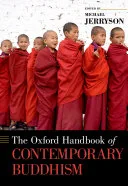
The Oxford Handbook of Contemporary Buddhism
 73
73

The Oxford Handbook of Contemporary Buddhism
Michael K. Jerryson’s compilation, *The Oxford Handbook of Contemporary Buddhism*, offers a necessary, if somewhat dense, examination of Buddhism's global footprint. The strength lies in its breadth; chapters exploring Buddhist presence in regions like Latin America or Africa move beyond established academic comfort zones. One finds particularly insightful analyses of how local political and social structures shape Buddhist practice, a departure from purely textual studies. However, the sheer academic rigor, while commendable, can render certain sections challenging for the non-specialist. The discussion on the revival of Buddhism in post-Khmer Rouge Cambodia, for instance, is meticulously detailed but assumes a prior understanding of the region’s complex history. Despite this, the handbook functions as an authoritative survey of the field, presenting a vital snapshot of Buddhism's evolving global narrative.
📝 Description
73
The 2017 Oxford Handbook of Contemporary Buddhism compiles scholarly analyses of Buddhist traditions worldwide.
Published in 2017, this handbook offers a global survey of Buddhist traditions in the modern era. It moves beyond traditional Asian contexts to include studies of Buddhism in Africa, Latin America, and Oceania. This approach provides an international perspective on how Buddhist thought and practice manifest across diverse cultures.
The volume is useful for academics, researchers, and students in religious studies, Buddhist philosophy, and anthropology. It is also valuable for anyone interested in the adaptation of religious traditions, especially Buddhism outside its historical geographic centers. The handbook serves as a resource for understanding contemporary religious movements and their global spread.
The book emerged during a time of increased academic focus on the globalization of religions. It builds on earlier scholarship that began charting Buddhist presence in Western and other non-traditional regions from the mid-20th century. The work acknowledges scholars who first documented these shifts.
While the handbook focuses on contemporary manifestations, it implicitly engages with the esoteric dimension of Buddhism by examining how ancient teachings are reinterpreted. Esoteric traditions often involve specific lineages, practices, and interpretations of doctrine that are transmitted through specialized channels. This collection addresses how these aspects might be preserved, transformed, or newly formed as Buddhism adapts to global contexts, secularization, and engagement with modern social and political concerns. It shows how Buddhist traditions continue to hold specialized knowledge and practices even as they spread and change.
💡 Why Read This Book?
• Gain an understanding of Buddhist adaptation in non-traditional regions, such as the specific challenges and innovations discussed in chapters concerning Buddhism in Africa. • Analyze how globalization has influenced Buddhist identity and practice, moving beyond simplistic notions of religious diffusion to explore localized interpretations. • Appreciate the academic discourse surrounding Buddhism's engagement with secularism and modernity, as explored in various case studies from around 2017.
⭐ Reader Reviews
Honest opinions from readers who have explored this book.
❓ Frequently Asked Questions
What is the primary focus of The Oxford Handbook of Contemporary Buddhism?
The handbook's primary focus is the global spread and adaptation of Buddhist traditions in contemporary times, examining their presence and evolution in regions beyond traditional Asian centers like India, Japan, and Tibet.
Who are the contributors to this handbook?
The contributors are leading scholars in the field of Buddhist studies, offering expert analysis on diverse geographical and thematic aspects of contemporary Buddhism.
Does the book cover Buddhism in Western countries?
Yes, while the blurb highlights less traditional regions, the comprehensive nature of the handbook implies coverage of Buddhist developments in Western countries as well, as part of its global scope.
When was The Oxford Handbook of Contemporary Buddhism first published?
The Oxford Handbook of Contemporary Buddhism was first published in 2017.
What kind of academic perspective does this book offer?
It offers a scholarly, analytical perspective grounded in religious studies, anthropology, and history, examining Buddhism's social, cultural, and political dimensions worldwide.
Are there discussions on how Buddhism interacts with local cultures?
Absolutely. A central theme is how Buddhist traditions are localized and interact with diverse cultural, social, and political environments globally.
🔮 Key Themes & Symbolism
Globalization and Localization
This theme explores how Buddhist teachings and practices, originating from ancient Indian traditions, are transformed and reinterpreted as they spread across diverse global landscapes. The handbook investigates the tension between maintaining doctrinal integrity and adapting to local cultural, social, and political contexts. It highlights how communities in places like Africa or Latin America forge unique Buddhist identities, demonstrating that Buddhism is not monolithic but a dynamic, evolving tradition shaped by its practitioners.
Buddhism in Non-Traditional Regions
A significant focus is placed on Buddhism's presence and development in areas historically outside its primary geographical and cultural spheres. This includes detailed case studies of communities in Latin America, Africa, and Oceania. The research examines the specific challenges and opportunities these burgeoning Buddhist movements face, from establishing institutions to engaging with indigenous beliefs and contemporary societal issues, offering a counterpoint to studies focused solely on East Asian or South Asian Buddhism.
Contemporary Buddhist Identity
The handbook examines how individuals and groups construct and maintain Buddhist identities in the modern world. This involves analyzing the influence of secularization, the impact of migration, and the role of the internet and media in shaping contemporary Buddhist thought and practice. It considers how concepts of 'Buddhist modernism' continue to evolve and how new forms of Buddhism, sometimes distinct from traditional monastic lineages, emerge in response to contemporary life.
Buddhism and Socio-Political Engagement
This theme addresses the ways in which contemporary Buddhist communities engage with pressing social and political issues. It moves beyond viewing Buddhism as solely an introspective or monastic pursuit, showcasing its involvement in activism, peacebuilding, environmentalism, and responses to political oppression or social inequality in various parts of the world. The analyses reveal Buddhism's capacity to influence and be influenced by the political realities of the 21st century.
💬 Memorable Quotes
Direct passages from the work, attributed to the author.
“Contemporary Buddhism demonstrates a remarkable capacity for adaptation to diverse cultural milieus.”
— This statement underscores the central argument that Buddhism is not static but fluid, capable of integrating and transforming within vastly different societal structures and belief systems encountered globally.
“The study of Buddhism in Africa reveals unique syncretic developments.”
— This highlights the book's exploration of how Buddhism, when introduced to the African continent, blends with existing indigenous spiritual traditions, creating distinct forms of practice and belief.
“Globalization facilitates both the spread and the redefinition of Buddhist practices.”
— This points to the dual impact of global interconnectedness: it allows Buddhist traditions to reach new populations while simultaneously prompting practitioners to reconsider and reshape their understanding of core doctrines.
“Scholars examine Buddhist presence in regions previously overlooked by traditional studies.”
— This emphasizes the handbook's contribution to expanding the academic field by focusing research on geographical areas like Oceania and Latin America, previously receiving less scholarly attention.
“The book charts the historical development of Buddhist traditions worldwide.”
— This suggests that the work provides a historical narrative, tracing the lineage and evolution of Buddhist thought and practice not just in its birthplaces but across its global diaspora.
🌙 Esoteric Significance
Tradition
While contemporary Buddhism itself is not a singular esoteric tradition in the Western sense (like Hermeticism or Kabbalah), this handbook engages with the *esoteric potential* within its diverse global manifestations. It examines how certain practices or interpretations, particularly those adapting to modern secular contexts or engaging with psychological frameworks, can be seen as carrying esoteric dimensions for practitioners seeking deeper meaning or altered states of consciousness. It fits within the broader academic study of global spiritualities.
Symbolism
The handbook implicitly touches upon the symbolic richness of Buddhism, such as the Bodhi tree representing enlightenment, the Dharma wheel symbolizing the Buddha's teachings, or the lotus flower signifying purity and spiritual awakening. By analyzing how these symbols are understood and utilized in varied cultural contexts – from urban centers in Africa to rural communities in South America – the work reveals the dynamic nature of Buddhist iconography and its adaptation to contemporary esoteric or spiritual seeking.
Modern Relevance
Contemporary thinkers and practitioners interested in the intersection of spirituality, psychology, and global culture find relevance here. Schools of Buddhist modernism, mindfulness-based therapeutic approaches, and scholars of secular spirituality draw upon the insights presented. The work informs contemporary discussions about how ancient wisdom traditions can address modern existential anxieties and contribute to global ethical frameworks, particularly for those exploring non-Western spiritual paths outside institutionalized religion.
👥 Who Should Read This Book
['• Scholars of comparative religion and anthropology seeking to understand the global diffusion and adaptation of Buddhist traditions beyond traditional Asian contexts.', '• Students of Buddhism looking for comprehensive, up-to-date research on contemporary practice and theory, particularly in less commonly studied regions like Africa or Latin America.', '• Individuals interested in how religious traditions evolve under globalization, offering case studies that illuminate the dynamic interplay between culture, society, and belief systems worldwide.']
📜 Historical Context
First published in 2017, *The Oxford Handbook of Contemporary Buddhism* arrived at a time when the academic study of religion was increasingly focused on globalization and the diversification of religious practices. The late 20th and early 21st centuries saw a surge in scholarship examining Buddhism’s expansion beyond its traditional Asian strongholds, a trend building on earlier work by scholars like Gananath Obeyesekere who analyzed Buddhist modernism. Jerryson’s compilation reflects this shift, moving beyond established centers like India, Japan, and Tibet to incorporate burgeoning Buddhist communities in Latin America, Africa, and Oceania. The handbook’s significance lies in its comprehensive mapping of these less-studied terrains, offering a counter-narrative to Eurocentric or Asia-centric views of religious development. It engaged with contemporary discussions in religious studies, anthropology, and sociology, implicitly positioning itself against more traditional, text-focused approaches to Buddhism.
📔 Journal Prompts
The localization of Buddhist doctrine in Africa: initial observations and subsequent adaptations.
Contemporary Buddhist identity construction in Latin America: challenges and innovations.
The Dharma wheel's symbolism across diverse global interpretations.
Buddhism's engagement with socio-political issues in Oceania: case study analysis.
Reinterpreting enlightenment narratives in secularized Western contexts.
🗂️ Glossary
Buddhist Modernism
A movement, primarily emerging in the late 19th and early 20th centuries, where Buddhist thinkers adapted teachings to resonate with Western scientific and philosophical thought, often emphasizing rationalism and ethical practice over ritual or metaphysics.
Localization
The process by which a religious tradition or practice is adapted to fit the specific cultural, social, and historical context of a particular place or community, often leading to unique expressions of the tradition.
Syncretism
The blending of beliefs and practices from different religious or cultural systems, resulting in a new, hybrid form of religious expression, often seen when a religion encounters indigenous traditions.
Secular Buddhism
An approach to Buddhism that emphasizes its ethical, psychological, and philosophical aspects while downplaying or omitting metaphysical beliefs, deities, and traditional rituals, aiming for relevance in a secularized world.
Dharma
A foundational concept in Indian religions, referring to cosmic law and order, duty, righteousness, and the teachings of the Buddha in Buddhism.
Bodhi
In Buddhism, 'enlightenment' or 'awakening,' referring to the profound understanding of the nature of reality achieved by the Buddha and other enlightened beings.
Sangha
Traditionally refers to the monastic community of bhikkhus (monks) and bhikkhunis (nuns), but in contemporary usage can also refer to the broader community of Buddhist practitioners, lay and ordained.