The neoplatonism of William Blake

 78
78

The neoplatonism of William Blake
Harper's "The Neoplatonism of William Blake" provides a much-needed philosophical grounding for Blake's often bewildering prophetic works. Its strength lies in its detailed exegesis, drawing clear lines between Plotinus and Blake's symbolic universe, particularly in Harper's analysis of Blake's concept of "Emanation." However, the prose can occasionally become dense, requiring sustained attention from the reader, a common challenge when dissecting complex philosophical arguments. A particularly illuminating section is Harper's discussion of how Blake's "Urizen" can be seen as a corrupted "Intellect" figure, a direct echo of Neoplatonic hierarchies. This meticulous scholarly approach makes it an invaluable resource, though not a casual read. It offers a critical perspective that remains vital for understanding Blake's intellectual landscape.
📝 Description
78
George Mills Harper's 1962 book connects William Blake's art and poetry to Neoplatonic philosophy.
George Mills Harper's study, "The Neoplatonism of William Blake," first published in 1962, meticulously examines the influence of Neoplatonic philosophy on William Blake's creative output. Harper traces Blake's engagement with ancient Greek thinkers like Plotinus, showing how their metaphysical ideas shaped Blake's cosmology and his critique of Enlightenment thought. The book argues that Blake's symbolic language and invented mythologies stem from a philosophical tradition concerned with divine emanation from the One.
This work is particularly valuable for students of Romantic literature, art history, and comparative philosophy. It will appeal to those interested in the esoteric roots of Western art and thought, and readers seeking to understand the philosophical structure behind Blake's "Songs of Innocence and of Experience" and his prophetic writings. Those already familiar with Neoplatonic texts will find a new perspective on their application in Blake's revolutionary art.
Published in 1962, Harper's work emerged as academic interest in William Blake shifted towards his philosophical and symbolic depth. It situated Blake within a lineage of esoteric thought, moving beyond purely biographical or formalist criticism. By linking Blake to Neoplatonism, Harper connected his visionary art to a long-standing tradition of mystical and metaphysical inquiry that sought to understand the divine source of reality. This approach offered an alternative to prevailing materialist interpretations, highlighting how ancient philosophical schools continued to inform modern artistic and spiritual expression.
💡 Why Read This Book?
• Understand Blake's cosmology through the lens of Neoplatonism, learning how Plotinus's concept of "The One" informs Blake's creation myths. • Gain insight into Blake's critique of Enlightenment rationalism by examining how his "Urizen" character reflects Neoplatonic ideas about intellect and emanation. • Appreciate the philosophical depth of Blake's prophetic books, such as "Jerusalem," by understanding the specific ancient philosophical currents that shaped their creation.
⭐ Reader Reviews
Honest opinions from readers who have explored this book.
❓ Frequently Asked Questions
What specific Neoplatonic philosophers are discussed in relation to William Blake's work?
The book primarily focuses on Plotinus, the foundational figure of Neoplatonism, and his key concepts. It also explores the broader influence of the Neoplatonic school on Blake's thought.
How does "The Neoplatonism of William Blake" explain Blake's critique of Enlightenment thought?
Harper connects Blake's criticisms of empirical reason and materialism to Neoplatonic ideas that posit a spiritual reality beyond the material world, viewing Enlightenment rationality as a limited, fallen state.
When was George Mills Harper's book originally published?
George Mills Harper's "The Neoplatonism of William Blake" was first published in 1962, placing it within mid-20th-century Blake scholarship.
Does the book analyze Blake's visual art as well as his poetry?
Yes, Harper's analysis integrates Blake's visual art with his poetry, arguing that his Neoplatonic philosophical framework is expressed through both mediums.
What is the central argument regarding Blake's "symbolic language"?
The central argument is that Blake's complex symbolism is not arbitrary but is deeply informed by Neoplatonic metaphysics, providing a coherent, albeit unique, philosophical system.
Is this book suitable for someone new to Neoplatonism?
While comprehensive, the book assumes some familiarity with philosophical concepts. Readers new to Neoplatonism might benefit from a foundational text on Plotinus alongside Harper's study.
🔮 Key Themes & Symbolism
Blake's Emanation Theory
This theme examines how Blake's visionary creation of "emanations"—spiritual beings or aspects of the divine—directly mirrors Neoplatonic concepts of emanation from "The One." Harper traces Blake's specific interpretations of this process, particularly how it relates to the perceived "fall" into material existence. The work demonstrates that Blake's complex mythologies are not arbitrary but are structured by this ancient metaphysical principle, offering a lens to understand the generation of both spiritual and fallen worlds within his oeuvre.
The One and the Material World
Harper elucidates Blake's engagement with the Neoplatonic "One" as the ultimate, ineffable source of all reality. The book argues that Blake viewed the material world, particularly as understood by Enlightenment science, as a degraded or limited manifestation—a "fallen" state resulting from deviations in the emanation process. This dualistic tendency, where spirit is primary and matter is secondary or illusory, is presented as a core element linking Blake to ancient philosophical traditions.
Urizen as Corrupted Intellect
A significant focus is placed on Blake's character Urizen, often depicted as a stern, law-giving figure. Harper connects Urizen to the Neoplatonic concept of the "Intellect" (Nous), the first emanation from "The One." However, Blake's Urizen represents a corrupted or self-imprisoned form of this Intellect, one that has become divorced from divine unity and is responsible for the creation of a restrictive, material reality. This interpretation highlights Blake's philosophical critique embedded within his mythological figures.
Blake's Synthesis of Traditions
The work emphasizes that Blake did not simply adopt Neoplatonism but synthesized it with his own mystical experiences, Christian theology, and unique artistic vision. Harper explores how Blake reinterpreted and transformed ancient philosophical doctrines to serve his personal spiritual and artistic goals. This synthesis is crucial for understanding the originality of Blake's "system" and its departure from strict adherence to any single philosophical school, including Neoplatonism.
💬 Memorable Quotes
Direct passages from the work, attributed to the author.
“Blake's universe is built on the foundation of Neoplatonic thought.”
— This statement expresses the book's central thesis, asserting that the structure and core ideas of William Blake's imaginative cosmology are directly derived from and explicable through the principles of Neoplatonic philosophy, particularly the concepts of emanation and the divine source.
“Blake's depiction of Urizen reflects a fallen or self-imposed limitation of the divine intellect.”
— This interpretation highlights Harper's analysis of the character Urizen. It suggests that Urizen, a key figure in Blake's mythology, embodies a Neoplatonic concept of intellect that has become detached from its divine origin, leading to the creation of a flawed material world.
“Blake's mythopoeia is a philosophical system rooted in ancient metaphysical speculation.”
— This statement frames Blake's often abstract and symbolic writings not as mere fantasy but as a coherent philosophical structure. Harper argues that this structure is deeply indebted to the metaphysical inquiries of ancient thinkers, especially the Neoplatonists.
💡 Key Ideas
Editorial paraphrase of the work's core concepts — not direct quotes.
The "One" is the ultimate reality from which all existence emanates.
This paraphrased concept refers to a fundamental tenet of Neoplatonism, which Harper argues profoundly influenced Blake. It describes the ineffable, singular source of all being and the process by which reality flows outward from it.
The material world is understood as a secondary or even illusory plane in Blake's philosophy.
This paraphrased idea points to the Neoplatonic influence on Blake's dualistic worldview. It suggests that Blake, like the Neoplatonists, did not consider the physical realm to be the ultimate reality but rather a manifestation of a higher, spiritual order.
🌙 Esoteric Significance
Tradition
This work is firmly situated within the study of Western Esotericism, specifically its connection to Neoplatonism and its impact on Romanticism. It bridges classical philosophy with the visionary art of William Blake, a figure often considered proto-Theosophical or Gnostic in his explorations of divine consciousness and spiritual hierarchies. Harper's analysis demonstrates how an ancient esoteric philosophical lineage, Neoplatonism, provided a conceptual framework for Blake's unique mystical system, which itself became a source of inspiration for later esoteric movements.
Symbolism
Key symbols explored include "The One," representing the ultimate, ineffable divine source from which all reality emanates, a core Neoplatonic tenet. Blake's "Emanations" are analyzed as spiritual beings or aspects of consciousness arising from this divine source, mirroring the Neoplatonic concept of Nous (Intellect) and Psyche (Soul). The text also studies Blake's "Urizen," interpreted as a corrupted "Intellect" figure that creates a limited material reality, a concept echoing Neoplatonic views of the material world as a degraded state.
Modern Relevance
Contemporary scholars of Western Esotericism, comparative mythology, and Romantic literature continue to draw upon Harper's foundational work. Thinkers exploring the relationship between philosophy, art, and consciousness often reference Blake's Neoplatonic leanings as illuminated by this study. Furthermore, artists and writers seeking to understand or integrate complex metaphysical systems into their creative output find value in Blake's example, as analyzed through Harper's lens, connecting ancient philosophical ideas to modern visionary expression.
👥 Who Should Read This Book
• Advanced students of William Blake and Romantic literature seeking to understand the philosophical underpinnings of his work. • Scholars of comparative philosophy and intellectual history interested in the transmission of ancient ideas into modern art. • Practitioners and students of Western Esotericism interested in the Neoplatonic roots of visionary art and thought.
📜 Historical Context
George Mills Harper's "The Neoplatonism of William Blake" emerged in 1962, a period when academic scholarship was increasingly moving beyond purely aesthetic or biographical interpretations of William Blake. The mid-20th century saw figures like Northrop Frye publishing influential works that explored Blake's complex symbolic systems. Harper's study situated Blake within a long philosophical tradition, directly linking him to Plotinus and the Neoplatonic school. This was significant because it offered a counterpoint to purely materialist or empiricist readings of Blake that were prevalent in some intellectual circles. The book contributed to a broader academic conversation about the enduring influence of ancient philosophical thought on modern artistic and spiritual expression, placing Blake in dialogue with thinkers from antiquity rather than isolating him as a singular, inexplicable genius. Its reception contributed to solidifying the view of Blake as a profound philosophical poet.
📔 Journal Prompts
Blake's concept of "Emanation" as a reflection of Neoplatonic thought.
The role of "The One" in structuring Blake's cosmology and its Neoplatonic parallels.
Urizen as a representation of a fallen "Intellect" in Blake's mythology.
The synthesis of ancient philosophy with Blake's personal visionary experiences.
How Blake's critique of Enlightenment reason aligns with Neoplatonic dualism.
🗂️ Glossary
Neoplatonism
A school of philosophy originating in the 3rd century CE, stemming from Plato's teachings but heavily influenced by Plotinus. It posits a hierarchical reality emanating from an ultimate, ineffable "One."
The One
In Neoplatonism, the ultimate, supreme, and ineffable principle of reality, the absolute source from which all existence emanates. It is beyond being and comprehension.
Emanation
The Neoplatonic concept describing the outflow or radiation of reality from "The One" in a hierarchical series of beings (e.g., Intellect, Soul). It is distinct from creation ex nihilo.
Plotinus
The most influential Neoplatonic philosopher (c. 204/5 – 270 CE), whose "Enneads" form the foundational text of Neoplatonic thought and deeply impacted Western philosophy and mysticism.
Urizen
A key figure in William Blake's mythology, often depicted as a stern, self-limiting creator representing reason divorced from imagination or divine unity. Harper links him to Neoplatonic concepts of Intellect.
Enlightenment Rationalism
The philosophical movement of the 17th and 18th centuries emphasizing reason, empiricism, and individualism, often critiqued by Romantics like Blake for its perceived limitations in understanding spiritual or imaginative realms.
Mythopoeia
The creation of myths or a mythological framework, often used to describe Blake's complex, self-created universes and narratives in his prophetic works.
🔮 Readers Also Liked
Browse all →









More by George Mills Harper
All books →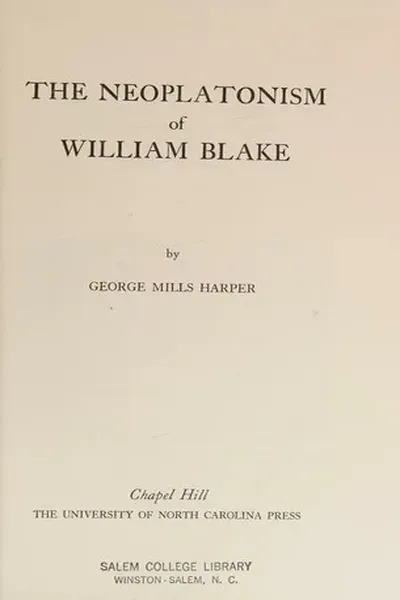





More Free Occult Philosophy Books
View all →