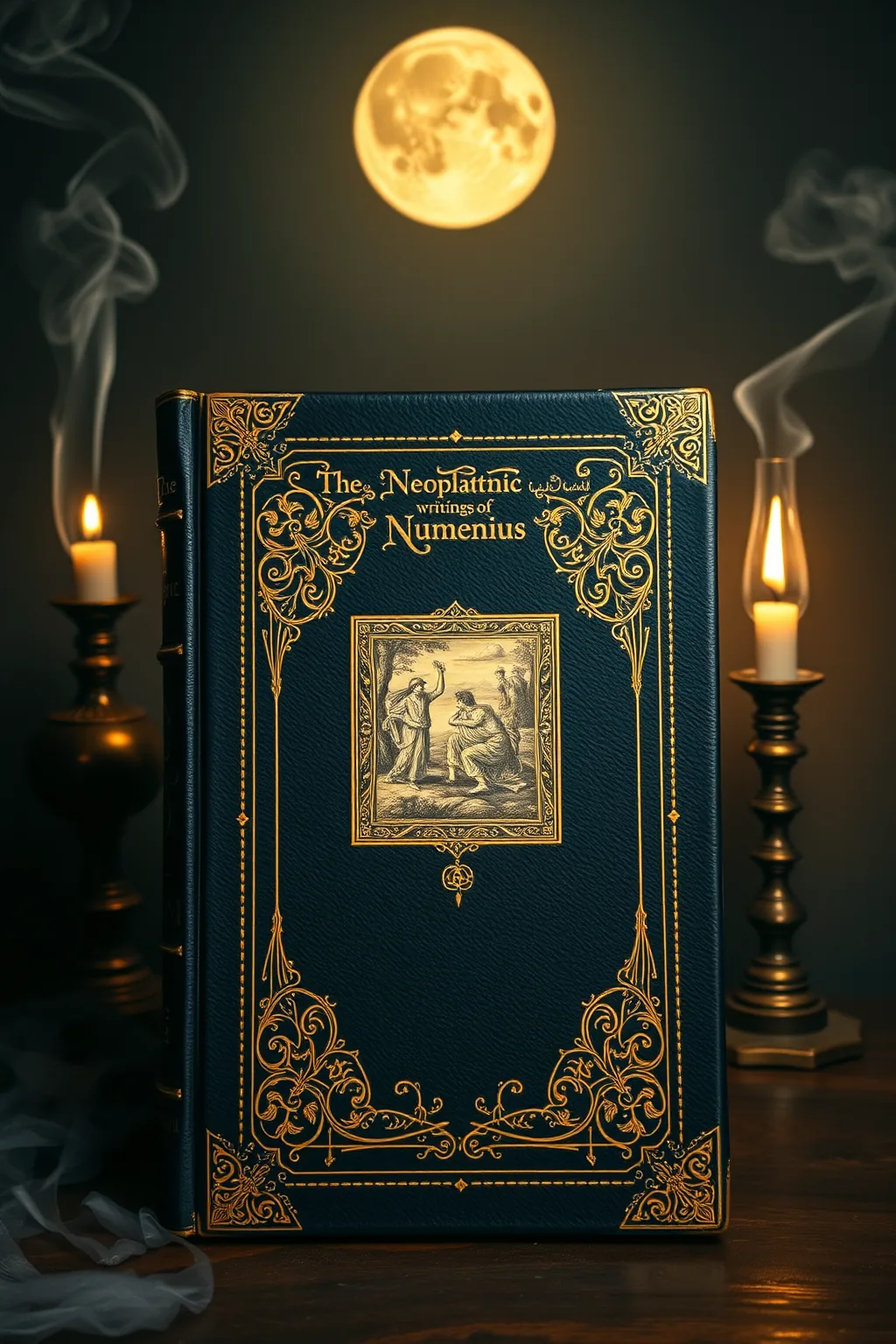
The neoplatonic writings of Numenius
 79
79

The neoplatonic writings of Numenius
Guthrie's compilation of Numenius offers a vital, albeit challenging, window into a philosopher whose influence often exceeds his textual availability. The primary strength lies in its consolidation of scattered fragments, providing a more coherent (though still piecemeal) presentation of Numenius’s thought. However, the translation, while earnest, can feel dated and occasionally opaque, demanding considerable effort from the reader to grasp the nuances of Numenius's highly abstract arguments. The section exploring Numenius’s critique of Plato, where he argues Plato merely rearranged older ideas, is particularly illuminating for understanding the philosophical landscape of the 2nd century. Despite its textual difficulties, this work remains indispensable for anyone seriously investigating the roots of Neoplatonism and its precursors.
📝 Description
79
Numenius of Apamea, writing in the 2nd century CE, bridged Middle Platonism and later Neoplatonism.
This volume collects the surviving writings of Numenius of Apamea, a philosopher active in the second century CE. Kenneth Sylvan Guthrie translated and compiled these texts, making them accessible to readers interested in the development of Neoplatonic thought.
Numenius's philosophy marks a significant point in the transition from earlier Platonic schools to the more systematic approach of Plotinus. His work addresses core metaphysical questions concerning the nature of the divine, the structure of the cosmos, and the destiny of the human soul. The texts available here, though often fragmentary and preserved through citations by later authors like Eusebius, reveal a complex thinker who engaged with Pythagoreanism, Platonism, and possibly influences from Eastern traditions.
This edition is for those who wish to study the origins of Western esoteric thought and its philosophical foundations. It requires a prior understanding of Plato's core ideas and a willingness to grapple with challenging metaphysical concepts. It is not a simple introduction but a resource for in depth study.
Numenius of Apamea stands as a crucial early figure in the development of Neoplatonism, a philosophical and mystical tradition that profoundly shaped Western esotericism. His thought emerged during a period of intellectual ferment in the Roman Empire, characterized by syncretism and the merging of various philosophical and religious currents. Numenius sought to synthesize Platonic ideas with other traditions, aiming to articulate a coherent metaphysics that could account for the divine, the material world, and the path of spiritual ascent. His emphasis on a supreme, transcendent God and a hierarchy of divine emanations laid groundwork for later Neoplatonists and influenced subsequent mystical and occult philosophies.
💡 Why Read This Book?
• Gain direct exposure to Numenius's unique conception of the transcendent First God, understanding his departure from earlier Platonic dialogues and his influence on later metaphysical systems. • Explore Numenius's intricate hierarchical cosmology, including his views on the Demiurge and the soul's ascent, offering a framework for understanding ancient spiritual psychology. • Grasp Numenius's critical engagement with the Pythagorean tradition, as evidenced in his emphasis on numerical and mathematical principles as keys to understanding the divine order.
⭐ Reader Reviews
Honest opinions from readers who have explored this book.
❓ Frequently Asked Questions
What is the primary philosophical school associated with Numenius of Apamea?
Numenius of Apamea is considered a key figure in the development of Neoplatonism. His work bridges Middle Platonism and the later systematization by Plotinus, influencing the trajectory of Platonic thought in the ancient world.
When did Numenius of Apamea live and write?
Numenius of Apamea was active during the 2nd century CE. His philosophical activity places him as a precursor to the more widely known Neoplatonist philosopher Plotinus.
How much of Numenius's original work survives?
Most of Numenius's original writings have not survived intact. They are known primarily through fragments and citations by later authors, such as Eusebius of Caesarea, making compilations like Guthrie's essential.
What is the significance of Kenneth Sylvan Guthrie's translation?
Guthrie's translation aims to consolidate the available fragments of Numenius's work, providing a unified presentation for scholars and students. It was first published in 1986, making these complex texts more accessible.
Does Numenius discuss the concept of the 'One'?
Yes, Numenius extensively discusses the concept of a supreme, transcendent God, often referred to as the 'First God' or 'the One,' which serves as the ultimate source of all reality.
What is the relationship between Numenius and Pythagoreanism?
Numenius shows a strong affinity for Pythagorean philosophy, incorporating its emphasis on numbers and mathematical principles into his own metaphysical system. He saw Pythagoras as a prophet.
🔮 Key Themes & Symbolism
The Transcendent First God
Numenius posits a radical transcendence for the ultimate divine principle, the 'First God.' This God is utterly beyond being and comprehension, serving as the absolute source from which all reality emanates. This concept differentiates his philosophy from earlier Platonic interpretations and significantly shapes the Neoplatonic doctrine of the ineffable One, influencing subsequent thinkers who sought to articulate the nature of ultimate reality beyond conventional philosophical categories.
Hierarchical Cosmology and Emanation
Central to Numenius's thought is a structured cosmology featuring multiple levels of divine reality. He outlines a hierarchy that includes the First God, a second divine principle often associated with the Demiurge or Intellect, and a third principle related to the soul or world soul. This emanationist model, where reality flows sequentially from the most unified source, became a central to Neoplatonic metaphysics, explaining the derivation of the multiplicity of the cosmos from a singular origin.
Pythagorean Influence and Mathematical Order
Numenius deeply integrates Pythagorean ideas, viewing Pythagoras as a divinely inspired prophet. He emphasizes the role of numbers and mathematical order as fundamental principles underlying the cosmos and as a means to apprehend divine truth. This integration suggests a sophisticated attempt to synthesize Platonic dialectics with Pythagorean numerology, seeing mathematical structures as a bridge between the intelligible and sensible realms.
The Soul's Journey and Divine Knowledge
The human soul, for Numenius, originates from the divine realm and is currently entangled with the material world. His philosophy outlines a path of spiritual ascent, a journey of purification and recollection aimed at returning the soul to its divine source. This involves understanding the hierarchical structure of reality and cultivating intellectual and ethical virtues to transcend the limitations of embodied existence.
💬 Memorable Quotes
Direct passages from the work, attributed to the author.
“Numenius states Plato is an Atticizing Moses.”
— This statement suggests Numenius believed Plato's philosophy was derived from ancient Hebrew wisdom, specifically Moses. It highlights Numenius's syncretic approach, seeking connections between Hellenic philosophy and older traditions.
“The first God is not even being.”
— This assertion emphasizes the absolute transcendence of the supreme deity in Numenius's system. It posits a God so far beyond existence that the concept of 'being' itself is inadequate to describe it, a radical departure from many philosophical conceptions.
“The soul has descended.”
— This phrase captures the Neoplatonic view of the soul's current condition, suggesting it originates from a higher, divine realm but has fallen or become entangled in the material world, necessitating a return.
“Numenius distinguished between two Intellects.”
— This refers to Numenius's complex division of divine intellect, distinguishing between a higher, more transcendent Intellect and a lower one associated with the Demiurge or the ordering of the cosmos.
“He saw Pythagoras as a source of true philosophy.”
— This highlights Numenius's profound respect for Pythagoras, whom he regarded not merely as a mathematician but as a divinely inspired sage whose teachings contained fundamental truths about reality.
🌙 Esoteric Significance
Tradition
Numenius stands as a central figure in the lineage of Western Esotericism, specifically within the Platonic and Pythagorean traditions that underpin much of its metaphysical structure. He is a direct precursor to Neoplatonism, a school whose esoteric interpretations of Plato profoundly shaped Hermeticism, Gnosticism, and later Kabbalistic thought. His work represents an effort to recover and synthesize ancient wisdom, emphasizing a hierarchical divine reality and the soul's ascent, themes central to many esoteric paths seeking union with the divine.
Symbolism
Key symbols in Numenius's thought include the concept of the 'First God,' representing absolute unity and transcendence beyond being. The 'Demiurge' functions as a divine craftsman, ordering the material world according to divine patterns, symbolizing the mediation between the ultimate source and phenomenal reality. Furthermore, Numenius's focus on numbers and mathematical harmony, inherited from Pythagoras, symbolizes the underlying intelligible structure of the cosmos, accessible through reason and contemplation.
Modern Relevance
Contemporary esoteric thinkers and practitioners continue to draw upon Numenius's foundational ideas. His concept of a transcendent Godhead and hierarchical cosmology informs modern metaphysical explorations within various Platonic and Neoplatonic revival movements. His emphasis on the soul's journey and the pursuit of divine knowledge remains relevant for spiritual psychology and contemplative practices seeking to understand consciousness and its relation to ultimate reality.
👥 Who Should Read This Book
• Students of Ancient Philosophy: Those seeking to understand the evolution of Platonic thought beyond Plato himself, particularly the transition into Neoplatonism, will find Numenius essential. • Comparative Religion Scholars: Individuals interested in the cross-pollination of ideas in the Hellenistic and Roman periods, including influences on early Christianity and Gnosticism, will benefit from his syncretic approach. • Esoteric Tradition Researchers: Those tracing the roots of Western esoteric thought, especially Neoplatonism's impact on Hermeticism and mystical traditions, will find foundational insights here.
📜 Historical Context
Numenius of Apamea wrote during the latter half of the 2nd century CE, a period marked by intellectual ferment across the Roman Empire. This era saw the flourishing of Middle Platonism, the emergence of Gnosticism, and the beginnings of what would become classical Neoplatonism. Numenius's philosophy was deeply engaged with these currents, attempting to synthesize Platonic and Pythagorean traditions while addressing spiritual and metaphysical questions then prevalent. He sought to establish a unified philosophical system that could account for the divine, the cosmos, and the soul's place within it. His work was known to and cited by later Christian thinkers, such as Eusebius of Caesarea, who preserved many of the fragments we have today. Numenius's emphasis on a transcendent, ineffable God and his hierarchical cosmology laid crucial groundwork for Plotinus, the systematizer of Neoplatonism, though Numenius himself predated him.
📔 Journal Prompts
Numenius's First God: Reflect on the implications of a divine principle described as beyond being.
The Soul's Descent: Consider the concept of the soul originating from a divine realm and its current state.
Pythagorean Influence: Explore how mathematical order might serve as a bridge to understanding the divine.
The Demiurge's Role: Ponder the function of a divine craftsman in structuring the cosmos.
Syncretic Philosophy: Analyze Numenius's attempt to unify diverse intellectual traditions.
🗂️ Glossary
Neoplatonism
A philosophical system developed by Plotinus in the 3rd century CE, building upon Plato's philosophy. It emphasizes a transcendent, ineffable One as the source of all reality and outlines a path of spiritual ascent for the soul.
Middle Platonism
A phase of Platonism (c. 1st century BCE to 3rd century CE) that sought to reconcile Plato's dialogues with other philosophical and religious traditions, often emphasizing a more personal God or Intellect.
Demiurge
In Platonic and Neoplatonic philosophy, the craftsman or creator of the physical universe, often seen as a subordinate divine being responsible for ordering the material world according to eternal forms.
Emanation
A metaphysical concept where reality flows or issues forth from a single divine source in a hierarchical manner, without diminishing the source itself. It's central to Neoplatonic cosmology.
Transcendent
Referring to that which exists beyond the physical universe and is independent of it. In Numenius, the First God is described as absolutely transcendent.
Intelligible Realm
The non-physical, eternal field of Forms or Ideas, accessible through intellect and reason, as opposed to the sensible, material world perceived by the senses.
Syncretism
The combining of different, often contradictory, beliefs and practices from various philosophical, religious, or cultural systems into a new whole.
🔮 Readers Also Liked
Browse all →









More Free Occult Philosophy Books
View all →