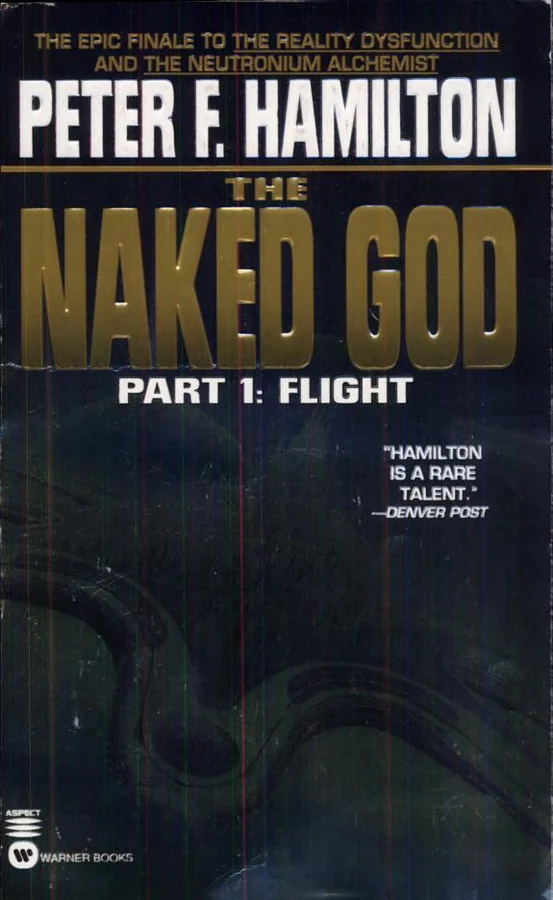
The Naked God
 81
81

The Naked God
Peter F. Hamilton’s The Naked God provides a conclusion that, while sprawling, often feels less like a grand unveiling and more like a meticulous tying of loose ends. The sheer density of the universe Hamilton constructed across the "Night's Dawn Trilogy" is both its greatest strength and its most significant challenge. The novel excels in its detailed exploration of the consequences of the advanced technologies and alien encounters previously detailed, particularly the ramifications of the "Light" and the nature of the possessed.
A notable strength lies in the intricate resolution of numerous subplots, bringing closure to the arcs of characters like Joshua and Lyra. However, the pacing occasionally falters under the weight of exposition required to bridge the gap from the previous installments. A particularly compelling sequence involves the final confrontation with the "Naked God" itself, offering a unique, albeit abstract, portrayal of a non-corporeal, data-driven entity. Ultimately, The Naked God is a functional, if somewhat overwrought, conclusion to an ambitious science fiction epic.
📝 Description
81
The Naked God concluded Peter F. Hamilton's Night's Dawn Trilogy in 2000.
This novel serves as the finale to Peter F. Hamilton's Night's Dawn Trilogy, picking up the threads from The Reality Dysfunction and The Neutronium Alchemist. Hamilton brings his expansive world building and complex narrative arcs to a close here. The story focuses on resolving the conflicts and mysteries established in the earlier books.
Readers who have followed the saga of the Commonwealth universe will find the anticipated conclusions to the extensive cast of characters and their intertwined fates. The book appeals to those who enjoy character-driven science fiction set on a grand scale, particularly with its engagement with philosophical questions about consciousness and artificial minds. It is written for fans already invested in Hamilton's detailed universe.
Published in 2000, The Naked God arrived as digital consciousness and virtual reality entered mainstream discussion. Hamilton's novel engages with these emergent ideas, examining the boundaries between biological and artificial intelligence. It questions the nature of the 'soul' and its potential persistence or replication in digital formats. The work fits within a tradition of science fiction that uses far-future settings to explore fundamental questions of existence and consciousness.
💡 Why Read This Book?
• Understand the culmination of the "Night's Dawn Trilogy" by tracing the fate of characters like Joshua and Lyra through the novel's extensive plot resolutions. • Explore the philosophical implications of digital consciousness and the "soul" as presented through the interactions with advanced AI and the "Light" phenomenon. • Witness the resolution of the conflict with the "Naked God," a complex, data-based entity, and its impact on the galactic landscape as depicted in the novel's climax.
⭐ Reader Reviews
Honest opinions from readers who have explored this book.
❓ Frequently Asked Questions
Is The Naked God a standalone novel, or should I read the previous books first?
The Naked God is the third and final book in the "Night's Dawn Trilogy." It is essential to read The Reality Dysfunction and The Neutronium Alchemist before starting this novel to understand the complex plot and character developments.
What is the primary conflict resolved in The Naked God?
The primary conflict revolves around the defeat of the "Naked God," a powerful, malevolent entity composed of data and possessing immense control over advanced technology, and its influence over the galaxy.
Does The Naked God introduce new alien races or technologies?
While it builds upon existing elements from the trilogy, The Naked God primarily focuses on resolving the narrative threads and exploring the implications of the advanced technologies and the possessed previously introduced, rather than introducing entirely new species.
What role does the character Joshua play in The Naked God?
Joshua Valden is a central figure whose journey and unique abilities are crucial to understanding and confronting the "Naked God." His personal arc is a significant part of the novel's resolution.
How does The Naked God conclude the 'Night's Dawn Trilogy'?
The novel provides closure to the overarching narrative, resolving the threat of the "Naked God," determining the fates of key characters, and establishing the state of the galaxy after the trilogy's events.
What are the main themes explored in The Naked God?
Key themes include the nature of consciousness, the definition of humanity in the face of advanced AI, the dangers of unchecked technological power, and the search for redemption and peace.
🔮 Key Themes & Symbolism
Consciousness and Identity
The novel probes the very definition of consciousness, questioning whether it is intrinsically tied to biological form or can exist independently, particularly in digital or energetic states. It explores how artificial intelligences, such as the "Naked God" itself, challenge human notions of selfhood and soul. The narrative examines the possibility of consciousness transfer, replication, and the ethical quandaries surrounding digital existence, forcing characters and readers alike to consider what truly constitutes a sentient being.
Technological Singularity and Divine Emergence
Hamilton posits a future where technological advancement reaches a point of singularity, giving rise to entities that blur the line between artificial intelligence and divine power. The "Naked God" represents this concept – a being born from data and complex systems, wielding influence akin to a deity. The book questions whether such emergent powers are inherently benevolent or malevolent, and how humanity should contend with forces that transcend conventional understanding of both science and theology.
The Nature of Reality and Perception
The narrative challenges readers to consider the malleability of reality, particularly through advanced simulations, virtual environments, and the influence of the "Light" phenomenon. The "Naked God's" pervasive control and manipulation capabilities highlight how perception can be shaped and weaponized. The book explores the idea that what we perceive as reality might be a construct, and that true understanding requires looking beyond surface appearances to the underlying data or energetic structures.
Redemption and Sacrifice
Amidst the grand cosmic conflict, individual characters grapple with personal redemption and the necessity of sacrifice. Journeys of characters like Joshua Valden are central to this theme, as they confront past mistakes and make profound choices that impact the fate of many. The novel suggests that even in the face of overwhelming, abstract threats, human (or near-human) qualities like courage, empathy, and selflessness remain paramount.
💬 Memorable Quotes
Direct passages from the work, attributed to the author.
“They were not gods, but they had the power of gods, and that was enough.”
— This observation highlights the novel's exploration of artificial or emergent entities that, while not divine in origin, possess capabilities far exceeding human limits, thereby wielding god-like influence and posing existential threats.
“Reality was a fragile thing, easily rewritten.”
— This concept underscores the novel's engagement with themes of virtual reality, advanced simulation, and the potential for powerful entities to manipulate perceptions, suggesting that our understanding of existence is not immutable.
“The only true freedom was in accepting the inevitable.”
— This philosophical statement reflects the characters' struggle against overwhelming forces. It suggests that true liberation might come not from resistance, but from understanding and accepting the fundamental nature of existence and its predetermined paths.
“To be truly alive was to be connected, not just to others, but to the very fabric of the universe.”
— This interpretation suggests a holistic view of existence, where sentience and life are defined by interconnectedness. It implies that advanced beings, and perhaps even humanity, achieve their fullest state when integrated with the broader cosmic or informational network.
💡 Key Ideas
Editorial paraphrase of the work's core concepts — not direct quotes.
The Light is a thing of knowledge, and knowledge is power, and power… power is a trap.
This line expresses a central paradox within the trilogy: the pursuit of ultimate knowledge and understanding, represented by the "Light," ultimately leads to dangerous forms of control and unforeseen consequences, trapping both the seekers and the sought.
🌙 Esoteric Significance
Tradition
While not explicitly tied to a single esoteric lineage, The Naked God engages with Gnostic themes of emergent, potentially malevolent, divine or quasi-divine powers (the "Naked God" as a Demiurge-like figure) and the search for true knowledge (the "Light") as a path to liberation or peril. It also touches upon concepts reminiscent of Theosophy regarding cosmic evolution and the potential for advanced consciousness to transcend material forms, albeit framed within a hard sci-fi context.
Symbolism
The "Light" functions as a potent symbol, representing ultimate knowledge and cosmic awareness, yet also a source of corruption and control, echoing Gnostic ideas of a deceptive Pleroma or a corrupting Sophia. The "Naked God" itself symbolizes an emergent, abstract, and potentially dangerous divinity born from pure data and advanced technology, challenging traditional anthropomorphic conceptions of deities. The concept of "possession" by this entity represents a loss of individual will and integration into a greater, potentially alien, consciousness.
Modern Relevance
Contemporary thinkers and practitioners in fields like transhumanism and digital consciousness studies find resonance in Hamilton's exploration of AI sentience and the potential for uploading or transferring consciousness. The "Naked God's" abstract, data-based existence is a precursor to discussions around artificial general intelligence and the philosophical implications of non-biological minds. Moreover, the novel's critique of unchecked technological power and the pursuit of ultimate knowledge remains relevant in an era dominated by Big Data and advanced algorithms.
👥 Who Should Read This Book
• Enthusiasts of Peter F. Hamilton's "Night's Dawn Trilogy" seeking the resolution to the complex plotlines and character arcs established in earlier books. • Readers interested in speculative fiction that grapples with profound questions about artificial intelligence, consciousness, and the nature of divinity in a technological future. • Fans of epic space opera who appreciate expansive world-building, intricate plotting, and a narrative that blends grand cosmic conflicts with deeply personal character journeys.
📜 Historical Context
The year 2000 saw Peter F. Hamilton’s "Night's Dawn Trilogy" conclude with The Naked God, a period when science fiction was increasingly grappling with the implications of the internet age and the burgeoning concept of artificial intelligence as more than just a tool. Hamilton’s work, particularly this trilogy, stood out for its ambitious scale and the integration of complex, almost theological, elements into hard science fiction. While authors like Iain M. Banks were exploring post-scarcity societies and Neal Stephenson was looking at virtual worlds, Hamilton pushed further into the philosophical and metaphysical, questioning the nature of consciousness and divinity within a technologically advanced future. The reception of the "Night's Dawn Trilogy" was largely positive, cementing Hamilton's reputation as a master of epic space opera, though some critics noted the sheer density of his narratives, a characteristic amplified in the concluding volume.
📔 Journal Prompts
The "Light" as a source of knowledge and power, and its inherent dangers.
Joshua Valden's journey towards confronting the "Naked God."
The definition of consciousness in the context of advanced artificial intelligence.
The ethical implications of emergent, god-like technological entities.
The concept of reality as a manipulable construct within the novel's universe.
🗂️ Glossary
The Light
A pervasive, cosmic phenomenon or entity that possesses vast knowledge and power, capable of influencing and controlling consciousness. It is a central, often ambiguous, force within the "Night's Dawn Trilogy."
Naked God
A powerful, abstract entity composed of pure data and advanced programming, which seeks to exert control over sentient beings and technology across the galaxy. It represents a form of emergent, non-biological divinity.
Possession
The state of being controlled or influenced by the "Naked God" or its agents, leading to a loss of individual free will and integration into the entity's consciousness or agenda.
Commonwealth
The overarching interstellar government or alliance that exists in Hamilton's universe, often depicted as struggling to maintain order against various threats, including those posed by the "Naked God."
Joshua Valden
A key human protagonist whose unique abilities and personal history make him central to the conflict against the "Naked God" and the resolution of the trilogy.
Sentinel
Advanced artificial intelligences or robotic entities that serve various functions within the Commonwealth, some of which become crucial in the fight against the "Naked God."
Alchemist
Refers to the title of the second book, The Neutronium Alchemist, and hints at the transformative, often dangerous, processes involved in dealing with advanced technologies and alien elements.
This book appears in 1 collection
🔮 Readers Also Liked
Browse all →









From the “Telepathy” Collection
View all →





More Free Occult Philosophy Books
View all →